

How Much Can Be Saved Through E-Auctions?
E-auctions can reduce costs by increasing supplier competition and making procurement processes faster and more efficient. Savings depend on factors such as the category, market conditions, supplier participation, and auction type.
E-auctions can generate savings in several ways. In addition to reducing purchase prices through increased supplier competition, they can reduce administrative workload, shorten procurement cycle times and improve process visibility. The level of savings achieved will vary according to factors such as the procurement category, market conditions, supplier participation and the auction model used.
As procurement teams face growing pressure to control costs and improve efficiency, many organisations are turning to digital sourcing tools to strengthen competition and manage sourcing processes more effectively.
One of the most common questions is: How much can an organisation actually save through an e-auction?
There is no single percentage that applies to every sourcing event. Savings depend on the category being sourced, the level of supplier competition, prevailing market conditions and the organisation’s existing purchase price.
It is also important to look beyond the final auction price. E-auctions can create value through lower purchase costs, reduced administrative workload, shorter sourcing cycles and greater process traceability.
How are savings generated through e-auctions?
E-auction savings are sometimes measured only by comparing the final auction with the price at the start of the auction. While this is an important measure, it captures only part of the overall benefit.
When an online auction system is used, savings can generally be generated in three areas:
1.Direct (price) savings: Live auction can encourage suppliers to revise their offers during the auction process, helping the buyer identify more favourable commercial terms.
2.Operational savings: Automating activities such as auction collection, document management, supplier communication and auction comparison reduces the time teams spend on manual processes and spreadsheets.
3.Time and opportunity savings: Digital sourcing can shorten negotiation and sourcing cycles that might otherwise take days or weeks, enabling procurement decisions to be completed more quickly.
Factors affecting savings in e-auctions
The level of savings will not be the same across every procurement category. A category with limited competition and highly specialised requirements may produce relatively modest price reductions, while a standardised category with a broad supplier pool may create much stronger competitive tension.
A number of factors influence the savings that can be achieved:
-Number of participating suppliers: A broader pool of qualified suppliers can increase competitive tension and provide a clearer view of available market pricing.
-Level of supplier competition: Competition is typically stronger where several suppliers can meet the requirement and have sufficient capacity or commercial motivation to win the business.
-Procurement category: Standardised products and services may be more suitable for price-based competition, while complex or specialist categories may require greater emphasis on technical, service or quality criteria.
-Auction model: The auction model should reflect the dynamics of the category. Depending on the sourcing objective, this may include reverse auctions, Dutch auctions or Japanese auctions.
-Market conditions: Inflation, commodity prices, currency movements, capacity constraints and other market developments can all affect the level of savings available.
-Quality of the supplier pool: Savings potential can also depend on whether the organisation has identified and invited a sufficient number of qualified suppliers before the sourcing event begins.
How are e-auction savings calculated?
To measure savings consistently, an organisation first needs to establish a reference price, or baseline, against which the final auction result can be compared.
A simple calculation is:
Net Savings = Reference Price − Final Auction Price
The choice of reference price is important because different baselines can produce very different savings figures.
Organisations may use several approaches:
-Previous purchase price: The price paid for the same or a comparable product or service in the previous period.
-Approved budget: The budget allocated to the purchase before the sourcing process begins.
-Auction starting value (Target price): The first-round quotation or average of quotations received before further negotiation or an e-auction.
Whichever method is used, organisations should apply it consistently and document the basis of the calculation so that reported savings remain transparent and comparable.
Do e-auctions only reduce the purchase price?
No. The value of e-auctions extends beyond the difference between an opening and closing price. Compared with traditional sourcing methods, e-auctions can also reduce the administrative effort involved in collecting and comparing proposals, managing supplier communications and maintaining procurement records.
Savings in Sourcing Cycle Time
In traditional sourcing processes, collecting proposals by email, responding to supplier questions and requesting revisions can take days or weeks. E-sourcing platforms bring these activities into a structured digital workflow, helping procurement teams manage sourcing events more quickly and consistently.
Reduction in Operational Workload
Procurement teams can spend less time consolidating spreadsheets, tracking documents and following up manually with suppliers, allowing more time to be focused on activities such as market analysis, category management and supplier relationship management.
Faster Auction Comparison
E-sourcing platforms can standardise incoming commercial information and consolidate supplier proposals into comparable formats, making evaluation faster and reducing reliance on manual calculations.
Increased Supplier Competition
Digital sourcing can make it easier to engage a broader pool of qualified suppliers, including suppliers from different regions or markets. This can strengthen competitive tension where the procurement category is suitable for wider participation.
Standardisation and Repeatability
Reusable sourcing templates can help procurement teams apply consistent processes across recurring categories. Once specifications, evaluation criteria and workflows have been established, similar sourcing events can be launched more efficiently in future periods.
Recent research also highlights the wider role of digitalisation in procurement and supply chain operations. PwC’s Digital Trends in Operations Survey reports that 53 per cent of operations and supply chain leaders are using digital automation and smart technologies to anticipate and mitigate supply chain disruption. More broadly, moving from fragmented email- and spreadsheet-based processes to digital platforms can support greater process visibility and shorter cycle times.
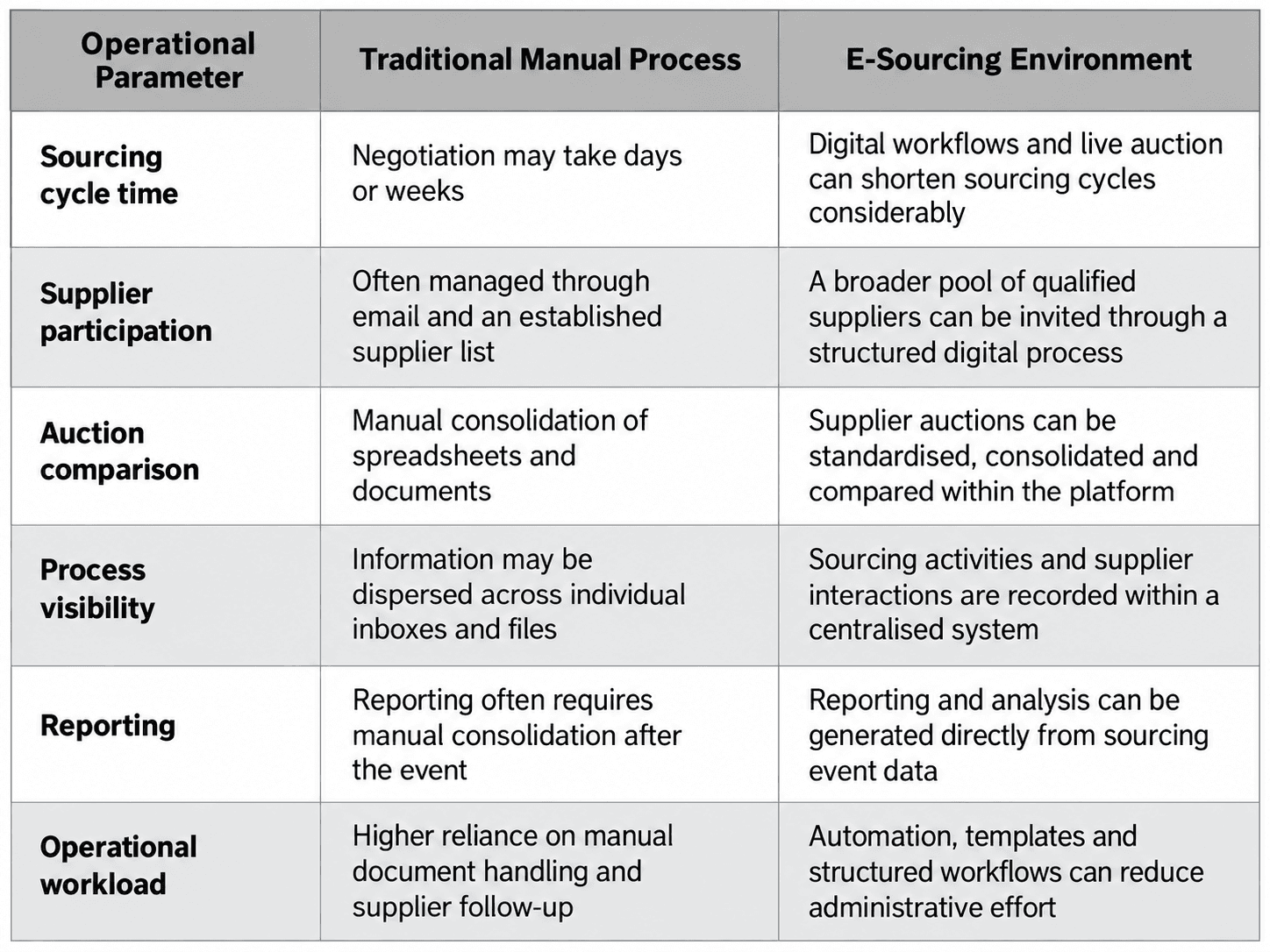
Comparison of the Procurement Process Before and After E-Auction
The table below summarises some of the key operational differences between manual sourcing processes and an e-sourcing environment:
Which KPIs can be used to measure e-auction performance?
Procurement teams can use a range of KPIs to assess both savings and the wider performance of sourcing events:
-Opening-to-closing auction movement: The change between initial and final proposals during the e-auction, which can indicate the level of competitive movement generated.
-Reference price versus final price: The difference between the agreed baseline and the final result of the sourcing event.
-Supplier participation rate: The proportion of invited or approved suppliers that actively submit proposals.
-Sourcing cycle time: The time elapsed from launching the sourcing event to selecting the preferred supplier.
-Operational cost per sourcing event: The internal labour and process cost associated with managing an individual sourcing event.
Does a high saving rate always mean a successful e-auction?
Not necessarily. A large percentage reduction in price does not in itself mean that the sourcing event has produced the best overall result.
For example, a supplier may submit the lowest proposal but subsequently fail to meet delivery schedules, quality requirements or service expectations. In such cases, the apparent saving can be offset by additional operational costs or disruption.
For this reason, an end-to-end sourcing framework should assess more than price alone. Depending on the category, decision criteria may also include Total Cost of Ownership (TCO), quality, delivery performance, warranty or service conditions, commercial risk and the supplier’s performance history.
Key considerations for maximising savings through e-auctions
To create the right conditions for an effective e-auction, procurement teams should consider the following:
-Build a suitable and qualified supplier pool: Suppliers should be assessed before the sourcing event to confirm that they can meet the relevant technical, commercial and operational requirements.
-Select the appropriate auction model: The auction model should reflect the characteristics of the procurement category, pricing structure and sourcing objective. Reverse, Dutch or Japanese auction models, for example, may be appropriate in different circumstances.
-Define clear specifications: Requirements, commercial terms and evaluation criteria should be sufficiently clear to allow suppliers to price consistently and avoid unnecessary risk premiums.
-Create sufficient competitive tension: A suitable number of qualified suppliers should be invited, and participants should understand the rules and mechanics of the e-auction before live auction begins.
The contribution of flexible automation and competitive sourcing environments to procurement performance is also reflected in Deloitte’s latest Global Chief Procurement Officer (CPO) Survey.
According to Deloitte, organisations it identifies as “Digital Masters” — those that more effectively integrate technology and e-sourcing solutions into their procurement processes — achieve a return on investment of up to 3.2 times on their digital investments.
The survey also reports that these leading organisations allocate around 24 per cent of their procurement budgets to digital technologies, giving them a stronger position in pursuing cost-saving objectives compared with organisations relying more heavily on traditional methods.
Cost Savings and Efficiency in E-Auction Processes with Promena
Promena supports end-to-end digital procurement with flexible e-sourcing and e-auction capabilities designed to strengthen supplier competition, improve process visibility and support more measurable sourcing outcomes.
Companies can use Promena to manage competitive sourcing processes across a wide range of procurement categories, with tools that support different auction models, supplier participation, proposal comparison and analysis.
To learn more, explore Promena’s sourcing solutions or contact us to speak to our expert team.
-Different Auction Models: Depending on the characteristics of the category, organisations can use different auction models, including reverse, British, Dutch, Japanese and sealed-bid formats.
-Advanced Live Auction and Supplier Portal: Suppliers can submit proposals through a user-friendly interface and, depending on the live auction settings, follow relevant auction information during the e-auction.
-Automated Comparison and Analysis: Price breakdowns, savings rates and proposal comparisons can be generated automatically once the sourcing event is complete.
Frequently Asked Questions
Do e-auctions really reduce costs?
E-auctions can support cost reduction by creating a structured competitive environment in which qualified suppliers are able to revise their proposals under clearly defined rules. The financial benefit may extend beyond the final purchase price. Digital sourcing can also reduce administrative workload, shorten sourcing cycle times and improve process traceability.
How is the savings rate calculated in e-auctions?
The savings rate is generally calculated by comparing the final auction price with a reference price established before the e-auction. The reference price may be based on the previous purchase price, an approved budget, a target price or the average of initial proposals.
Is every procurement category suitable for e-auctions?
No. E-auctions are generally most suitable where requirements can be clearly specified, several qualified suppliers are available and there is sufficient potential for competition. For categories where requirements are still being defined, supplier capabilities need to be assessed or the market is relatively unfamiliar, an RFI or RFQ process may be more appropriate before moving to an e-auction.
Should the supplier offering the lowest price be selected in an e-auction?
Not necessarily. Price is an important consideration, but the lowest proposal does not automatically represent the best overall outcome. Following the e-auction, procurement teams may also consider criteria such as quality, delivery capability, payment terms, TCO and the supplier’s previous performance before selecting the preferred supplier.
Do e-auctions also reduce operational costs?
They can. By reducing manual document handling, email-based proposal collection, spreadsheet consolidation and supplier follow-up, e-auction and e-sourcing platforms can lower the administrative effort required to manage a sourcing event. Automation and reusable workflows can also make recurring sourcing processes faster and more consistent.