

e-Sourcing vs. Traditional Procurement: Benefits and Key Differences
What are the differences between e-Sourcing and traditional procurement? Compare their advantages and disadvantages in terms of cost, speed, transparency, and overall procurement efficiency.
As the rules of global trade are being rewritten, procurement departments have reached a critical crossroads. Should they stick with traditional methods rooted in years of habit, or embrace the speed of digital technology and step into the world of e-auctions? In this article, we weigh both approaches—with all their pros and cons—on the scales, offering a roadmap to help you make the right decision for your business.
Digitalization is not simply a change of tools in procurement processes. It is also a fundamental efficiency revolution. Paper files, endless email traffic, and opaque manual calculations are being replaced by digital systems that can analyze data in seconds, trigger competition in real time, and leave little room for error. Global research shows that an overwhelming 95% of decision-makers in procurement recognize that there is significant room for digitalization and optimization in their existing procurement processes.
In this article, we analyze e-tendering vs traditional tendering methods in detail, examine the advantages and disadvantages of both approaches, and explore how businesses can gain a competitive advantage in an increasingly digital procurement environment.
What is an e-auction?
E-auction refers to the management of all bid collection and evaluation processes required for a company’s procurement of goods or services through internet-based digital platforms. Usually using cloud-based software, e-auctions form part of a digital ecosystem in which suppliers can submit bids in real time, competition can be measured in a transparent environment, and all data can be collected in a single center.
E-auction transforms procurement from a routine paperwork process into a strategic data management process, supporting operational excellence. For organizations with multiple locations in particular, this system provides a centralized management capability that makes it possible to control all procurement activities from a single screen.
What is a traditional auction?
Traditional auctions are a manual operating model in which procurement processes are carried out through conventional methods, generally using paper documents, originally executed files, face-to-face meetings, or lengthy email correspondence. In this method, bids are usually collected in sealed envelopes, while evaluations are conducted through physical files or complex manual spreadsheets.
The process is entirely dependent on human effort and lacks a digital audit trail. Although this traditional structure was once the standard approach in the past when time was more abundant, it has the potential to create serious risks in today’s speed-driven business environment.
E-auction vs traditional auction
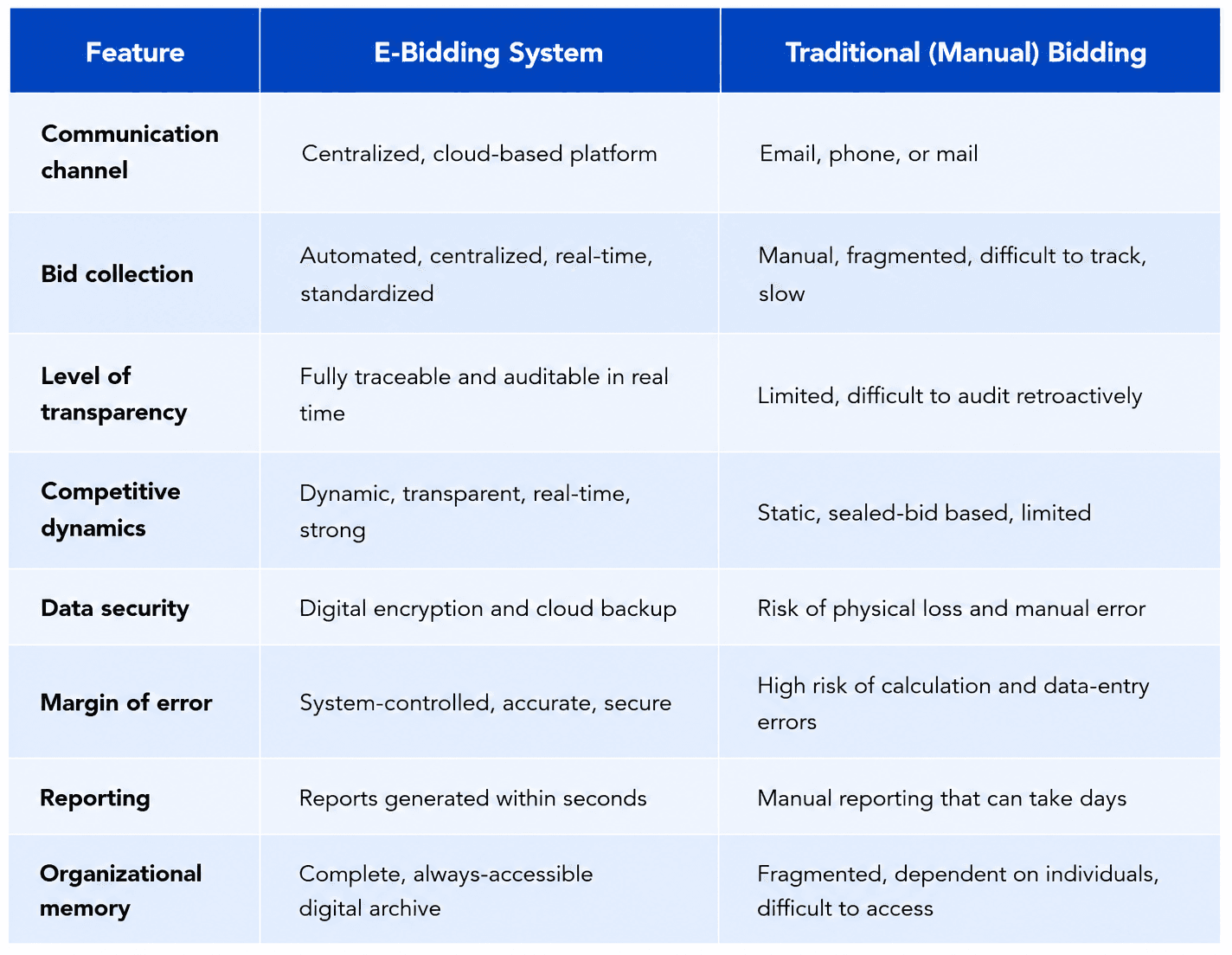
The difference between e-auction and traditional auction is not limited to the use of technology. It also reflects deeper differences that influence the fundamental operating logic of the process itself. To understand the dynamics of modern procurement, these differences need to be examined closely.
- Process speed and agility: In traditional tendering, the delivery of bids, shipment of documents, sorting of files, and manual analysis stage can take weeks. In online auction platforms, the entire process can be reduced to days through instant notifications and automated scoring systems that operate in seconds. This speed gives businesses greater agility in responding to market fluctuations.
- Transparency and auditability: In traditional processes, the reasons for rejecting a bid or the way selection criteria are applied may sometimes be open to personal interpretation. In e-auction, every bid entry, every price revision, and every scoring action leaves an indelible digital trail. This protects corporate ethical standards while also helping to prevent potential irregularities.
- Competition dynamics: In the traditional auction method, suppliers cannot see the moves made by competitors, which often leads them to submit a “safe price”. In an e-auction, suppliers can track their real-time ranking. Although identities remain confidential, the intensity of competition is felt, encouraging suppliers to push their limits.
- Cost structure: Manual processes involve high hidden costs, from stationery expenses and logistics to staff time and operational error margins. Procurement process digitalization significantly reduces operational expenses, while the competitive environment created by e-auction delivers direct savings in unit costs.
The comparison table below illustrates these fundamental changes in processes more clearly, highlighting the operational capabilities of each method:
Advantages of E-Bidding
Online bidding systems provide businesses with more than speed. They also offer financial and strategic assurance. Over the long term, these advantages directly affect a company’s profitability:
- Sustainable savings: Models that trigger competition in real time allow the most competitive market price to emerge naturally. This supports cost management based on market realities rather than forced negotiations.
- Efficiency and time management: E-bidding eliminates the time procurement specialists lose to manual data entry. Instead of dealing with paperwork, teams can focus on more strategic market research and supplier development projects.
- Broader supplier pool: By removing geographical boundaries, e-bidding enables qualified suppliers from anywhere in the world to participate in the process. This diversity reduces dependence on a single source.
- Error-free reporting: As soon as the bidding process is completed, the system converts all data into visual reports. This eliminates the risk of mathematical errors or data loss that can occur in manual reporting.
- Strategic visibility: Senior management can monitor all digital procurement activities in real time. This places spending discipline and budget management on a much stronger footing.
Disadvantages of E-Bidding
Although procurement digitalization represents a major step forward, there are also realistic challenges that may arise during the adaptation process:
- System adaptation: Teams and suppliers that have worked with traditional methods for years need training to become familiar with new software. Resistance to change may slow the process at the beginning.
- Infrastructure requirements: For the system to work efficiently, uninterrupted internet access and basic hardware capability are essential. This may create a barrier for stakeholders in regions with infrastructure challenges.
- Cybersecurity awareness: As with any digital system, users need to be aware of data security. Choosing a platform with strong encryption infrastructure is critical in this respect.
Advantages of Traditional Bidding
The continued use of older methods in some cases is rooted in certain comfort zones:
- Depth of face-to-face communication: In highly specialized, complex, or first-time projects, direct contact with suppliers may allow technical details to be discussed in greater depth.
- Trust based on familiarity: For smaller organizations that do not want to invest in new technology or take on the perceived risks of digital transformation, traditional methods offer a predictable environment.
- Technology independence: Traditional bidding allows processes to be carried out through physical participation alone, without requiring any digital infrastructure or software investment.
Disadvantages of Traditional Auction Methods
Traditional bidding brings serious inefficiencies in today’s fast-moving, data-driven commercial environment:
- Operational sluggishness: The circulation of physical files and manual comparisons extend procurement cycles. This creates a major obstacle when urgent needs must be met.
- Limited competition: Since suppliers are unaware of their competitors’ positions, they often try to protect their own profit margins by staying above market prices.
- Fragmented data: Accessing historical data is often impossible. Organisational memory remains dependent on individuals, and when that person leaves the company, the procurement experience leaves with them.
- High margin of error: Manually prepared tables can lead to incorrect cost calculations and undermine budget discipline.
Which is the best auction method for procurement?
Every business has a different operational structure and different needs. When choosing between bidding methods, several criteria should be considered. If the products you procure have standard specifications and there are many available suppliers, e-bidding is unrivaled. However, in cases such as procuring a highly specialized work of art or managing an engineering project that has never been carried out before, the technical stages may be handled face to face.
Even so, many complex projects today achieve much more efficient results through hybrid models, where the technical stage is conducted face to face and the commercial stage is managed through e-bidding. As company size increases, e-bidding becomes the only viable option for establishing an auditable structure.
The Importance of Digitalization in Procurement Processes
The world of procurement has evolved beyond the sourcing of goods and services into the management of vast amounts of data. Digital transformation does more than give teams speed. It also equips them with the ability to read market trends and make data-driven decisions.
This shift transforms procurement departments from cost centers into strategic units that directly improve the company’s profit margin. Industry analyses shared by PwC show that companies that integrate data analytics tools into their processes are 2.5 times more successful in managing procurement and supply chain risks. Companies with data visibility are much more resilient to supply chain disruptions and can anticipate risks before taking preventive action.
Efficient Procurement Management with Online Bidding Platforms
Choosing the right online e-tendering platform determines the critical line between the sluggishness of traditional methods and the agility of digital procurement. With the digital solutions we offer at Promena, we make transparency, full control, and maximum competitive advantage a standard part of your procurement operations.
Global research shows that the majority of leading procurement executives see transparent information sharing and digital traceability as the most critical steps for supply chain resilience. With this vision, we simplify complex processes and transform the relationship you build with your suppliers into a data-driven, sustainable, and profitable efficiency model.
Frequently Asked Questions About E-Bidding and Procurement Processes
Is an online auction system for procurement only suitable for large companies?
No. Digitalization delivers cost and time savings for businesses of every size. Mid-sized companies with growth ambitions, in particular, can benefit greatly from e-bidding systems as they build procurement discipline and expand their supplier networks.
How long does it take to switch from a traditional bidding method to an e-bidding system?
This depends on the company’s current structure and how user-friendly the selected platform is. With cloud-based solutions such as Promena, no technical installation is required, so teams and suppliers can adapt to the system and launch the first bidding process within just a few days.
Are e-bidding systems risky in terms of data security?
On the contrary, they are much more secure than traditional bidding methods, which carry risks such as the loss of physical files or unauthorized access. E-bidding platforms store all data in encrypted form on high-security cloud servers and maintain the full transaction history through log records, providing a complete audit trail.
Do suppliers have difficulty using e-bidding systems?
Modern e-bidding platforms are designed with supplier-friendly interfaces. Suppliers do not need to download any software. They can join the system and submit their bids through the invitation link sent to them, which increases participation rates and competition.