

What Are the Differences Between RFI, RFP, and RFQ?
Explore and compare the purposes and use cases of RFI, RFP, and RFQ processes, as well as their key differences in procurement.
RFI, RFP and RFQ are all RFx methods used at different stages of the procurement process. An RFI is used to gather information about the market and potential suppliers, an RFP to evaluate proposed solutions, and an RFQ to compare prices and commercial terms once the requirement has been clearly defined.
Procurement teams use RFx processes to identify suitable suppliers and evaluate responses in a structured way. However, using RFI vs RFP vs RFQ interchangeably can lead to poorly defined requirements, proposals that are difficult to compare and unnecessarily lengthy procurement processes. Understanding the purpose of each method, when it should be used and what it is designed to produce is therefore important.
RFI RFP RFQ meaning in procurement?
Before looking at RFI RFP RFQ difference in more detail, it is useful to define the three main RFx methods and the role each plays in the sourcing process.
What is an RFI?
An RFI, or Request for Information, is typically used at an early stage of the procurement process to gather information about the market, supplier capabilities and the solutions available.
It can help procurement teams understand the supplier landscape, explore possible approaches and refine their requirements before moving to a more formal sourcing stage.
For more detail and guidance on the process, please see our What is an RFI? guide.
What is an RFP?
An RFP, or Request for Proposal, is used when the overall requirement is understood but suppliers are expected to propose how they would meet it.
Suppliers are typically asked to set out elements such as their proposed solution, technical approach, methodology and implementation plan. This allows the buyer to compare different approaches as well as commercial considerations.
For a more detailed explanation, please see our What is an RFP? article.
What is an RFQ?
An RFQ, or Request for Quotation, is primarily used when the requirement has already been clearly defined and the buyer wants to compare supplier pricing and commercial terms.
It is most appropriate where specifications, quantities and other key requirements are sufficiently clear for suppliers to provide directly comparable quotations.
For further information, please see our What is an RFQ? article.
What are the key differences between an RFI, an RFP and an RFQ?
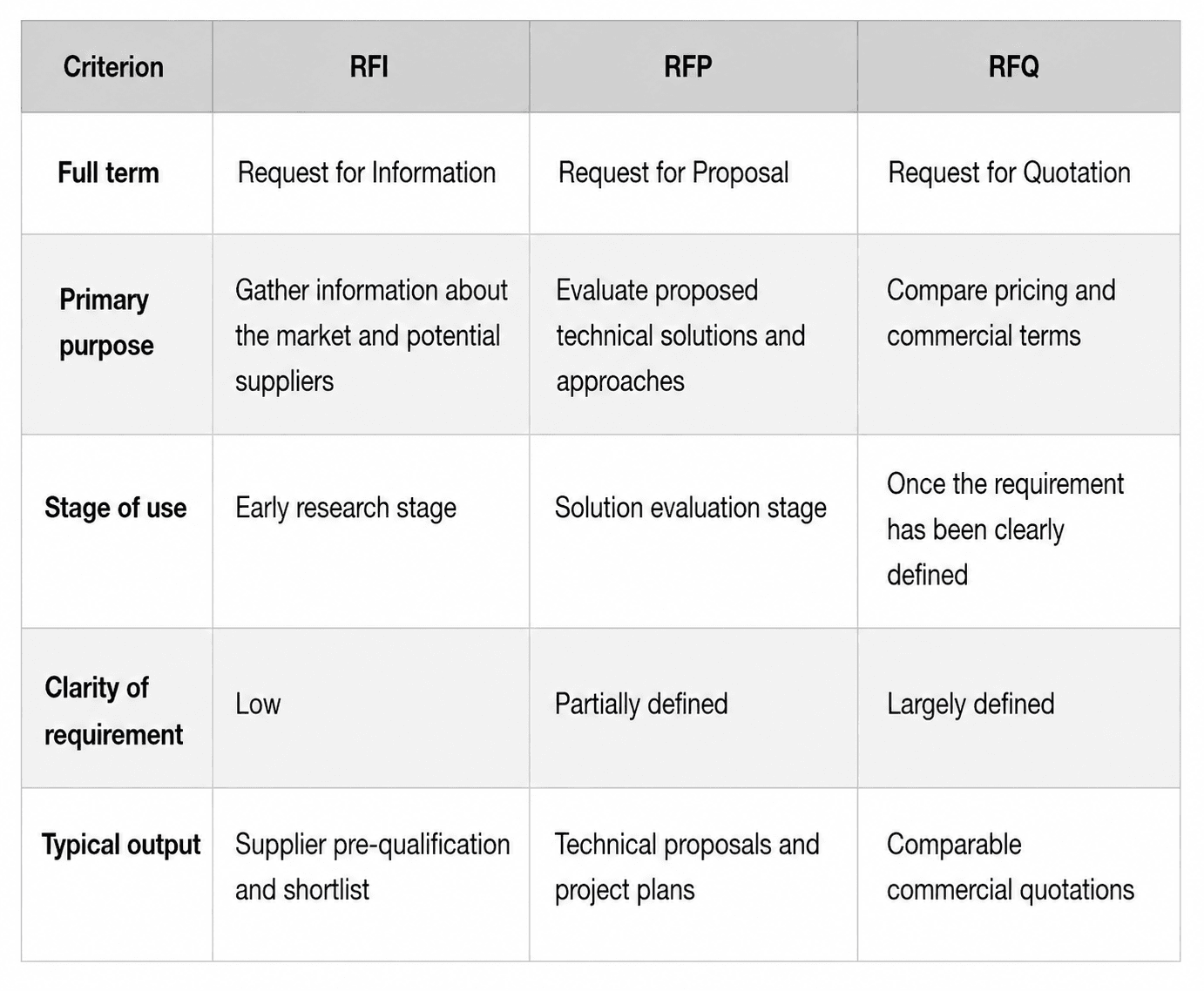
The three methods differ primarily in their purpose, the stage of the sourcing process at which they are used and the type of information or response they are intended to generate.
RFI RFP RFQ Comparison Matrix
When should you use an RFI, RFP or RFQ?
Choosing the wrong RFx method can result in suppliers submitting responses that do not match the buyer’s needs, making evaluation more difficult and extending the procurement process.
Procurement teams should therefore select the method that best reflects how clearly the requirement has been defined and how mature the project is.
If you need market and supplier information: RFI
An RFI can be used when a company is exploring a new product or service category, does not yet have a clear view of potential suppliers, or needs more information about the market.
At this stage, the priority is not to compare prices, but to understand the supplier landscape, gather relevant information and identify suitable suppliers.
If you need to evaluate proposed solutions: RFP
An RFP is appropriate when the overall requirement is broadly understood but the preferred methodology, technology or implementation approach has not yet been determined.
For more complex service requirements, such as ERP integration, warehouse management or consultancy, an RFP allows procurement teams to compare how different suppliers propose to meet the same business need.
If the scope and requirements are clearly defined: RFQ
An RFQ can be used when technical specifications, quantities, delivery requirements and other key commercial parameters have largely been defined.
At this stage, suppliers can be compared on factors such as price, delivery times, payment terms and other commercial conditions.
Checklist for selecting the right RFx process
-
Is the product or service requirement still unclear?
Consider an RFI or RFP. -
Do you need more information about the market or potential suppliers?
An RFI may be the most appropriate option. -
Do you want suppliers to propose different technical solutions or approaches?
Consider an RFP. -
Are the technical specifications, quantities and delivery requirements largely defined?
An RFQ may be appropriate.
Do RFI, RFP and RFQ processes always have to follow one another?
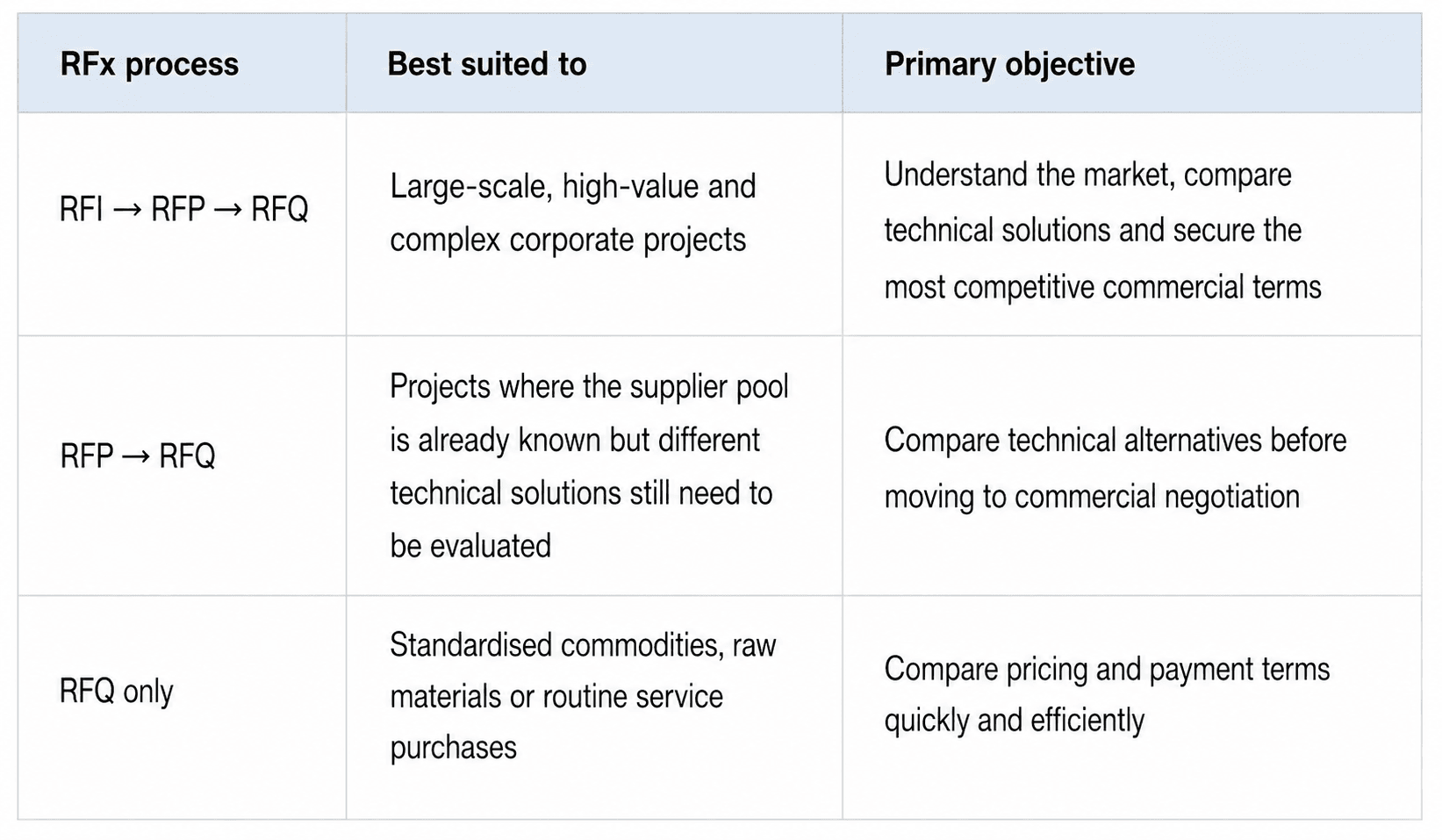
No. Although RFI RFP RFQ in procurement can form a logical sequence within a sourcing process, companies do not need to use all three stages for every procurement requirement.
The process can be adapted according to the complexity and maturity of the requirement. A routine raw-material purchase, for example, may move directly to an RFQ if specifications and quantities are already clear. A more complex project, such as setting up a new facility, may benefit from progressing through all three stages, from market research and supplier discovery to solution evaluation and final quotation comparison.
RFI → RFP → RFQ Sample Process Flows
What happens if the wrong RFx process is selected?
Choosing an RFx method that does not match the requirement can result in suppliers responding to different assumptions or scopes, making responses difficult to compare and extending the sourcing process. The choice of method should therefore reflect how clearly the requirement has been defined, the type of supplier response required and the criteria that will be used to evaluate it.
- Using an RFQ when an RFI is required: Requesting quotations before the requirement has been sufficiently defined may lead suppliers to price on the basis of different assumptions. This makes it difficult to compare quotations on a like-for-like basis. In these circumstances, it may be more appropriate to begin with an RFI to gather information about the market, available solutions and supplier capabilities.
- Moving directly to an RFQ when an RFP is required: Where a procurement requirement involves technical complexity or different possible solution approaches, focusing on price alone may mean that technical suitability is not evaluated in sufficient depth. This can increase the risk of implementation problems, quality issues, delays or additional costs. An RFP can first be used to evaluate the proposed technical solution and project approach before moving to commercial comparison.
- Using an RFP when an RFQ is sufficient: Requesting detailed solution proposals for a standard product or service with clearly defined specifications can make the procurement process unnecessarily lengthy. Requiring suppliers to prepare extensive presentations or project plans also creates additional work for both suppliers and the procurement team. In these cases, an RFQ may be used directly to compare pricing and commercial terms.
How are RFI, RFP and RFQ processes managed on digital platforms?
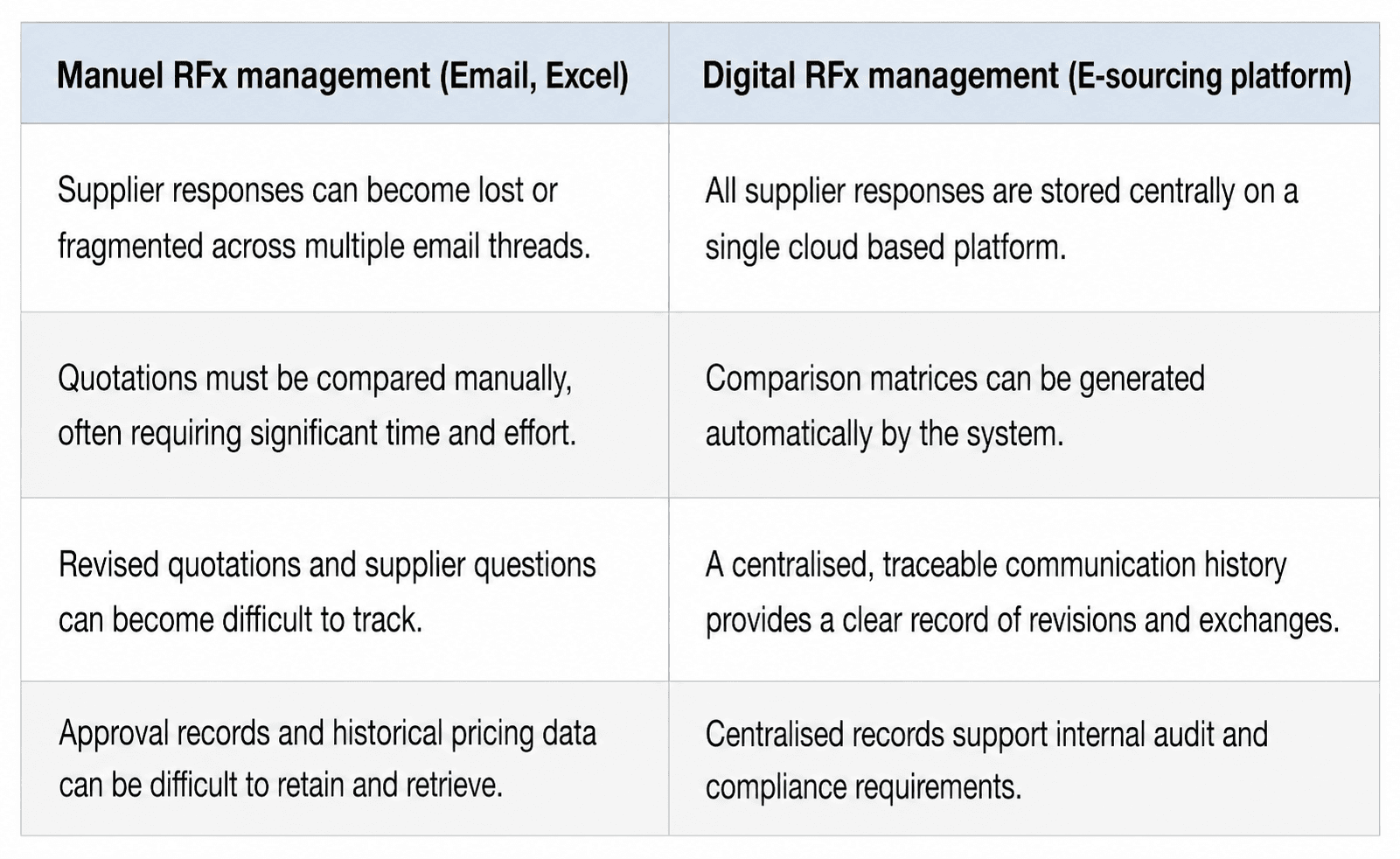
In traditional procurement environments, RFx processes are often managed through email, PDF specifications and large Excel spreadsheets. This can make processes difficult to control and create operational challenges such as version confusion, fragmented data, limited visibility and information security risks.
According to APQC’s American Productivity & Quality Center) April 2026 benchmarking report, The $4 Million Procurement Gap, organisations that rely heavily on manual procurement processes and have not standardised quotation collection can incur transaction costs of more than $54 per purchase order, while high-performing procurement functions using standardised digitalisation and automation tools can reduce this cost to as little as $14.
E-sourcing and digital procurement platforms can improve operational efficiency by bringing procurement RFx processes together within a single, structured environment.
The Advantages of Digital RFx Management Over Manual Processes
How can RFx processes be managed more efficiently with Promena?
Promena brings together the digital tools companies use to manage procurement and sourcing activities, including e-procurement, supplier relationship management, e-sourcing , RFx processes and e-auctions. By managing RFI, RFP and RFQ processes within a single platform, Promena can help companies standardise supplier responses, improve visibility and reduce the manual work involved in comparing and evaluating submissions.
- Digital management of RFI, RFP and RFQ processes: Promena allows procurement teams to create forms tailored to specific requirements, upload relevant specifications and documentation, and collect supplier responses in a structured format.
- Standardised and comparable supplier responses: Technical and commercial responses can be brought together within a common structure, making them easier to review and compare. This reduces the time procurement teams spend consolidating data manually and allows greater focus on analysis and decision-making.
- Moving from RFQ or RFP to e-auction or negotiation: Promena’s integrated structure allows shortlisted suppliers identified through an RFQ or RFP process to move into a live e-auction or negotiation stage. This can help strengthen competitive tension and support more effective commercial negotiation.
- Transparent, traceable and auditable process management: Key process steps, such as supplier invitations, document access, revisions and approvals, can be recorded with timestamps. This creates a traceable process history that supports internal audit and compliance requirements while maintaining a reliable record of procurement activity.
Frequently asked questions about RFx processes
Must RFI, RFP and RFQ all be used in every procurement process?
No. The appropriate process depends on factors such as how clearly the requirement has been defined and how well the supplier market is understood. In some cases, only one or two stages may be necessary. Routine purchases with clearly defined specifications, for example, may move directly to an RFQ.
Can an RFQ follow directly after an RFI?
Yes. If the RFI has provided sufficient information to identify suitable suppliers and clarify the technical scope, the process can move directly to the RFQ stage without an RFP in between.
Can pricing information be requested during an RFP?
Yes. An RFP can include pricing information alongside the proposed technical solution and project approach. However, at this stage, commercial information may be considered together with technical and methodological criteria rather than used as the sole basis for the final decision.
How can supplier responses be scored in RFI, RFP and RFQ processes?
The scoring approach should reflect the purpose of each process. An RFI may assess factors such as supplier eligibility, capabilities and suitability. An RFP typically places greater emphasis on the proposed technical solution, methodology and implementation approach, while an RFQ generally gives greater weight to pricing and other commercial terms.