

What Is Corporate RFQ and Tender Management? RFI, RFP, and e-Tendering
What is corporate tender management? How are RFI, RFP, and e-tendering processes managed? Learn step by step how organizations manage RFQ collection and tender processes.
Your company’s success is measured not only by what you sell, but also by how effectively you manage your resources. While procurement is often associated simply with purchasing goods or services, a far more critical process takes place behind the scenes: strategic decision-making.
In today’s increasingly complex business environment, selecting the right supplier is no longer just an operational detail; it is a direct source of competitive advantage. A procurement team overwhelmed by emails from multiple channels, complex Excel spreadsheets and opaque approval processes does not simply lose time. It also weakens the quality of decision-making. If the answer to “Why did we choose this supplier?” depends on personal opinions or ad hoc data, it becomes difficult to build a consistent corporate procurement process.
This is where bid-management and e-tendering systems come into play. These systems do more than accelerate processes; they help turn data into strategy and fragmented workflows into a manageable structure. In this guide, Promena examines the role of proposal and tender management in corporate procurement, the functional differences between RFI, RFP and RFQ, and the transformative power of digitalization in these processes.
What is corporate tender management?
Corporate tender and procurement management, in its simplest form, refers to the process of collecting supplier quotations and making decisions by comparing them. In practice, however, the process is far broader than this definition suggests. Procurement decisions involve much more than price alone; delivery times, quality, previous work experience and supplier reliability also play a critical role. For this reason, tender and procurement management sits at the heart of the corporate procurement process.
When structured correctly, the process does more than deliver cost advantages. It also helps companies build a more predictable, transparent and sustainable procurement framework. When procurement processes rely heavily on individuals, however, each new procurement cycle effectively begins from scratch, resulting in unnecessary losses of time, effort and cost.
Reducing the burden of this decision-making process on individuals and creating standardized procurement workflows has become a major focus of digital transformation. Recent industry data shows that this shift is no longer optional, but increasingly becoming the market standard.
According to ProcureAbility and ProcureCon’s 2025 benchmarking study, all procurement leaders surveyed (100%) reported adopting artificial intelligence (AI) to some extent, demonstrating how rapidly digital quotation management and evaluation processes are expanding. At the same time, while 72% of participants describe their AI maturity as intermediate, only 6% report reaching advanced integration levels.
The Concept of Tender Management
Tender management is the process of collecting quotations from different suppliers and evaluating them against defined criteria. The critical factor, however, is how the process itself is managed. In many companies, quotations are collected but the evaluation process lacks transparency. In some cases, decisions are driven solely by price, while in others they are shaped by past relationships. This makes it difficult to establish a consistent and standardized procurement framework. In a well-structured quotation management process, by contrast, all proposals are assessed against the same criteria. This creates a more consistent decision-making process and provides a clear answer to the question: “Why was this supplier selected?”
What is corporate tender management?
Corporate tender management can be described as a more structured and competitive version of the tender management process, particularly for high-volume or strategic procurements.
The aim is to create a controlled competitive environment among suppliers, helping companies achieve stronger outcomes in terms of both pricing and service quality.
In practical terms, corporate tender management is about standardizing procurement processes and establishing equal conditions for all participants. This enables procurement decisions to be made more objectively and transparently.
The Importance of Tender and Bidding Processes for Companies
Tender and procurement processes are often viewed as the background of the purchasing function. However, this is where the balance between cost, quality and operational risk is determined.
For the same product or service, quotations from different suppliers can vary significantly. These differences extend beyond price alone, covering factors such as delivery timelines, service quality and operational reliability.
For this reason, tender and procurement management should be seen not simply as an operational process, but as a strategic function that directly affects company performance.
The Role of Tender and Procurement Management in Corporate Procurement Processes
Corporate procurement refers to the process through which companies secure the products and services needed to support their administrative, operational and strategic activities through contractual agreements. The scope of corporate procurement can range from day-to-day operational needs to the raw materials and supplies used in the delivery of products, services and solutions.
Business procurement differs significantly from individual purchasing decisions. Large-scale procurement processes, for example, typically involve multiple decision-makers and must comply with industry-specific laws, regulations and internal governance requirements.
For this reason, managing corporate procurement is a highly complex process that must be handled without creating financial, operational or reputational risk for the company. Within these procurement processes, tender and bid management sits at the center of the decision-making framework. A well-structured process directly affects both the speed and quality of procurement outcomes.
Supplier Selection Processes
Supplier selection is one of the most critical stages of the procurement process. At this stage, procurement teams evaluate factors such as quality, lead times and reliability alongside pricing.
Corporate tender processes make these evaluations more structured and data-driven, helping companies make procurement decisions based on objective criteria rather than personal preferences.
Competitive Tendering Processes
Competitive tendering helps companies gain cost advantages by obtaining quotations from multiple suppliers for the same requirement, allowing market conditions to be assessed more accurately.
When managed manually, however, this process can become highly time-consuming. E-tendering systems enable tender processes to move much faster and more efficiently through centralized and digital workflows.
Transparent and Controlled Procurement Processes
Transparency is one of the foundations of trust in procurement management. Ensuring that all bids are recorded, traceable and auditable is important for both internal governance and external audits. Digital tender management systems create a more controlled procurement environment while making historical procurement data easier to access and analyze.
What are RFI vs RFP vs RFQ?
In an increasingly competitive and data-driven business environment, strategic procurement decisions depend heavily on the quality of information gathered from suppliers. Within this process, three key procurement tools play a central role: RFI RFP RFQ
Although these terms are often used interchangeably, each serves a different function and is used at a different stage of the procurement process. Understanding these distinctions is critical for building more efficient, transparent and strategic procurement workflows.
What is an RFI (Request for Information)?
An RFI is used to gather information from suppliers. The aim is to better understand the market, evaluate potential suppliers and collect preliminary information before moving into a formal procurement process. At this stage, companies are generally not yet requesting formal quotations.
What is an RFP (Request for Proposal)?
An RFP is used when companies require more detailed proposals from suppliers. At this stage, the company outlines its requirements in detail and invites suppliers to propose solutions. RFP processes are particularly common in large-scale or complex procurement projects.ü
What is an RFQ (Request for Quotation)?
An RFQ is a price-focused quotation process used when the required product or service has already been clearly defined. Suppliers are asked to submit pricing information based on fixed specifications, making this method particularly suitable for standardized products and services.
The Differences Between RFI, RFP and RFQ
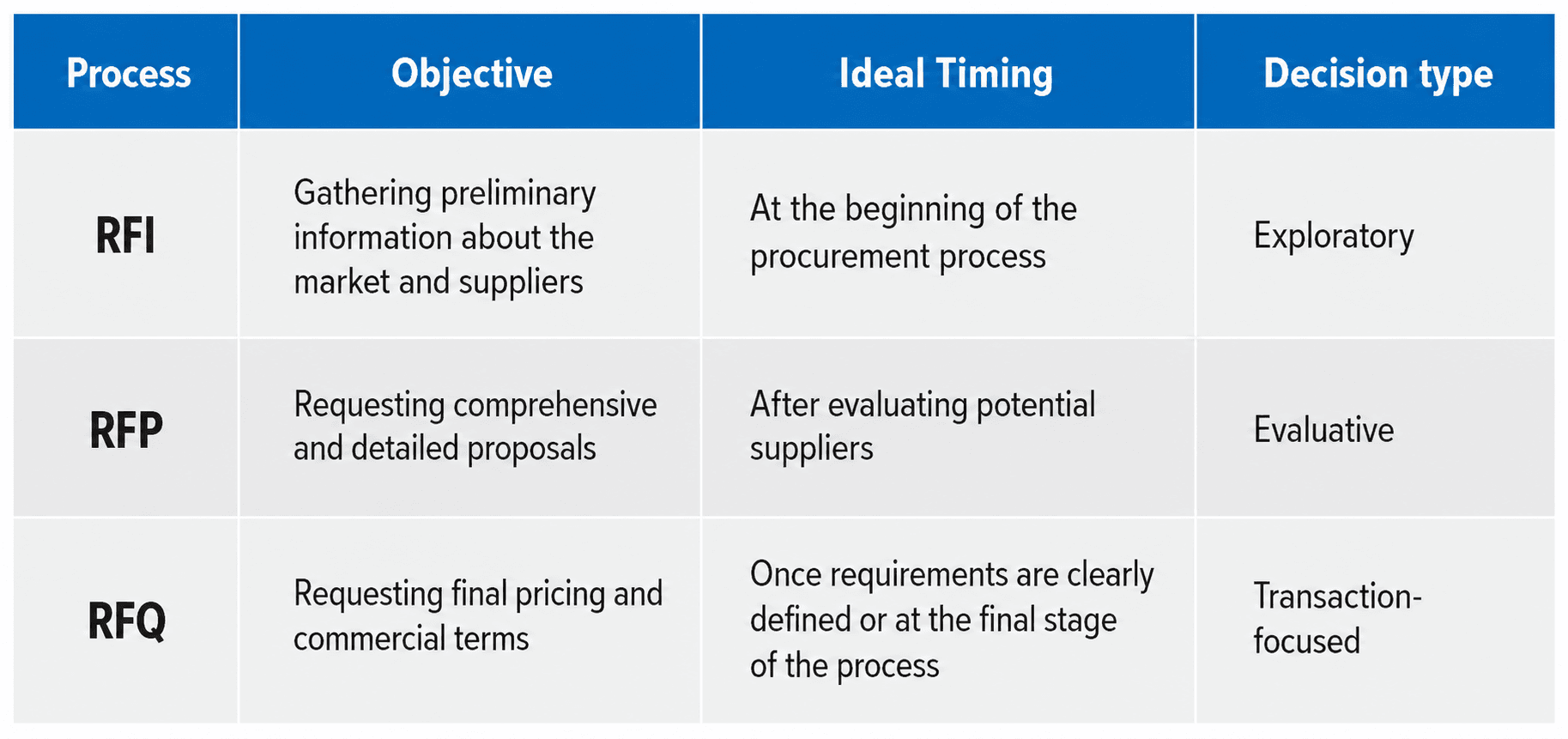
The intended purpose is the main difference between RFI RFP RFQ:
▪ RFI: Gathering information
▪ RFP: Requesting solution proposals
▪ RFQ: Requesting price quotations
Using the right format at the right stage is critical to ensuring efficient and well-structured procurement tender process steps. Each approach serves a different purpose and varies in terms of depth, scope and timing within the procurement cycle.
An RFI is primarily exploratory, an RFP is solution-oriented and evaluative, while an RFQ is focused on pricing and transaction execution.
How does the corporate proposal management process work?
Corporate tender management processes follow a series of structured stages, with each step directly affecting the next.
1. Needs analysis and requirement definition: The process begins with clearly defining procurement requirements. Incomplete or inaccurate requirements can negatively affect the entire procurement cycle.
2. Supplier research and invitation: Suitable suppliers are identified and invited to participate in the tender process. At this stage, supplier track records, references and past performance play an important role.
3. Tender collection process: Proposals and quotations are collected from suppliers. Digital procurement platforms make this process more organized, transparent and efficient.
4. Tender evaluation and supplier comparison: Submitted tenders are evaluated and compared using pre-defined criteria and scorecards.
5. Negotiation and commercial discussions: Final negotiations are conducted with the suppliers offering the strongest options. E-tendering systems support more transparent negotiations and help optimize procurement costs at this stage.
6. Contract and procurement stage: Once the supplier selection in procurement is complete, contractual agreements are finalized and procurement operations begin.
These traditional procurement stages are increasingly evolving into digital, data-driven workflows. This transformation is being accelerated by broader global trends across procurement and supply chain management.
Gartner’s 2025 supply chain forecast highlights the growing adoption of artificial intelligence and advanced analytics across procurement and supply chain operations. This shift strengthens data analytics and decision-support mechanisms while enabling faster, more consistent bid evaluation and supplier selection processes.
What is e-tendering?
E-auction systems are often used within broader e-tendering processes and e-tendering is the transition of traditional tender management processes into a fully digital environment. More than just a change in method, e-tendering enables critical stages such as bid collection, evaluation and supplier selection to be managed through a process that is faster, more transparent and easier to track.
How do e-tendering systems work?
An e-tendering system manages the procurement process end-to-end, functioning as a centralized digital platform. Procurement requirements are defined within the system, and suitable suppliers can be invited instantly. Suppliers submit bids through their own digital interfaces, while the system collects and analyzes procurement data in real time, making the evaluation process significantly more efficient for all parties.
The Difference Between E-Tendering and Traditional Methods
The paperwork, fragmented communication and manual follow-up associated with traditional tender processes are increasingly being replaced by digital procurement workflows. Traditional methods are often slower and more prone to errors because they rely heavily on manual processes. E-tendering systems, by contrast, provide faster execution, greater transparency and more data-driven procurement decision-making.
How does the e-tendering process work?
The e-tendering process follows a clear and structured workflow:
▪ Needs analysis: Procurement requirements are defined digitally.
▪ Supplier invitation: Suitable suppliers are invited through the system.
▪ Digital tender collection: Bids are collected and managed through a secure digital platform.
▪ Tender evaluation: Incoming bids are compared using objective criteria and predefined evaluation methods.
▪ Supplier selection: The winning supplier is selected transparently based on procurement data and evaluation outcomes.
This structure standardizes procurement processes while ensuring that every stage remains transparent, traceable and auditable.
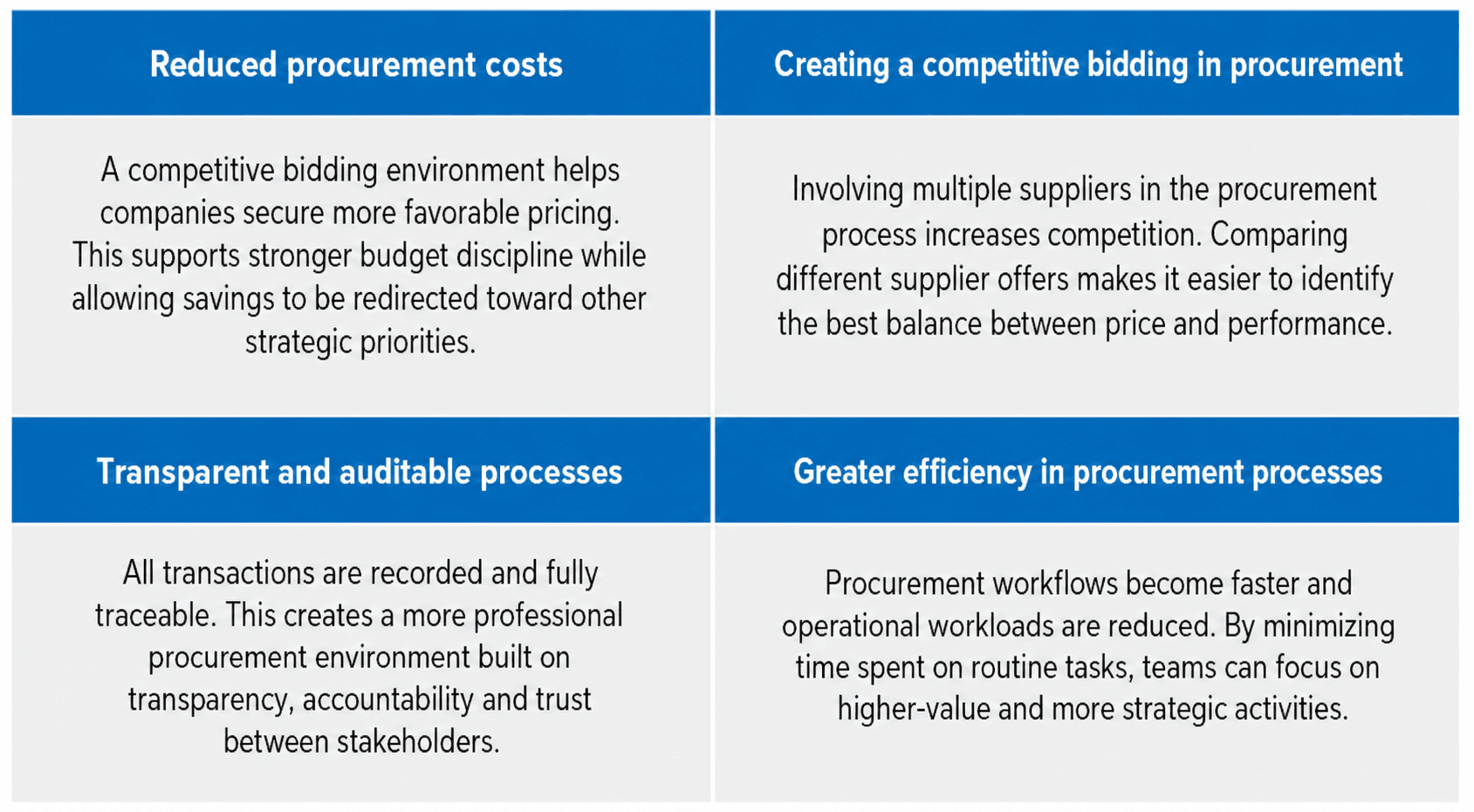
Why do corporate companies use e-tendering systems?
It is just as important to understand why the e-tendering system is used as it is to understand how it works.
Frequently asked questions about corporate tender management
Why is the RFI process critical?
The RFI process helps companies understand market capabilities and evaluate potential suppliers at an early stage. This reduces the risk of moving forward with incomplete information or poorly defined procurement requirements.
What is the fundamental difference between an RFP and an RFQ process?
An RFP (Request for Proposal) focuses on identifying the best solution for a project, while an RFQ (Request for Quotation) is primarily used to obtain pricing information for clearly defined products or services.
Does e-procurement simply mean achieving the lowest price?
No. E-procurement is about creating faster, more transparent and fully traceable procurement processes while ensuring a fair and competitive environment for all suppliers.
What are the advantages of digital tender management systems?
Digital tender management systems help transform procurement operations into more agile and data-driven workflows. Key benefits include faster procurement processes through automation, improved supplier relationships, stronger data-driven decision-making, greater process security and reduced operational errors.