

What is ERP? How does an ERP system work and what is it used for?
ERP systems bring data from different departments together under a single structure, providing operational visibility and data integrity across business processes.
As business operations become more complex, companies need a reliable way to bring together data and processes across different departments. ERP (Enterprise Resource Planning) systems provide a centralised structure for managing workflows across areas such as finance, inventory, human resources, procurement and the supply chain, improving operational visibility and data consistency across the organisation.
As companies grow, maintaining a clear view of activities across different departments becomes increasingly difficult. A finance team may be working from budget data that does not reflect current inventory levels, while a production team may receive late notice of delays in the raw materials it needs. These disconnects can slow down operations, increase costs and make decision-making more difficult. ERP (Enterprise Resource Planning) systems are designed to address this problem by connecting core business functions through a shared data platform. Rather than serving as standalone software for a particular department, an ERP system provides an enterprise-wide framework in which functions such as finance, human resources, inventory, procurement and supply chain management can work from the same information and coordinate their processes more effectively.
What is ERP?
ERP is a suite of integrated systems that brings a company’s operational data together in a centralised environment, automates the flow of information between departments and supports end-to-end management of business processes. By reducing the need for manual data transfer, ERP helps create a consistent and reliable flow of information across the organisation.
What does ERP stand for?
ERP stands for Enterprise Resource Planning. Its Turkish equivalent is Kurumsal Kaynak Planlama.
The term can be broken down into three components:
- Enterprise: Refers to the organisation as a whole, from small businesses to large multinational groups.
- Resource: Covers the assets and capabilities a company relies on, including financial resources, employees, raw materials, machinery and time.
- Planning: Refers to organising and allocating these resources systematically to improve efficiency, reduce waste and support profitability.
What does an ERP system do?
One of the main purposes of an ERP system is to reduce information silos between departments. Under traditional processes, for example, a new sales order may need to pass manually from the sales team to production, then to procurement for the required materials, and finally to finance for invoicing.
With an ERP system, these processes are connected. Information entered by one department can become immediately available to other relevant teams, helping the business respond more quickly and work from the same underlying data.
ERP systems also give management greater visibility across the organisation. Decision-makers can monitor information such as financial performance, inventory levels and production activity from a central system and use this data to support operational and strategic decisions.
How does an ERP system work?
ERP systems typically operate through a centralised database connected to a series of integrated modules. Employees in different departments may use interfaces designed for their own functions, but the underlying information is stored and managed within the same system.
A typical process might work as follows:
1. Order entry: A customer representative enters a new sales order into the system.
2. Automatic inventory check: The system checks whether sufficient finished goods are available.
3. Production and procurement triggers: If inventory is insufficient, the system can generate a production requirement. If the necessary raw materials are unavailable, a purchase requisition (PR) can then be created within the procurement module.
4. Financial processing: Once the required materials are received and the relevant invoice is recorded, the finance module updates the corresponding accounting records and financial data.
This integrated structure allows information to move between functions without the same level of manual intervention, helping departments coordinate their activities more effectively.
What are the core modules of an ERP system?
ERP systems are typically built around a modular structure, allowing companies to select and configure functionality according to their operational needs. The most commonly used core ERP modules include:
- Finance and Accounting Management: Supports general ledger accounting, accounts receivable and payable, budgeting, cash flow management and financial reporting.
- Procurement Management: Supports internal purchase requisitions, purchase order (PO) creation, approval workflows and basic supplier records.
- Inventory Management: Tracks goods received and dispatched, inventory levels, minimum and maximum stock thresholds, and transfers between locations.
- Production Management: Supports production planning, bills of materials (BOM), capacity planning and work order management.
- Sales and Customer Processes: Manages customer quotations, sales orders, delivery tracking and invoicing.
- Human Resources Management: Covers personnel administration, payroll, leave management and performance appraisal processes.
What are the benefits of using an ERP system?
Enterprise resource planning systems can deliver operational and financial benefits by connecting processes, improving data visibility and reducing reliance on manual workflows.
Process digitalisation can also reduce processing times. A study published in Scientific Reports, for example, found that following an ERP-supported process transformation, procurement processing time at a manufacturing company fell from 5.8 days to 2.1 days, a reduction of 63.8 per cent.
Key benefits can include:
- Data integrity and consistency: ERP systems reduce discrepancies caused by departments maintaining separate datasets and records.
- Operational efficiency: Automating repetitive tasks and reducing duplicate data entry can help employees use their time more effectively.
- Cost control: Improved visibility over inventory, purchasing and resource use can help companies identify excess stock, shortages and inefficient spending.
- Fast and flexible reporting: Financial and operational data can be consolidated more quickly, reducing the time required to prepare management reports.
- Regulatory compliance: Centralised and traceable records can support compliance with relevant tax, accounting and financial reporting requirements.
Which companies are ERP systems suitable for?
ERP solutions were once associated primarily with large industrial organisations, but cloud-based technologies have made them accessible to a much broader range of companies.
They can be particularly relevant for:
- Growing SMEs: Companies that need stronger coordination between departments as their operations become more complex.
- Manufacturers and industrial organisations: Businesses that need to manage raw materials, bills of materials, production planning and capacity.
- Organisations with complex supply chains: Organisations managing multiple warehouses, large supplier networks or high inventory turnover.
- Multi-site and international companies: Businesses seeking to consolidate financial data and operational processes across different locations.
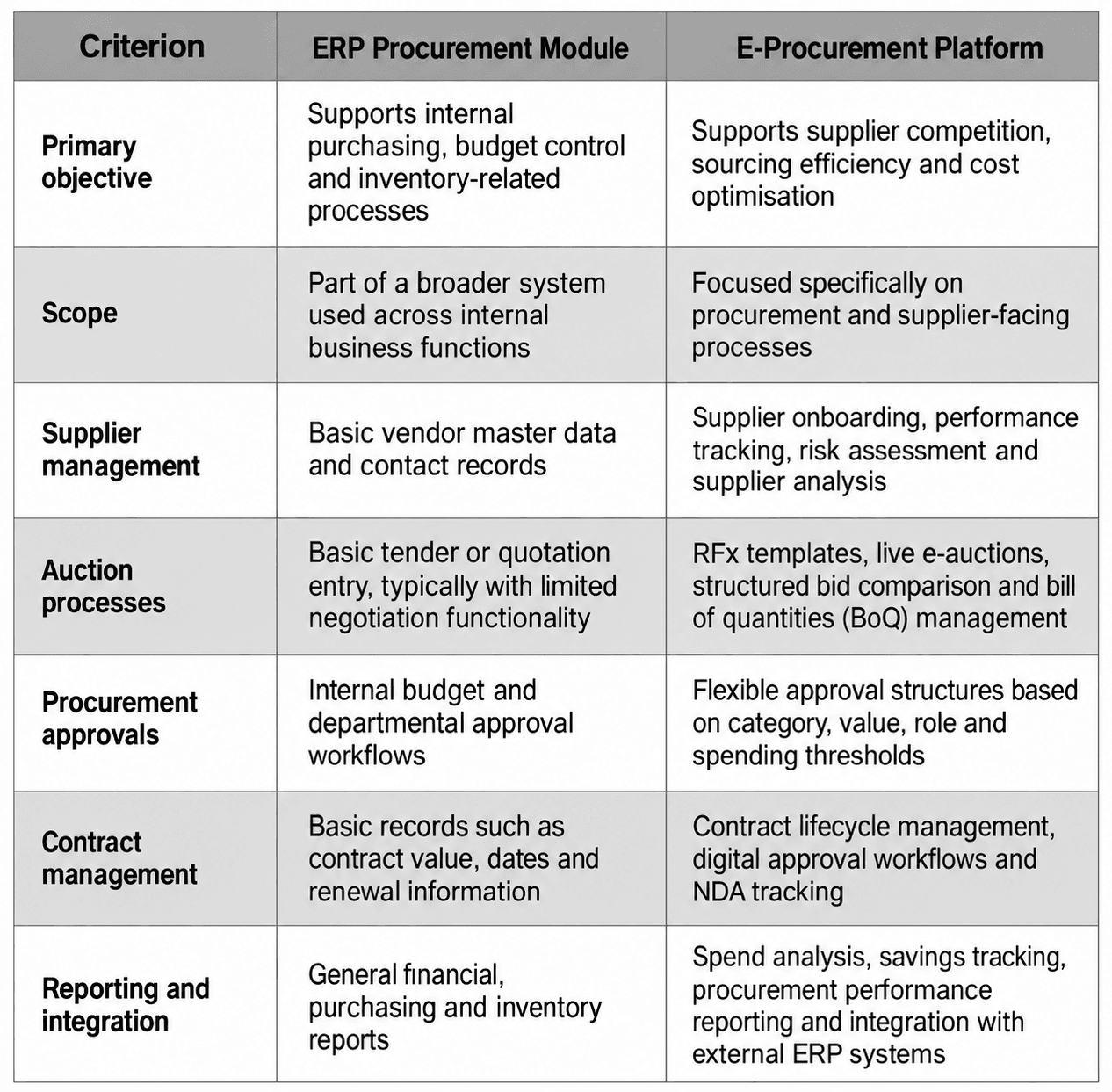
What is the difference between an ERP system and an e-procurement system?
A common misconception is that the procurement module within an ERP system provides the same functionality as a specialised e-procurement platform.
By contrast, dedicated e-procurement platforms provide more specialised functionality for managing supplier-facing procurement processes. These can include RFQs (requests for quotation), e-auctions, supplier negotiations, supplier performance management and contract management.
Comparison of ERP and E-Procurement Systems
How is ERP used in procurement processes?
ERP systems play an important role in managing the internal stages of procurement. They typically support the process from the initial purchase requisition through to purchase order creation, goods receipt, invoice matching and payment.
Purchase Requisition Management
Departments enter their requirements for goods or services into the ERP system as purchase requisitions. Once the relevant approvals have been completed, approved requests are routed to the procurement team for further action.
Purchase Order and Budget Management
Following an approved procurement decision, the ERP system can generate a purchase order (PO) and check the transaction against the relevant budget, cost centre or spending limit.
Inventory and Materials Management
When purchased goods are received, the goods receipt (GR) is recorded in the ERP system and inventory levels are updated accordingly. This helps procurement and operational teams work with current stock information and reduces the risk of unnecessary or duplicate purchases.
Invoice Matching and Financial Processing
Supplier invoices can be matched against purchase orders and goods receipt records within the ERP system. Once the relevant controls and approvals have been completed, the transaction can move into the payment process.
How does ERP and e-procurement integration work?
ERP systems are primarily designed to manage internal business processes and financial records. Specialist e-procurement platforms, by contrast, provide deeper functionality for supplier-facing activities such as RFQs, competitive sourcing, negotiations and e-auctions.
For this reason, ERP and e-procurement systems are often used as complementary solutions rather than alternatives.
A typical integrated procurement process may work as follows:
1. Purchase Requisition (ERP): An internal purchase requisition (PR) is created and approved within the ERP system, then transferred to the e-procurement platform through the integration.
2. Request for Quotation (E-Procurement): An RFQ is issued to selected suppliers through the e-procurement platform, where quotations and supporting information are collected.
3. Negotiation and Tendering (E-Procurement): Shortlisted suppliers can participate in further negotiation stages, including e-auctions or other competitive sourcing processes.
4. Supplier Selection (E-Procurement): Commercial and other relevant criteria are evaluated and the preferred supplier is selected.
5. Purchase Order Creation (ERP): The approved sourcing outcome and supplier information are transferred back to the ERP system, where the relevant purchase order can be created.
6. Goods Receipt and Supplier Performance (ERP and E-Procurement): Goods receipt and invoicing are recorded within the ERP system. Relevant delivery, quality and performance data can then be transferred to the e-procurement platform and incorporated into supplier performance records.
What are the advantages of using ERP alongside an e-procurement platform?
The functionality available within ERP systems varies according to the solution, configuration and scale of the organisation. Integrating an ERP system with a specialised e-procurement platform such as Promena can extend procurement capabilities while preserving the ERP as the organisation’s core transactional and financial system.
Research also points to the value of combining core systems with more flexible digital procurement tools. Deloitte’s Global Chief Procurement Officer Survey reports that leading procurement organisations using digital automation and e-sourcing capabilities perform strongly against cost-saving objectives.
Key benefits can include:
- Reduced duplicate data entry: Purchase requisitions, supplier information, sourcing results and purchase orders can move automatically between systems, reducing manual re-entry and the risk of errors.
- Stronger sourcing and negotiation capabilities: ERP-based budget controls can be combined with tools such as RFQs, e-auctions and structured supplier negotiations to support more competitive sourcing processes.
- End-to-end visibility: Procurement teams gain greater visibility across the process, from purchase requisition and sourcing through to purchase order, goods receipt, invoicing and supplier performance.
- Greater data consistency and traceability: Internal approvals and financial controls remain within the ERP environment, while supplier interactions and sourcing activities are recorded in a structured and auditable e-procurement platform.
- Centralised supplier performance management: Delivery, quality and other operational data generated through the ERP system can be transferred to the e-procurement platform and incorporated into supplier performance assessments.
What should be considered when selecting an ERP system?
Choosing the right ERP solution requires companies to assess both their current operational needs and their future requirements. Key criteria include:
- Sector-specific functionality: The ERP solution should support processes relevant to the company’s industry, whether manufacturing, retail, services or another sector.
- Flexibility and integration capability: The system should support integration with external platforms such as e-procurement, CRM and business intelligence (BI) tools, ideally through APIs or other standard integration methods.
- Scalability: The infrastructure should be able to accommodate growth in user numbers, transaction volumes, data and additional locations.
- User experience: A clear and intuitive interface can support faster adoption and reduce the training burden for employees.
- Total Cost of Ownership (TCO): Companies should assess not only licence fees, but also implementation, customisation, consultancy, maintenance, integration and training costs.
Frequently Asked Questions
ERP system is a broader concept that includes the software itself as well as the processes, data structures, workflows and people involved in using it across the organisation.
In which departments is ERP used?
ERP systems can be used across many different business functions, including finance, accounting, procurement, warehousing and logistics, production, sales, planning and human resources. The exact scope depends on the modules selected and the way the system has been configured for the organisation.
What is the difference between ERP and CRM?
ERP and CRM systems serve different but complementary purposes. ERP primarily supports internal business processes such as finance, inventory, production and procurement. CRM, or Customer Relationship Management, focuses more specifically on customer interactions, sales opportunities, pipelines, marketing activities and account management. The two systems are often integrated so that operational and customer-related data can flow between them.
Are ERP and e-procurement the same thing?
No. ERP and e-procurement systems perform different roles. ERP acts as the broader operational and financial backbone of the organisation, supporting areas such as accounting, inventory, purchasing and internal approvals. E-procurement platforms specialise in procurement activities involving suppliers, including RFQs, e-auctions, supplier negotiations, sourcing processes and supplier performance management.
Can ERP systems be integrated with e-procurement platforms?
Yes. Many modern ERP systems can be integrated with e-procurement platforms through APIs, middleware or other data integration methods.