

What Is an RFQ? How Is the Quotation Process Managed?
Explore the scope and use cases of the RFQ process, along with the key steps in preparing price quotations and the methods used to evaluate bids.
In competitive market conditions, sourcing the right product at the optimum cost begins with professional quotation management. At the heart of corporate procurement operations, the RFQ process increases efficiency and transparency in procurement while significantly reducing operational costs.
In modern supply chain and procurement management, sourcing the right product at the right time and at the optimum cost directly determines a company’s competitiveness. Procurement teams use a range of strategic tools to increase operational efficiency and optimise budget management. Among the foremost of these tools, and one of the most critical members of the RFx family in e-procurement, is RFQ. What is RFQ in procurement, and how should an effective quote collection process be structured? Let us examine this process, which lies at the heart of corporate procurement operations, step by step.
What is RFQ?
The English abbreviation RFQ stands for Request for Quotation. It is a formal request for quote document used in procurement processes to obtain quotations from suppliers for products or services whose scope, technical specifications, quantity and logistics requirements have been clearly defined.
For procurement professionals, RFQ meaning goes far beyond a form. It is a strategic procurement tool that enables companies to run standardised, transparent and traceable quote collection processes in which responses can be compared fairly with one another. This ensures that prospective suppliers know exactly what is expected of them and compete on a level playing field using clear information.
When is RFQ used?
Moving directly into a price-focused process does not always produce the right results for every procurement requirement. Just as important as understanding Request for Quotation is knowing when to use this tool.
Key scenarios for using RFQ
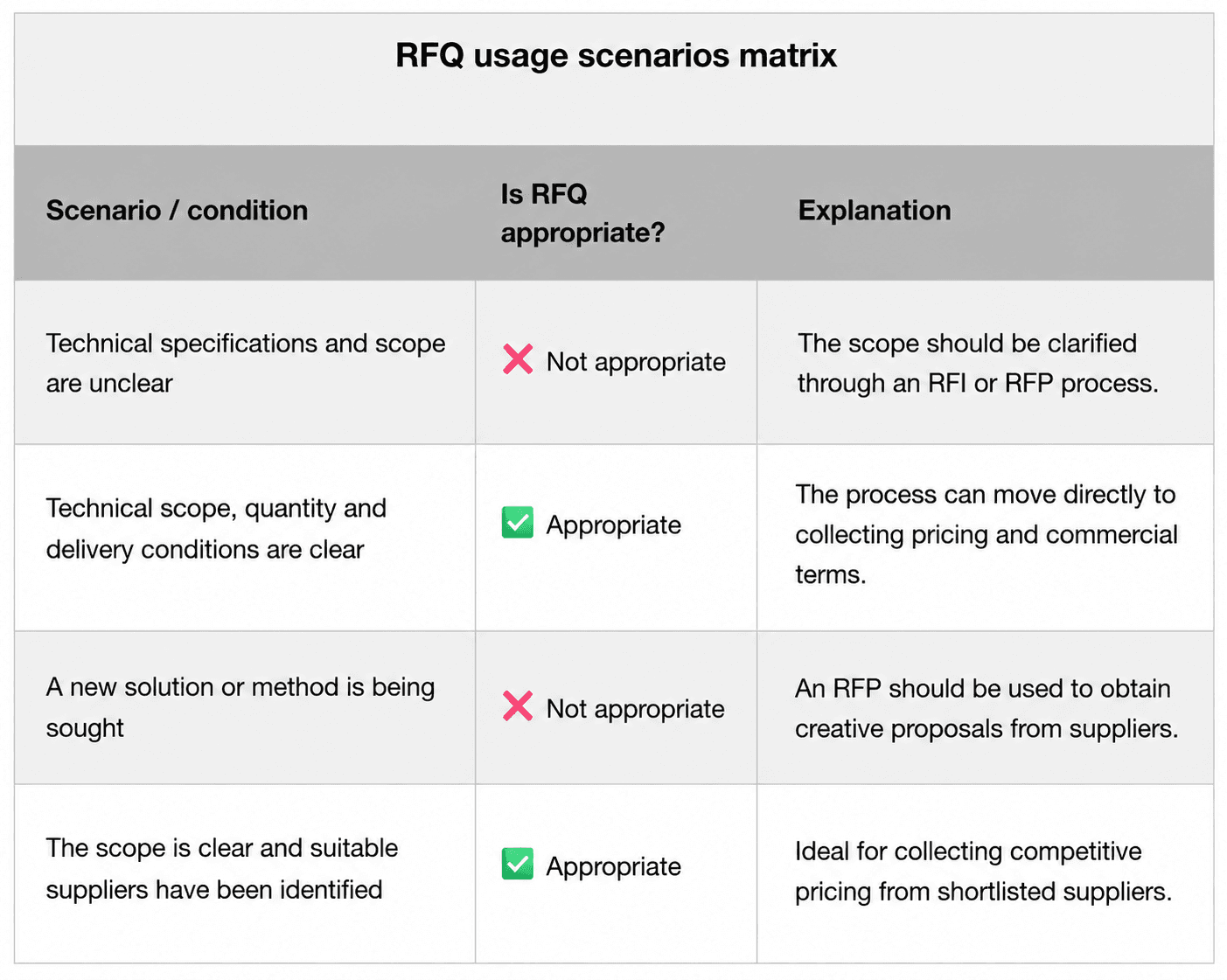
- When the product or service scope has been clearly defined: An RFQ process can be initiated once technical specifications, quantities, delivery locations, packaging conditions and other requirements have been determined.
- When pricing and commercial terms need to be compared: It can be used to evaluate the pricing, payment terms, delivery times, quote validity periods and other conditions offered by multiple suppliers.
- When quotations need to be collected in a standard format: Requiring suppliers to quote against the same scope and criteria enables the evaluation process to be carried out more consistently.
- When RFI or RFP process has been completed: The process can move to the RFQ stage to obtain final pricing and commercial terms from suppliers whose technical capabilities have been evaluated and who have been shortlisted.
The table below summarises when using an RFQ is appropriate:
Why is RFQ used?
There is a strong rationale behind companies moving away from traditional email- and Excel-based quote collection practices and adopting a systematic RFQ structure.
- Collect comparable quotations: Analysing quotations submitted using each supplier’s own template can become an operational nightmare. RFQ requires all parties to submit quotations against the same scope and in the same format, creating an objective basis for evaluation.
- Gain a clearer view of procurement costs: The breakdowns within the RFQ document provide visibility not only into unit prices but also logistics expenses, customs clearance, packaging and all hidden operational costs in one place.
- Accelerate the supplier selection process: Standardised quotation templates and predefined evaluation criteria can reduce decision-making processes that might otherwise take weeks to days, or even hours.
- Create a transparent and traceable quotation process: From the beginning to the end of the process, records are kept of what information was sent to each supplier and when revised quotations were submitted, providing transparency that fully supports internal and external audits.
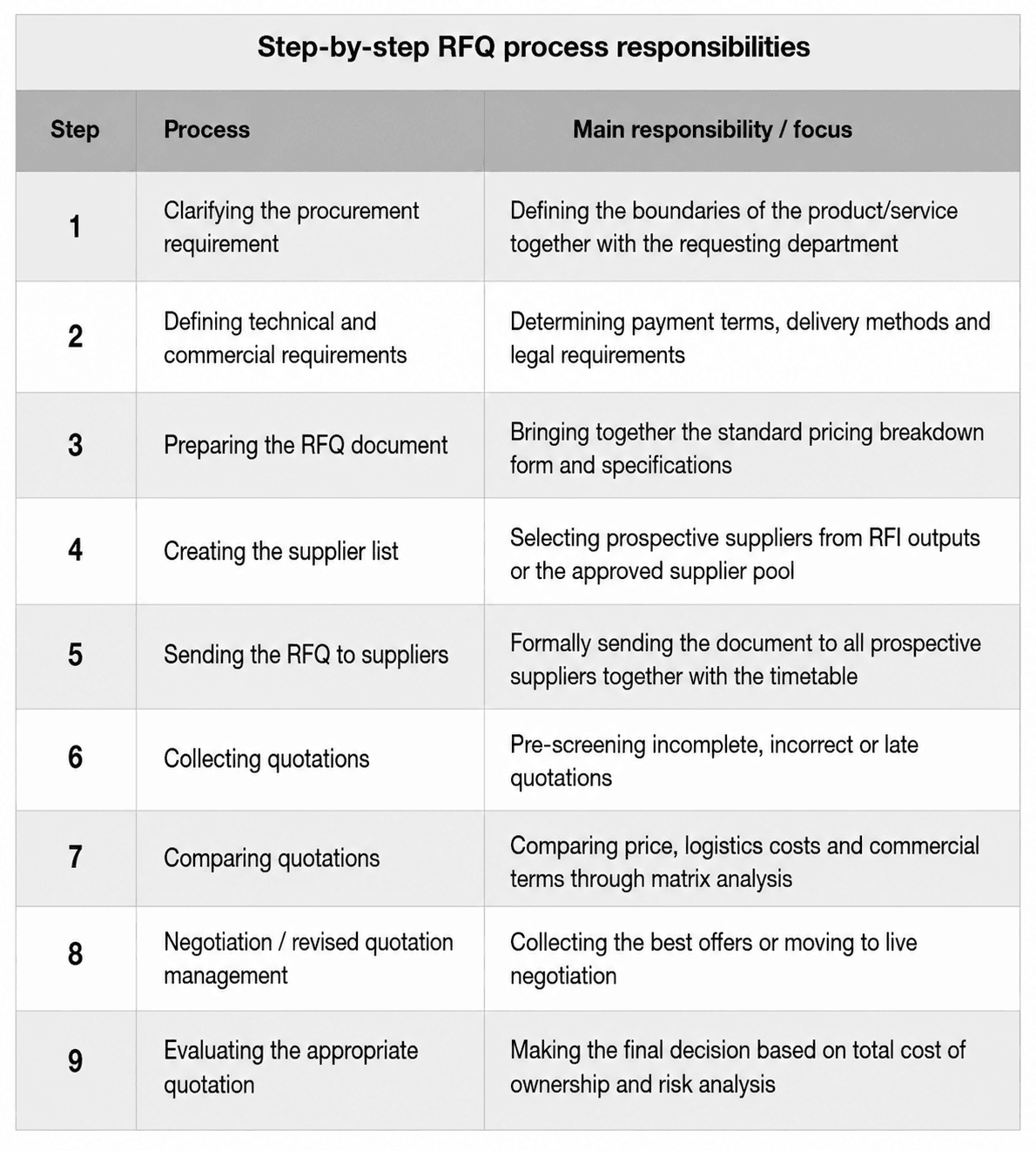
How does the RFQ process work?
A successful RFQ process consists of logical steps planned from end to end. Each stage of the process should be managed meticulously to prevent potential risks and loss of rights.
What information should an RFQ document contain?
The answer to how to prepare an RFQ professionally lies in the quality of the document. An incomplete document can lead to repeated questions from suppliers and wasted time. A well-designed RFQ should contain the following key elements:
- Brief information about the company and procurement requirement: Corporate background to help the supplier understand the project and the vision behind the work
- Product or service scope: Product name, full technical specifications, part numbers, required quantity, packaging standards and delivery locations
- Commercial terms: Required currency, target payment terms, warranty and maintenance/service periods, draft contract and the limits of logistics responsibilities
- Quote format and submission deadline: The currency and Excel or system format in which quotations must be entered, together with a firm submission date and time
- Evaluation criteria: A general outline of the scoring weights that will apply when selecting the supplier, for example 60% price, 20% delivery time and 20% quality
What are the differences between RFQ, RFI and RFP?
In procurement terminology, the concepts RFI, RFP and RFQ, grouped under RFx, are often confused with one another. However, each has a completely different purpose and place within the process.
- What is an RFI (Request for Information)? An early-stage information-gathering process used when information about the market and suppliers is limited and their capabilities need to be understood.
- What is an RFP (Request for Proposal)? A process used to obtain a “proposed solution and approach” from suppliers when a company has a problem or requirement to address but has not yet determined which methodology or technology should be used.
- What is an RFQ (Request for Quotation)? The final stage, used once the requirement and methodology have been fully defined and the focus is directly on pricing and commercial terms.
For a more detailed look at the purposes of RFI, RFP and RFQ and the differences between them, please see our article What are the differences between RFI, RFP and RFQ?
What should be considered when preparing an RFQ?
To ensure that the process runs smoothly and delivers the most profitable outcome for the company, the following golden rules should be observed during quotation management:
The scope should be clearly defined
Ambiguous wording can lead suppliers to make different assumptions. Company A may quote based on premium-grade material, while Company B may provide a price based on standard material. This completely eliminates the possibility of a fair comparison.
The quote format should be standardised
Rather than accepting PDF or paper-based quotations prepared in suppliers’ own formats, a common template should be mandatory, with each item and cost breakdown, such as labour, raw materials and logistics, clearly separated.
Evaluation should not focus solely on price
One of the biggest mistakes in supplier management is moving directly towards the cheapest quotation. A supplier offering a low price may have financial instability, logistics delays or poor quality, which can cause far greater losses for the company in the long term.
Evaluation criteria should be defined in advance
Scoring weights should be determined before the process begins. This prevents the procurement team from making emotional or subjective decisions and places the process on a fully analytical footing.
Suppliers should be given a reasonable response time
Very tight deadlines can cause suppliers to rush, build high risk premiums into their pricing and submit expensive quotations, or choose not to participate at all. A balanced timetable should be established according to the scale of the requirement.
How can the quote collection process be managed more efficiently?
For the quote collection process to be managed efficiently, communication should be conducted through a centralised structure, quotations should be compared against standard criteria and the complete transaction history should be retained. Digital procurement platforms enable these processes to be managed through a single system instead of manual email and Excel-based work.
According to APQC’s procurement benchmarking data, the cost to companies of processing a single purchase order can range from approximately $14 to more than $54. APQC states that this cost difference between companies is largely related to how procurement processes are structured and managed. Standardising processes and managing them through a central system can help reduce manual workload and control operational costs more effectively.
How can RFQ processes and quote collection be managed more efficiently with Promena?
Promena supports the digital creation and management of RFQ processes, their distribution to suppliers, the comparison of quotations against common criteria and the recording of the complete process history. This allows quote collection processes that would otherwise be managed through email and separate Excel files to be handled through a single system.
Centralised quote collection and supplier management: Promena’s RFx module can be used to prepare RFQ documents, invite suitable suppliers to participate and track the quote collection process through a centralised dashboard. Managing supplier communications, documents and quotation revisions within the same system reduces the risk of information loss and version confusion.
Standardised and comparable quote management: Suppliers can be required to submit pricing, delivery times, payment terms, logistics costs and other commercial conditions in a defined format. This makes quotations easier to compare against common criteria and enables the evaluation process to be managed more consistently.
Moving from RFQ to e-auction and negotiation: Quotations evaluated during the RFQ process can, where necessary, progress to an e-auction or negotiation stage. Recording the actions carried out throughout the process also supports traceability, reporting and audit activities.
Frequently asked questions about the RFQ process
How is the validity period of quotations determined in the RFQ process?
The quote validity period, or option period, is requested in advance by the procurement team in the RFQ document. Particularly during periods of volatile raw-material prices, suppliers may want to keep this period short; however, a reasonable period, such as 30, 60 or 90 days, should be stipulated with the project’s approval processes taken into account.
Is a technical specification mandatory when preparing an RFQ?
If the item to be purchased is not a standard, universally recognised commodity or a coded product, such as a specific brand of toner or a standard bearing, a technical specification must be included. Otherwise, suppliers will quote for products of different quality levels.
Should the lowest price always be selected in the RFQ process?
No. What matters in procurement is “Total Cost of Ownership” and supplier risk. If the supplier offering the lowest price has a long delivery time, a risky financial position or inadequate warranty terms, the quotation may prove more expensive in the long term.
How is supplier confidentiality maintained in the RFQ process?
Protecting the commercial secrets and pricing policies of suppliers participating in the process is essential. On digital procurement platforms, suppliers cannot see one another’s quotations. It is also standard corporate practice to require suppliers to approve a digital Confidentiality Agreement (Non-Disclosure Agreement | NDA) before the RFQ document is sent.
When is a purchase order created after RFQ?
Once quotation evaluations have been completed, management approval has been obtained and a commercial contract has been signed or an agreement reached with the selected supplier, an official “Purchase Order (PO)” is created through the system and sent to the supplier.