

What Is Agentic AI? AI Agents in Procurement
What is Agentic AI and how does it work? Explore AI agent use cases in procurement, key benefits, human oversight, data security and Promena PROMi.
Agentic AI refers to a new operating model in which artificial intelligence goes beyond simply generating information or content, enabling it to plan tasks toward defined goals and take action within authorized systems. In procurement processes, it can support the more efficient execution of various operational tasks, from needs analysis and supplier identification to quotation collection.
What Is Agentic AI?
Agentic AI is an artificial intelligence approach that can determine the steps required to achieve a specific goal, evaluate available information, and carry out tasks using the tools it is authorized to access.
In the traditional command-and-response model, the user often describes each step separately. In agentic systems, however, a broader goal can be defined. The system can plan toward this goal, change its next step in response to new information, and perform actions within defined boundaries. For this reason, Agentic AI should be considered not merely an advanced conversational experience, but a goal-oriented task execution model.
An AI Agent, meanwhile, is a software system that performs a specific task within this approach. An AI Agent can evaluate information, break a task down into sub-steps, perform actions using tools it has been granted permission to access, and determine the next step based on the results it obtains.
From this perspective, Agentic AI refers to the broader working approach, while an AI Agent refers to the application component that carries out tasks within this approach.
How Does Agentic AI Work?
The way Agentic AI systems work may vary depending on the technology used, the data they can access, and the permissions assigned to them. In general, however, the operating logic is based on understanding the goal, gathering the necessary information, planning the task, and using the appropriate tools.
A typical process may consist of the following steps:
1. The goal is defined: The task the system must complete or the outcome it must achieve is specified.
2. The necessary information is collected: The AI Agent obtains task-related information from the data sources it is permitted to access.
3. The task is planned: The complex task is divided into smaller steps and the order of operations is determined.
4. Tools and systems are selected: Authorized applications or data sources that can be used to carry out the task are identified.
5. Action is taken: The AI Agent performs the necessary operations within the scope of the permissions granted to it.
6. The result is evaluated: It is checked whether the action achieved the goal, and the plan is updated when necessary.
7. Human approval is obtained when necessary: Financially or commercially critical actions may be left under user control.
Not every AI Agent needs to perform all of these steps without human intervention. The level of autonomy may vary depending on the use case and the permissions granted to the system.
What Are the Use Cases of Agentic AI?
Agentic AI can support task execution in multi-step business processes such as customer service, financial operations, supply chain management, operations management, and procurement. For example, AI Agents can be used for tasks such as analyzing data, identifying suitable options, creating lists based on defined criteria, initiating processes, and monitoring outcomes.
In procurement processes, Agentic AI can be used in areas such as analyzing procurement needs, identifying suitable suppliers, preparing quotation processes, and carrying out repetitive operational tasks. These use cases can be examined in greater detail specifically in the context of procurement.
What Is the Difference Between Agentic AI and Generative AI?
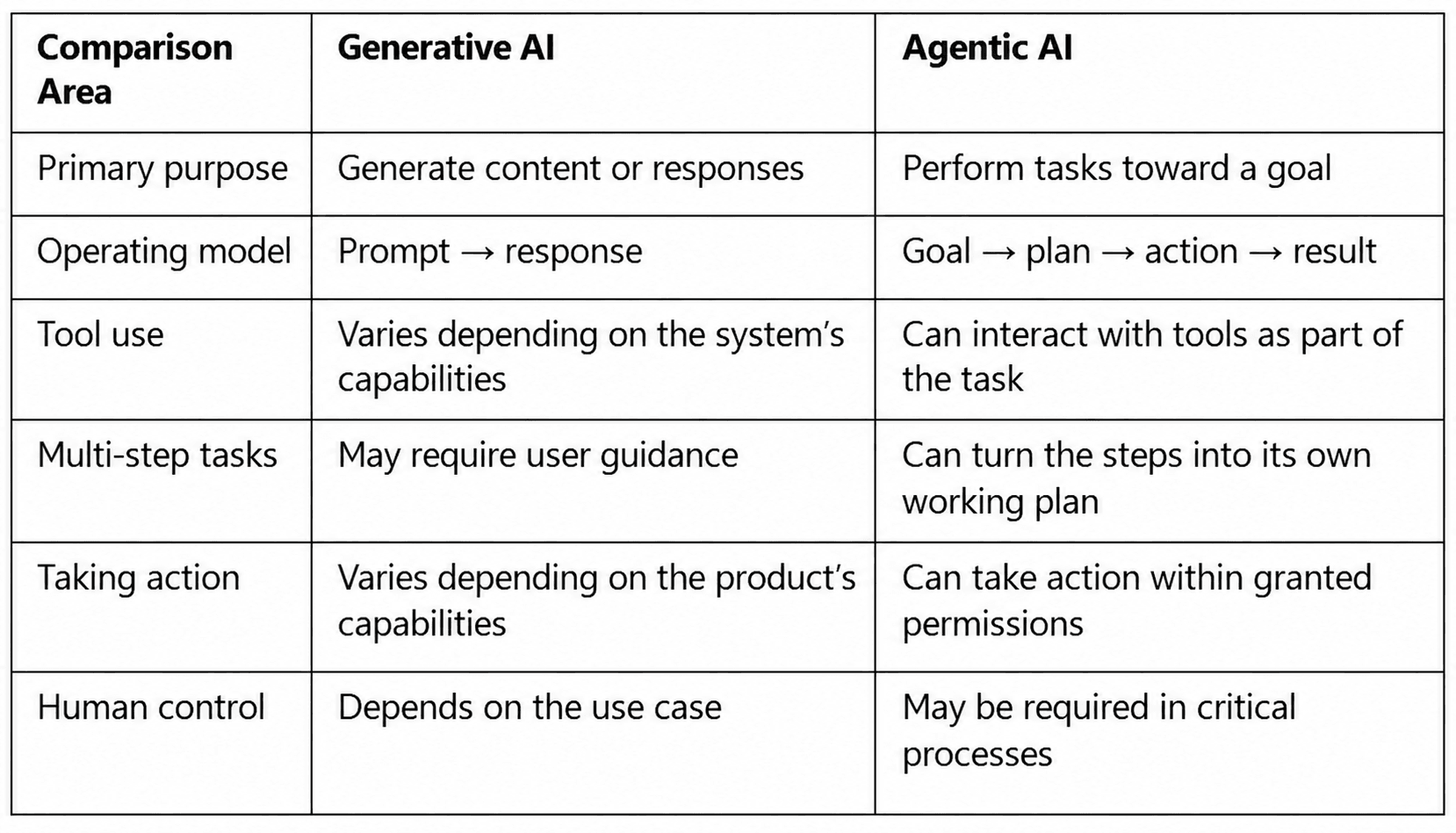
The fundamental difference between generative AI and Agentic AI lies in their purpose and operating model. While generative AI primarily focuses on creating text, images, code, or similar content, Agentic AI focuses on planning and executing tasks in order to achieve a goal.
However, these two approaches are not alternatives to one another. Generative AI models may be one of the components used by an agentic system while carrying out its tasks. Content generation, tool use, and action execution capabilities may coexist within the same application.
How Can Agentic AI Be Used in Procurement Processes?
Procurement is a business process that consists of more than simply comparing prices and includes numerous operational steps. From identifying the need and researching suppliers to collecting quotations and carrying out evaluations, different tasks must be managed in a coordinated manner.
At this point, Agentic AI can go beyond being a tool that merely provides recommendations to procurement professionals and enable defined tasks to be carried out within the permissions granted to it. In this way, existing quotation and auction management processes can be supported with a more advanced level of task automation.
Analyzing the Procurement Need
An AI Agent can evaluate information related to the category, product, service, or technical requirements included in a procurement request. This evaluation can help determine which data and supplier characteristics will be needed in subsequent stages.
Human oversight remains important in cases where requests are incomplete or unclear.
Identifying Suitable Suppliers
An AI Agent can evaluate potential suppliers using defined criteria and the data sources it is permitted to access. In this way, part of the operational workload that
procurement professionals devote to manual supplier research can be reduced.
The final supplier decision, however, should take company policies, commercial conditions, and the procurement team’s assessment into account.
Creating Supplier Lists
Businesses that meet the eligibility criteria can be compiled into a supplier or participant list. The AI Agent can perform this task in accordance with the data sources and rules defined for it. Especially in strategic or critical purchases, having the prepared list reviewed by a procurement professional can provide an appropriate control mechanism.
Preparing RFQ Processes
An AI Agent can support operational activities such as preparing the quotation collection process and including the relevant suppliers in the process. This can reduce the manual steps required to move a procurement request into the quotation collection stage.
For more detailed information about the basic stages of request for quotation processes, see What is RFQ?.
Automating Repetitive Operational Tasks (H3)
Procurement teams may spend a significant amount of time on repetitive activities such as collecting data, creating lists, and initiating processes. An AI Agent can help reduce this operational workload by carrying out suitable tasks within defined permissions.
This allows procurement professionals to spend more time on areas that require greater human judgment, such as category strategy, supplier relationships, and negotiation.
Analyzing Procurement Data
Agentic systems can be used to process and classify procurement data or to combine information from different sources.
However, the reliability of the results depends on the accuracy of the data used, integrations, and system design. Therefore, it should not be assumed that every procurement solution offers the same analytical capabilities.
AI Agent Use Case in Procurement
To illustrate how Agentic AI could work in the procurement process, let us consider an example procurement request.
Suppose a company creates a new procurement request for a specific product or service.
1. The procurement request enters the system: The request includes the product or service type, category, technical requirements, and any other available information.
2. The AI Agent analyzes the request: The agent evaluates the information in the request and identifies the criteria required for the procurement process to move forward. If information is missing or unclear, user oversight may come into play.
3. Suitable suppliers are identified: The AI Agent uses the defined criteria and the supplier data it can access to identify businesses that may be suitable for the need.
4. A participant list is created: Suppliers that meet the criteria can be added to the participant list to be used in the quotation collection process. For critical purchases, the list may be submitted to a procurement professional for approval.
5. The quotation collection process is prepared: Once the necessary information and suppliers have been identified, the AI Agent can support the preparation and initiation of the quotation collection process within the permissions defined for it.
6. Critical commercial decisions remain with the procurement team: While the AI Agent carries out operational steps, human oversight continues in areas that require expertise, such as negotiation, commercial evaluation, supplier relationships, and final decision-making.
The fundamental difference in this scenario is that the artificial intelligence does not merely generate a supplier recommendation or produce text. The AI Agent can carry out interconnected tasks that begin with the procurement need and extend through the quotation process toward a defined goal. In the source content as well, needs analysis, supplier identification, list preparation, and initiation of the quotation process are presented as the core steps of this usage model.
What Is the Difference Between Traditional Procurement Automation and an AI Agent?
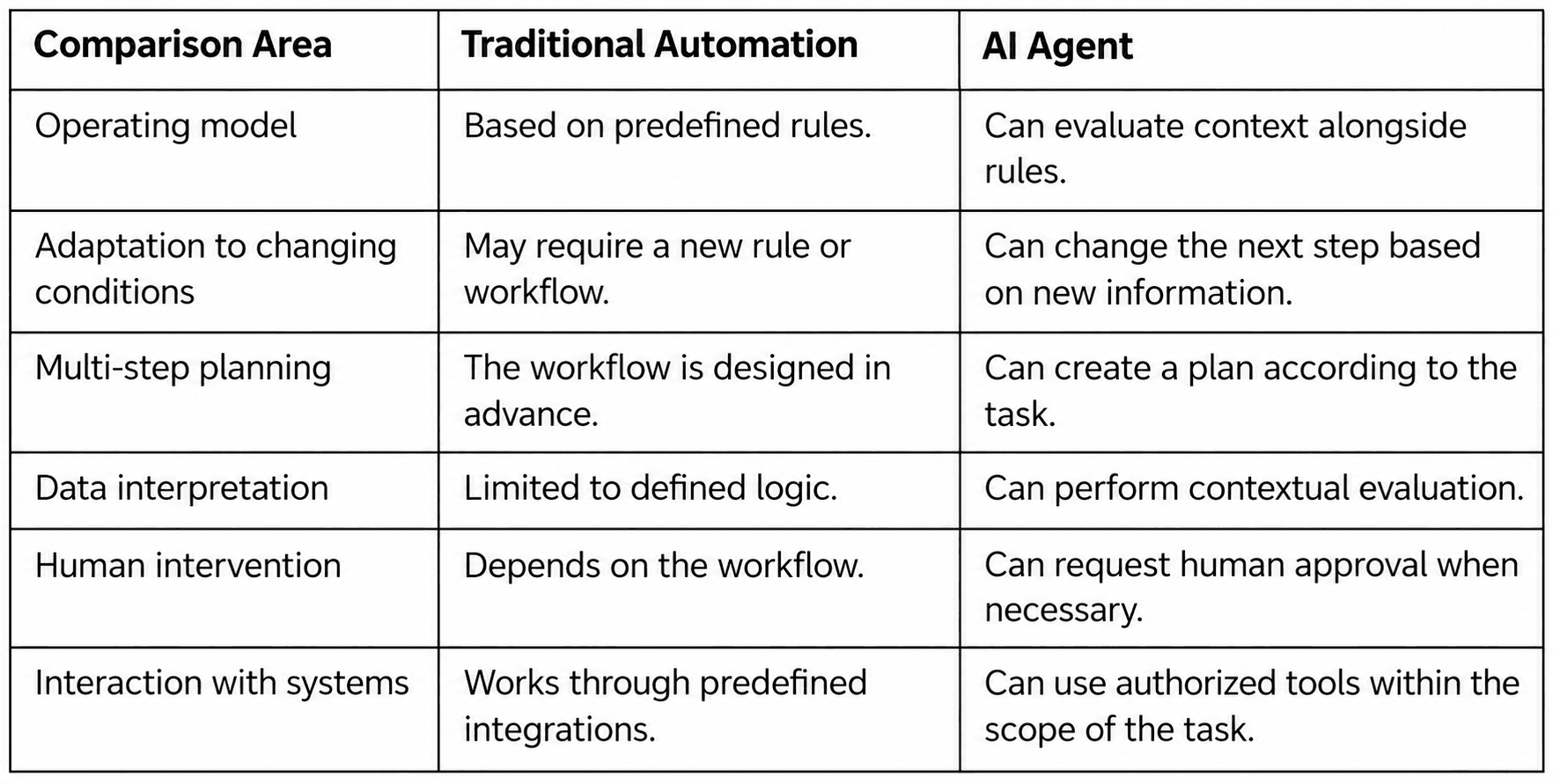
Traditional automation systems provide significant advantages in consistently applying predefined rules and workflows. In the AI Agent approach, however, information that emerges during the task can be evaluated, and the next action can be determined according to the current conditions.
This does not mean that Agentic AI makes traditional automation unnecessary. The two approaches can be used together to support both the application of standard rules and more flexible task management.
What Are the Benefits of Using AI Agents for Procurement Teams?
The primary purpose of using an AI Agent is not to transfer all of a procurement professional’s responsibilities to technology, but to automate some of the time-consuming and repetitive operations.
For procurement teams, the use of AI Agents can support:
- reducing manual and repetitive work,
- accelerating supplier research,
- evaluating large data sets in a shorter period of time,
- carrying out standard operations more consistently,
- allowing professionals to spend more time on strategy, negotiation, and supplier relationships.
The extent of these benefits depends on data quality, system integrations, and application design. The use of an AI Agent alone does not guarantee definite cost savings or a specific performance outcome.
For more detailed information about digital procurement processes, see What is E-Procurement?.
Human Oversight and Data Security in the Use of Agentic AI
Because procurement processes can result in financial consequences, supplier relationship impacts, and commercial obligations, the boundaries of the permissions granted to an AI Agent should be clearly defined.
Human approval can serve as an important control mechanism, particularly in matters such as supplier selection criteria, exceptional transactions, and decisions that are difficult to reverse. Verifying the accuracy of the data used and the results generated by the AI Agent is also part of process management.
From a data security perspective, it should be clearly defined:
- which data the AI Agent can access,
- which systems it can use,
- which actions it can perform,
- which actions require human approval,
- how user permissions are managed,
- how completed actions are recorded.
Because corporate procurement systems contain company information, supplier records, and commercially sensitive data, access controls and transaction logs are important for both security and auditability.
For more detailed information about data security in procurement processes, see Data Protection and Data Security in Procurement Processes.
How Is the Promena PROMi AI Agent Used in Procurement Processes?
PROMi is the AI Agent that operates within Promena’s Sourcing module.
According to current product information, PROMi analyzes procurement needs, identifies suitable suppliers, creates the participant list, and can automatically initiate the quotation collection process.
Thanks to this structure, sequential operational steps in the procurement process can be supported by the AI Agent toward the same goal instead of being carried out manually one by one.
PROMi’s workflow essentially includes the following steps:
- Analyzing the procurement need
- Identifying suitable suppliers
- Creating the participant list
- Initiating the quotation collection process This usage model is positioned to help procurement teams focus more on strategic decisions by reducing the time spent on operational tasks. PROMi’s current features and the solution it is part of can be reviewed on the Sourcing with Promena page.
Frequently Asked Questions About Agentic AI (FAQ)
What does Agentic AI mean?
Agentic AI is an artificial intelligence approach that can plan tasks toward a specific goal, evaluate available information, and take action using permitted tools. The system’s level of autonomy may vary according to the permissions granted to it.
What is an AI Agent and how does it work?
An AI Agent is a software system that can collect information, plan the necessary steps, and use authorized tools in order to perform a specific task. It can determine the next action based on the results that emerge during the task and can work with human approval when necessary.
What is the difference between Agentic AI and generative AI?
Generative AI primarily focuses on generating content or responses. Agentic AI, on the other hand, focuses on planning and carrying out tasks toward a goal. The two approaches can be used together within the same application.
What is the difference between an AI Agent and a chatbot?
A chatbot primarily focuses on communicating with users and answering questions. An AI Agent, on the other hand, can focus on performing a specific task, use the tools it is authorized to access, and determine the next step based on the outcome of the task. Some modern chatbot applications may also include agentic capabilities.
Can an AI Agent operate completely autonomously?
A high level of autonomy may be possible for some tasks, but this does not apply to all AI Agents. The level of authority is determined according to the system design and use case. Critical actions may be made subject to human approval.
Can Agentic AI replace procurement professionals?
Rather than viewing Agentic AI as something that can completely replace procurement professionals, it is more appropriate to consider it a technology that transforms the way they work. An AI Agent can take over some operational tasks such as data collection, preparing supplier lists, and initiating certain processes. In contrast, category strategy, supplier relationships, negotiation, commercial evaluation, and critical decisions are areas in which human expertise remains important.