

What Is an Online Sourcing System? A Guide to Digital Procurement Processes
Learn what an online sourcing system is, how it works, and the benefits it offers businesses. Discover solutions that help optimize digital procurement processes.
Today, the key to unlocking a competitive edge in business lies in managing resources using digital intelligence. Online procurement systems contribute to companies’ sustainable growth by transforming procurement departments into strategic decision-making centers. In this article, we examine how you can build a more transparent, competitive, and efficient structure by digitizing your procurement operations.
For businesses looking to move away from the complexity of traditional tendering methods, digitalisation has become an operational necessity. Paper-based processes and quotes lost across long email chains are being replaced by digital ecosystems where all stakeholders come together on a fair, transparent and traceable platform.
Recent analysis shared by Gartner shows that companies that simplify cumbersome and complex processes through digitalisation are 42% more likely to succeed in their transformation projects than their competitors. In this guide prepared by Promena, we examine the roadmap for digital transformation in procurement, from how an online bidding system works and the key advantages it offers companies to the main differences between traditional tendering and online auction systems, as well as strategic tips for improving efficiency.
What is an online procurement system?
An online procurement system is a digital model that enables companies to manage procurement activities through internet-based platforms instead of traditional, manual methods. It brings key processes such as quote collection, online auctions, e-auction platform for supplier bidding and evaluation into a centralised software environment.
At its core, an online bidding system is designed to ensure that procurement processes are managed in a transparent, traceable and competitive digital ecosystem. By consolidating communication, documentation and supplier participation on a single platform, it helps companies improve control, reduce complexity and make better-informed procurement decisions.
How does an online auction system work?
Unlike manual processes, a digital tendering process follows a systematic flow that minimises the risk of error and maximises speed. In simplified terms, the process consists of the following steps:
1. Strategic request creation: The process begins when the procurement department defines the required product or service on the digital procurement platform, including all technical details. This includes not only what will be procured, but also the technical specifications, quality standards and logistics expectations. By creating this clear framework digitally, companies can eliminate potential ambiguities at the very start of the process, before they affect later stages of the tender.
2. Smart supplier invitation: Once the specification has been prepared, suitable suppliers are invited to the platform. These may be suppliers already registered in the system or selected according to strategic criteria such as location, past performance and financial competence. This stage enables personalised notifications to be sent to thousands of suppliers at the same time, preventing procurement specialists from becoming overwhelmed by email traffic.
3. Digital quote collection and competition: Suppliers enter their quotes into a centralised and secure digital pool within the specified timeframe. This is where online systems make the clearest difference. Depending on the type of tender, competition can be triggered in real time through reverse auction sessions. Suppliers can monitor their market position without seeing their competitors, while this dynamic structure enables the best market price to emerge naturally.
4. Objective evaluation: When the tender period closes, all submitted quotes are automatically analysed by the system. Cross-comparisons are made not only on price, but also against pre-defined key performance indicators (KPIs) such as quality score, delivery time and supplier performance history. The calculation errors caused by manually maintained Excel files are replaced by transparent reports prepared in seconds.
5. Data-driven finalisation: At the final stage, the supplier offering the most suitable conditions is identified using the analytical data provided by the system. The tender result is automatically communicated to all parties, and the process is completed with a digital audit trail. As a result, the company does not simply complete a procurement transaction; it also lays the foundation for a long-term business partnership.
Key benefits of an online auction systems for companies
Digital procurement solutions reduce operational workload while directly strengthening a company’s competitive position:
- Sustainable cost advantage: Competition across a broad supplier pool enables lasting improvements in total cost of ownership. This creates a savings model based not only on unit price, but also on logistics and operational costs.
- Increased competition: A transparent environment involving multiple suppliers helps companies reach the most suitable business partners in the market. When suppliers can see their competitors’ moves anonymously, they are encouraged to submit more competitive prices.
- Full transparency: The ability to track every step from quote to payment minimises errors and simplifies audit processes. The answer to the question “Why was this supplier selected?” is always based on concrete data.
- Time savings: By eliminating manual data entry, phone traffic and complex approval processes, online systems increase operational agility. Tender processes that could take weeks can be reduced to just a few days through digital platforms.
- Proactive risk management: These systems enable procurement teams to regularly monitor suppliers’ financial position, ethical standards and operational capacity, helping them prevent potential disruptions across the supply chain.
Differences between an online bidding process and a traditional tendering process
The clear distinction between traditional methods and digital platforms forms the basis of modern procurement. This is not simply a change of tool, but a shift in operational mindset.
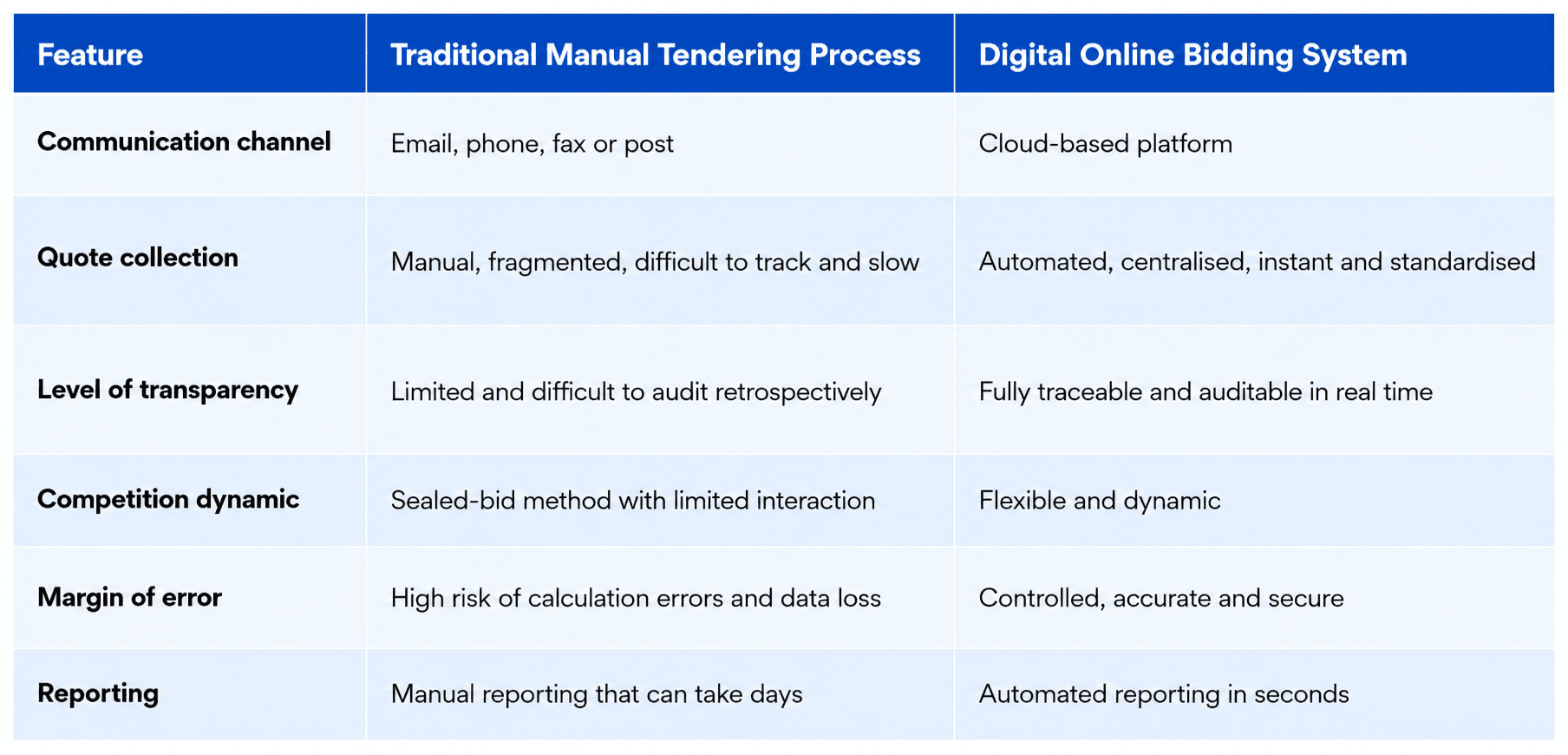
- Digital vs manual processes: Traditional processes are managed on paper or through email, while online systems centralise all communication in a single place. This also helps preserve institutional memory.
- Data accuracy and security: In manual processes, there is always a risk of data loss or calculation errors. In online systems, all data is stored on highly secure, encrypted cloud servers, helping prevent unauthorised access.
- Speed and decision quality: With traditional methods, comparing quotes can take days. In digital tenders, the system scores all quotes instantly, helping procurement teams make more accurate decisions.
- Scalability: With old-style methods, operational workload can become unmanageable as business volume increases. In digital structures, however, hundreds of tenders can be managed simultaneously without disruption.
Comparison table: Traditional tendering vs online auction system
Transparency and competition in online bidding processes
Online bidding systems create a fair structure that gives every participant an equal opportunity. Recording all quotes through the system makes internal audit easier and places supplier relationships on a more professional footing.
In a transparent environment, competing suppliers can revise their performance in line with market conditions and focus on offering the highest added value. Thanks to these data-driven systems, supplier competition becomes more than a price contest for businesses. It also becomes a source of efficiency.
Which companies are online bidding systems suitable for?
Digitalisation offers advantages for any business with procurement operations, but for some segments it has become a necessity:
- Medium-sized and large companies: Organisations with multiple stores, factories or business units need these systems to ensure centralised control.
- Companies working with multiple suppliers: Online bidding systems are an ideal solution for businesses that want to manage large supplier networks, centralise communication traffic and segment each supplier accurately.
- Businesses with high procurement volumes: Companies that want to establish spending discipline and manage large budgets transparently can achieve significant savings through online systems.
What should companies consider in an online bidding process?
For the system to succeed and create real value, companies should pay attention to the following critical points:
- Clarity of specifications: Quality standards and success criteria should be clearly defined from the outset.
- Selecting the right suppliers: The focus should not be limited to price alone. Financial stability, technical competence and past performance scores should also be considered.
- Process management and up-to-date data: Ensuring that the data entered into the system is current and accurate is essential for reliable analysis.
- User-friendly interface: The system should have a simple interface so that it can be easily adopted by both internal teams and external suppliers.
The new era of digital procurement and online auctions
Procurement is no longer focused only on reducing costs. It is increasingly centred on data-enabled decision-making. Today’s forward-looking leaders use the analytical power of artificial intelligence to address potential risks before they emerge.
According to Log-hub’s guide to supply chain analytics , companies that use supply chain analytics effectively can turn complex data sets into strategic insights and gain much greater visibility across their operations. Through this digitalisation, inefficiencies that may be overlooked in manual management can be identified, enabling sustainable success in total cost management. The 2025 Deloitte Global CPO Survey also supports this picture, confirming that 61% of leaders see transparent information-sharing with suppliers as the most critical step in increasing resilience.
Digital solutions and platform use in procurement processes
Manual procurement processes can gradually become cumbersome structures that slow down a company’s operational pace. Paper-based tracking, lost emails and fragmented communication allow weak links that are difficult to detect to remain within the chain. Digital solutions eliminate this inefficiency through a problem-solving approach. As manual errors are replaced by the speed and accuracy of automation, procurement teams can devote more time to strategic projects.
Efficient procurement management with online tendering platforms
Choosing the right online bidding platform directly shapes a company’s operational agility and level of control. With the solutions we offer as Promena, we help make transparency, auditability and strong competition part of your corporate culture. Efficient procurement management is not only about adopting technology. It is about placing that technology at the centre of your procurement processes. Platforms that simplify complex processes and turn suppliers into strategic partners are already building the supply chain architecture of the future.
Frequently asked questions about online bidding systems
What is an online auction system for procurement?
An online bidding system is a procurement auction software that enables all stages of the tender process, from quote collection to finalisation, to be managed through procurement bidding platforms.
Is an online bidding system for procurement only for large companies?
No. Any business with suppliers, regardless of scale, can create a more strategic structure and gain a cost advantage.
Which criteria are measured in an online bidding process?
Key performance indicators (KPIs) such as delivery speed, quality standards, financial stability and cost alignment are measured.
Why is supplier segmentation important?
Segmenting suppliers according to specific criteria improves resource efficiency by making it easier to focus on the strategic stakeholders that are critical to the company, rather than spending the same level of effort on every supplier.