

What Are the Hidden Risks of Manual Sourcing Processes?
Explore the benefits of digitalization by examining the time loss, data errors, transparency, and tracking issues that arise in manual sourcing processes.
Maintaining cost discipline in changing market conditions depends on procurement processes that are transparent, traceable and well controlled. When procurement is managed using traditional methods, companies can face operational risks as well as hidden costs that become increasingly difficult to manage as the organisation grows.
In modern supply chain management, sourcing the right product or service on the right commercial terms has a direct impact on competitiveness. Procurement teams use quotation collection and sourcing processes to maintain budget control and ensure suppliers are evaluated consistently. Yet in many organisations, these activities are still managed manually.
At first, manual procurement may appear practical. But as procurement volumes increase, so do the risks, from financial leakage and data loss to bottlenecks and poor decision-making. So where do these risks arise, and how can companies manage sourcing processes more effectively?
What is a manual sourcing process?
A manual sourcing process involves managing RFx activities, supplier communication, quotation comparison, approvals and decision-making through tools such as email, Excel, telephone and hard-copy documents rather than through a digital e-sourcing or e-procurement platform.
A typical manual process may include the following steps:
1. Defining the requirement: Obtaining specifications and other requirements from the requesting department.
2. Identifying potential suppliers: Selecting suppliers using existing contact lists, email groups or individual networks.
3. Issuing the RFx request: Sending specifications, forms and other documentation to suppliers by email.
4. Collecting and consolidating responses: Manually bringing supplier responses received in different formats into a single spreadsheet.
5. Comparison and approval: Preparing a comparison table and circulating it to relevant managers for approval, often through email chains.
Why can manual processes appear adequate at first?
For low-volume procurement involving only a small number of suppliers or infrequent sourcing activity, traditional methods may appear quick and cost-effective. They require no additional software investment and rely on familiar tools such as Excel and Outlook.
However, this apparent simplicity becomes harder to maintain as the number of suppliers, procurement categories and sourcing events increases. Processes become more difficult to track, compare and control, while the risks associated with manual working grow.
Why do manual sourcing processes create risk?
The central weakness of manual procurement is its dependence on individuals, manual follow-up and fragmented sources of information. When quotations, specifications and supplier correspondence are stored across personal inboxes and spreadsheets, the organisation lacks a reliable central record of procurement activity.
This dependence on individuals can also make historical pricing and negotiation records difficult to access if the relevant procurement specialist leaves the company or is unavailable. At the same time, manually transferring data between emails, documents and spreadsheets increases the risk of errors, which can result in decisions being based on incomplete or inaccurate information.
The most common hidden risks of manual sourcing processes
Manual sourcing and quotation collection can create several less visible risks that ultimately affect procurement performance and profitability.
1. Data loss and version confusion
In email-based processes, revised quotations and updated commercial terms can easily become mixed up with earlier versions. A revised discount, price or delivery term may be overlooked, increasing the risk of decisions being made using outdated information.
2. Difficulty comparing quotations
When suppliers submit PDF or Excel files using different formats, parameters such as unit prices, logistics costs, payment terms and warranty periods can be difficult to compare consistently.
Procurement teams may therefore spend significant amounts of time consolidating and standardising supplier responses before meaningful analysis can begin.
3. Limited transparency and traceability
Manual processes can make it difficult to establish a complete record of which suppliers received which specifications, when responses were submitted or how requests for revisions were communicated.
This weakens process visibility and makes it harder to demonstrate that suppliers were evaluated consistently and on the same basis.
4. Time loss and operational inefficiency
Instead of focusing on higher-value activities such as market research, category management or supplier development, procurement professionals can become absorbed in operational tasks such as tracking emails, chasing responses and organising files manually.
As sourcing activity grows, this administrative workload can become a significant drag on procurement productivity.
5. Cost leakage
If quotation components such as transport, packaging, customs duties, maintenance or other associated costs are not analysed together, the lowest headline price may not represent the lowest overall cost.
A more complete assessment based on total cost of ownership (TCO) can therefore reveal that an apparently cheaper quotation is more expensive once all relevant costs are taken into account.
Risks and Impacts of Manual Sourcing
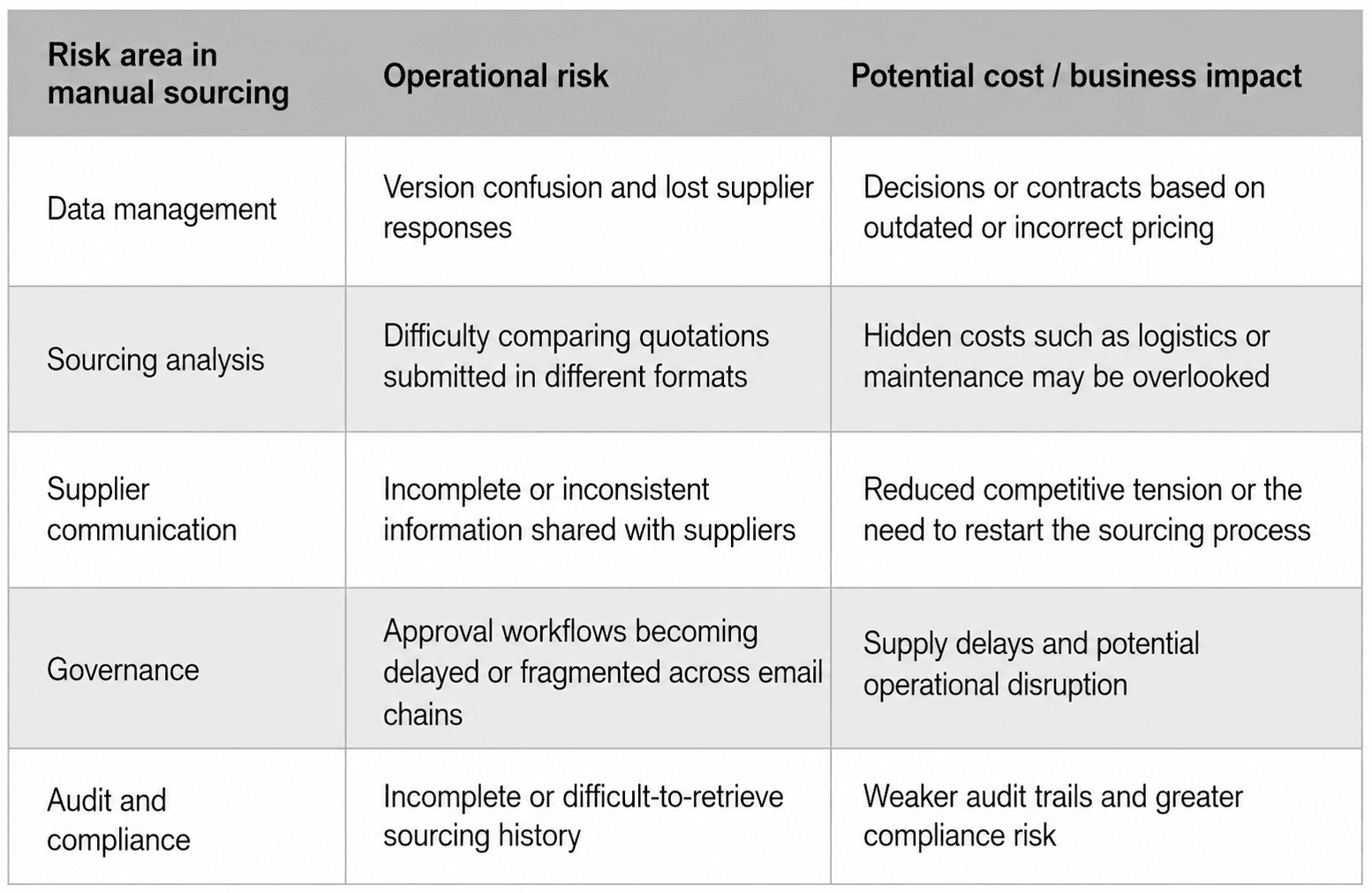
Checklist for Procurement Risks:
- Do all suppliers submit their auction in a single standard format?
- Are revisions and Q&As during the auction process recorded?
- Can past auction data be accessed with a single click?
- Are approval mechanisms system-driven and independent of individuals?
How do manual auction processes affect procurement costs?
There are traditional auction management risks. It leads to increases in both direct and indirect costs.
1. Hidden operational costs: The lengthening of the process and the working hours spent increase the transaction cost per auction.
2. Weakened bargaining power: As market data and past auction analyses are not readily available, it is not possible to establish a stronger bargaining position when negotiating with suppliers.
3. The lowest-price fallacy: Evaluations that focus solely on unit price lead to unforeseen deviations from the budget due to inflexible payment terms, high transport costs and inadequate warranty coverage.
The Hidden Side of the Iceberg: A Procurement Specialist's Ordinary Day
Theory aside, it is the procurement teams working on the ground who bear the brunt of the pressure created by traditional auctioning processes. The process begins in the early hours of the day with opening emails from dozens of suppliers, sifting through PDF quotations in various formats one by one, and manually entering the data into a massive Excel spreadsheet; before long, it turns into a full-blown race against time. If a supplier's last-minute revised discount rate, sent by email, is overlooked in the chaos, or if the file submitted for the manager's approval is an outdated version, it can instantly render the entire team's week's work useless.
The even more painful part begins after the auction. When managers ask, 'Why did we choose this supplier?' or 'How much did we pay for the same item last year?', spending hours searching through past correspondence in their personal email inboxes painfully highlights just how weak the organisation's memory is. When the process becomes reliant on individual memories and email archives, the procurement specialist ceases to be a professional making strategic decisions and instead becomes an operational follower merely handling paperwork. This is precisely the greatest hidden risk of manual auction management: draining teams' energy and preventing the company from making data-driven strategic moves.
Procurement processes carried out using traditional and manual methods create significant data chaos for organisations, as well as operational risks that are not immediately apparent. According to the ' andtheSurvey' published by Deloitte, 64 per cent of procurement leaders view increasing visibility in the supply chain as the most critical risk mitigation strategy, whilst 61 per cent regard improving information sharing and collaboration with suppliers as the most critical. The survey reveals that leading companies that support their processes with digital tools achieve a 96 per cent success rate in meeting their cost-saving targets compared to organisations using traditional methods, whilst also securing a clear advantage over their competitors in terms of supplier performance and operational efficiency.
A Comparison of Manual and Digital Sourcing Management
The table below summarises the key structural differences between traditional procurement methods and modern digital procurement management:
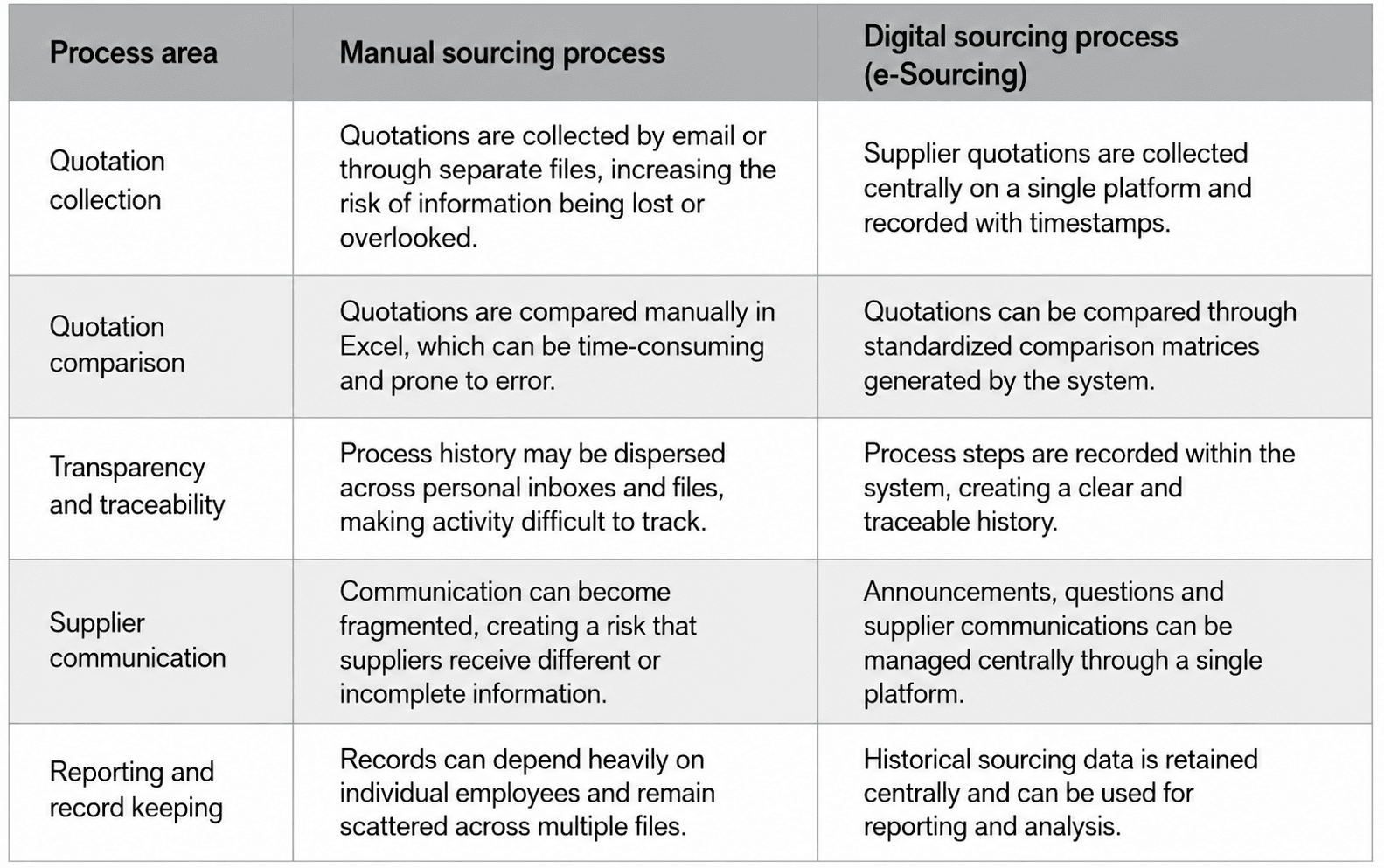
How does digital sourcing help mitigate these risks?
The inefficiencies, data fragmentation and control issues associated with manual processes are encouraging companies to adopt e-sourcing and digital procurement processes. A digital sourcing environment can help reduce these risks in several ways:
- Centralised data management: Supplier documentation, quotations, revisions and correspondence can be stored on a single platform, reducing the risk of information being lost across emails and separate files.
- Standardised forms: Suppliers can be asked to respond using defined formats, making submissions easier to compare and helping reduce missing or inconsistent information.
- Procurement automation approval workflows: Evaluation and approval stages can be routed through defined authorisation workflows, making them easier to track and reducing reliance on email chains.
- Live e-auctions: Suppliers shortlisted through an RFQ or other sourcing stage can be invited to a live e-auction, helping create competitive tension within a transparent and structured process.
How can Promena help companies manage sourcing processes more efficiently?
Promena brings together digital capabilities across e-procurement, supplier relationship management, e-sourcing, RFx and digital auction management. By centralising sourcing activity within a single platform, Promena can help companies reduce many of the risks associated with manual processes while improving visibility, consistency and control.
Digital sourcing management: Promena’s e-sourcing capabilities allow procurement teams to prepare sourcing documentation digitally, distribute it to selected suppliers and manage supplier responses within a centralised environment.
Standardised and faster comparison: Suppliers can submit responses in a consistent format, allowing procurement teams to use structured comparison matrices rather than manually consolidating information across multiple spreadsheets.
E-auction capabilities: Promena’s e-auction platform allows procurement teams to run live competitive e-auction sessions with selected suppliers, helping shorten negotiation cycles and support more effective commercial outcomes.
Traceability and audit support: Key process steps can be recorded with timestamps, creating a clear audit trail and maintaining a reliable record of sourcing activity for internal and external review.
Frequently asked questions about manual sourcing processes
Is manual sourcing sufficient for small-scale procurement?
For infrequent, low-value purchases involving only a small number of suppliers, manual processes may remain manageable.However, as procurement volumes, supplier numbers and process complexity increase, the risks associated with fragmented data, manual comparison and inconsistent record-keeping also become more significant.
What are the most common mistakes when collecting quotations by email?
Common problems include confusing revised quotations with earlier versions, receiving supplier responses in inconsistent formats, failing to share clarifications consistently with all participants and experiencing delays in approvals across lengthy email chains.
When should a company consider moving from manual sourcing to digital sourcing?
The case for digitalisation becomes stronger when supplier numbers increase, quotation comparison takes significant time, historical pricing is difficult to retrieve or approval delays begin to affect procurement and operational workflows. These are signs that manual processes may no longer provide sufficient visibility and control.
How does digital sourcing affect the supplier experience?
Digital platforms can provide a more structured and consistent way in supplier auction processes. Centralised access to specifications, questions, responses, submissions and revisions can make the process easier to follow and help ensure that participants receive the same information. This can improve the overall supplier experience and make participation more straightforward.