

What Is an RFP? How to Prepare a Request for Proposal
Learn what an RFP is, how to prepare one, the key steps in the request for proposal process, and how to create an effective RFP document.
Procurement departments have evolved from budget-control units into strategic hubs. At the heart of this transformation lies the RFP process, one of the most effective tools for identifying the right business partner.
RFP meaning “Request for Proposals” with unclear scopes or undefined evaluation criteria can lead to wasted time and increased costs for procurement teams. When procurement processes are managed through non-standardized workflows and manually prepared documents, operational errors become almost inevitable. In this comprehensive guide, Promena examines what is procurement RFP, how to prepare a professional RFP document, and how digital platforms can help streamline the process.
What is an RFP?
RFP stands for “Request for Proposal.” Known in Turkish as “Teklif Talebi” or “Teklif İstek Dokümanı,” an RFP enables companies to request a comprehensive approach and solution model from potential business partners for complex needs.
In procurement processes, an RFP is used to request solution proposals, technical approaches, project plans, commercial terms and pricing information from suppliers for a specific need, project or service. It is preferred in situations where the organization focuses not only on price, but also on the supplier’s methodology, technical competence, service quality and the project’s total cost of ownership (TCO). The Chartered Institute of Procurement & Supply (CIPS) , one of the world’s most respected procurement bodies, also highlights the importance of structured sourcing processes for comparing supplier responses objectively.
When and why is an RFP used?
An RFP is most useful when price alone is not enough to make the right procurement decision. It is not efficient to use an RFP process for every standard product purchase. However, when the need is clear, but the solution, methodology or supplier approach needs to be compared, this method becomes essential.
- When the need is clear, but the solution approach needs to be compared: An RFP comes into play when a company has defined the problem it wants to solve but needs to draw on suppliers’ expertise and compare different solution approaches to determine the right technology or project plan.
- If technical and operational criteria matter beyond price: If the quality of the service being procured affects operational continuity, focusing solely on the lowest price can create significant risks. The RFP process is initiated when service level agreements (SLAs), the project team’s expertise and technical compatibility take priority over price.
- When purchasing complex products, services or projects: An RFP is the most appropriate method for multi-faceted processes such as enterprise software (ERP/CRM) purchases, long-term consulting services, integration projects, logistics network management or outsourcing.
- When multiple stakeholders are involved in the decision-making process: If the procurement decision involves technical teams, information technology (IT), finance and legal departments at the same time, an RFP is used to ensure that all stakeholders can evaluate the proposal within a common framework.
The Step-by-Step RFP Preparation Process
The RFP preparation process consists of the following key steps:
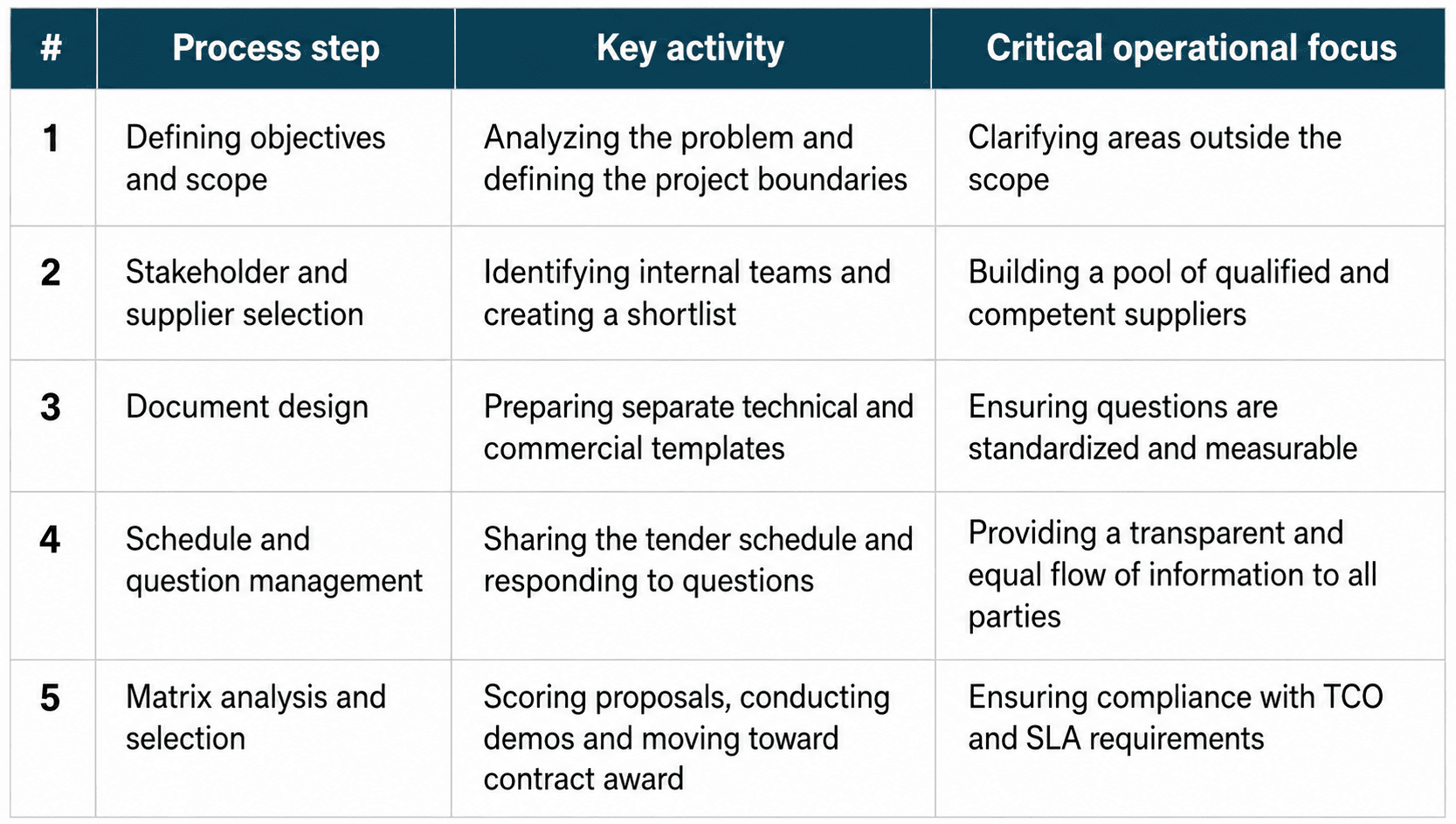
1. Define the need and establish the scope: First, the organizational problem to be solved is clarified and the project boundaries are defined. Locations, deliverables and any areas excluded from the scope are clearly documented. An ambiguous scope can lead suppliers to submit irrelevant proposals based on incorrect assumptions.
2. Identify stakeholders and create a vendor list: The technical, financial and legal decision-makers involved in the process are identified. The shortlist determined through the RFI, or Request for Information, process, or the pool of potential vendors selected through market research, is then added to the system.
3. Separate technical and commercial requirements: One critical rule in the structure of an RFP document is to set out technical requirements, such as solution quality, methodology and team structure, separately from commercial requirements, such as price and payment terms. This allows evaluation teams to score solution quality objectively without being influenced by cost considerations.
4. Define the criteria, timeline and Q&A process: The scoring matrix that will be used to evaluate proposals, as well as the Q&A period and submission deadline, should be clearly communicated. For transparency, questions should be submitted through a single channel, and responses should be shared equally with all bidders.
5. Collect proposals and compare them using the evaluation matrix: Incoming proposals are scored against predefined criteria. After missing documents have been checked, the supplier selection process is finalized through demos, presentations or e-auctions with the highest-scoring firms.
The table below summarizes the chronological management steps of an RFP process from start to finish and the operational focus of each step:
Step-by-step RFP preparation and management process
What information should be included in the RFP document?
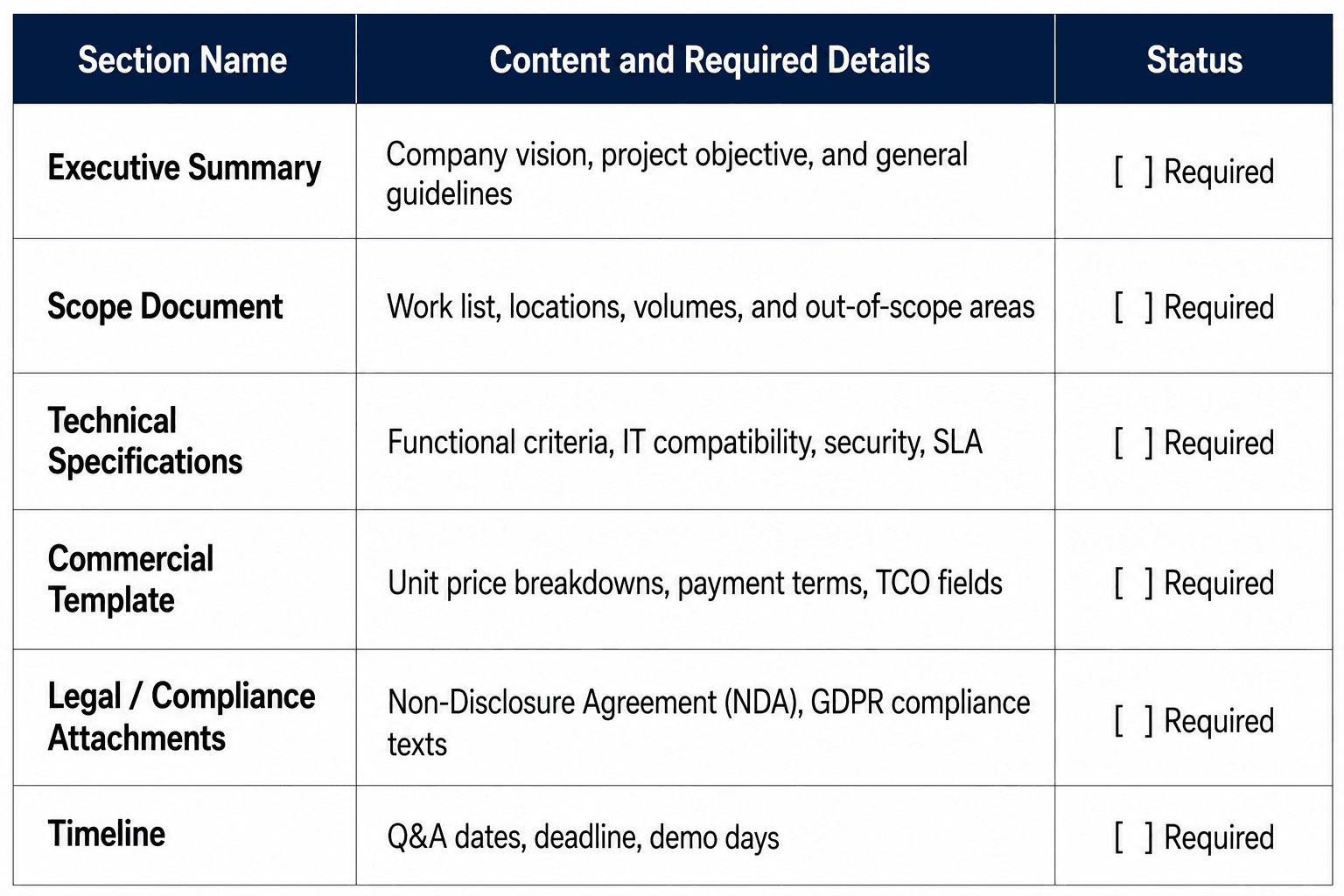
A well-crafted RFP document serves as the cornerstone of a procurement project. The strategic sections that should be included in the document are as follows:
- General information about the company and the project: A company overview, industry dynamics and the project’s primary business objective are summarized to help suppliers understand the context.
- Requirement definition and project scope: Expectations, deliverables, locations where the work will be performed and any areas excluded from the scope are detailed.
- Technical requirements: Functional features, IT integration needs, cybersecurity expectations and SLA terms are outlined in this section.
- Commercial requirements: The pricing model, such as turnkey or license-based pricing, payment terms, payment schedule and bid validity period are clarified.
- Supplier information and references: Financial eligibility documents, success stories from similar projects and the qualifications of the team assigned to the project are requested.
- RFP template and evaluation criteria: The template in which proposals must be submitted and the weighting criteria for scoring are clearly specified.
Sections and checklist for the RFP document
The following checklist provides a template to guide procurement managers in preparing a complete RFP document package:
What are the differences between an RFI, RFP, and RFQ?
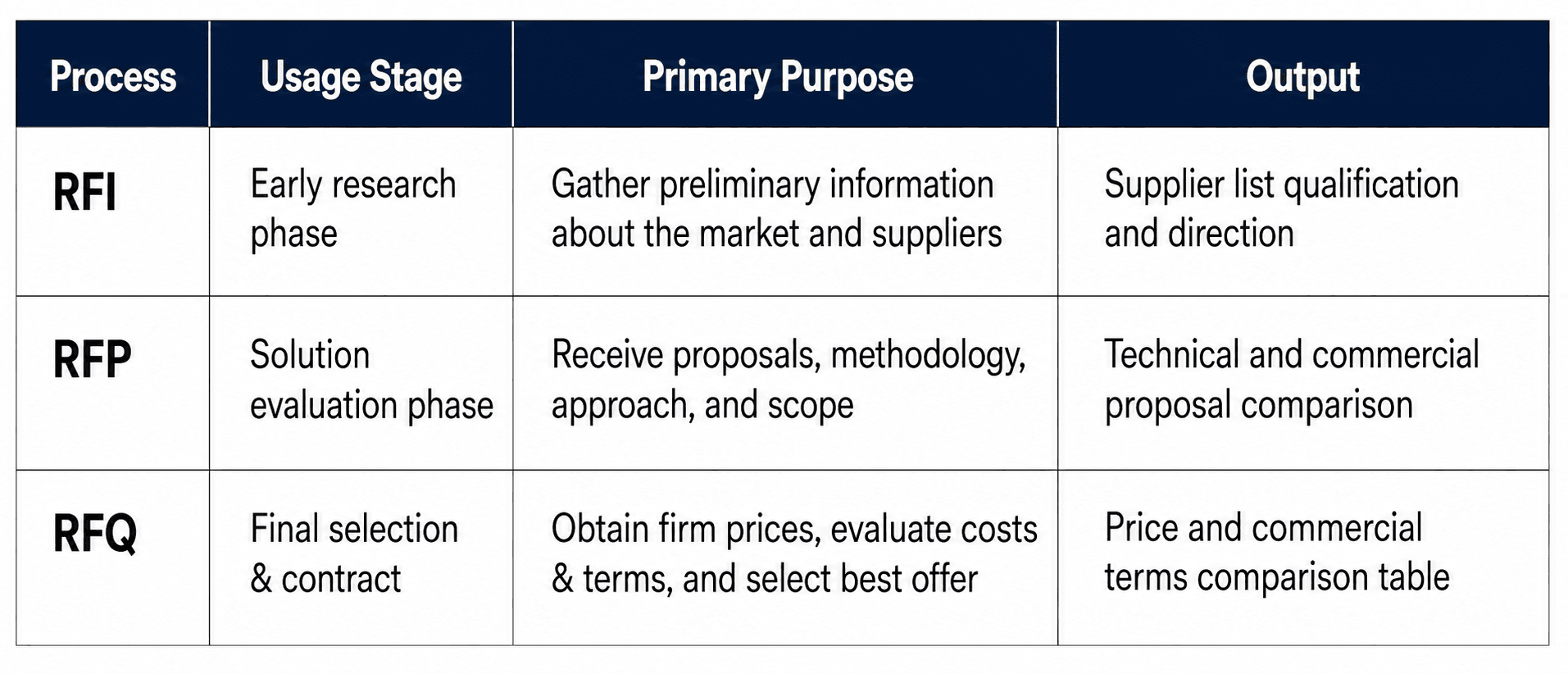
The most common methodological mistake in procurement operations is failing to use RFx processes at the right stage. Each tool serves a different purpose within the procurement cycle. The table below clearly distinguishes the strategic roles of these three core RFx mechanisms:
Comparison matrix of RFI, RFP, and RFQ processes
How are RFP evaluation criteria determined?
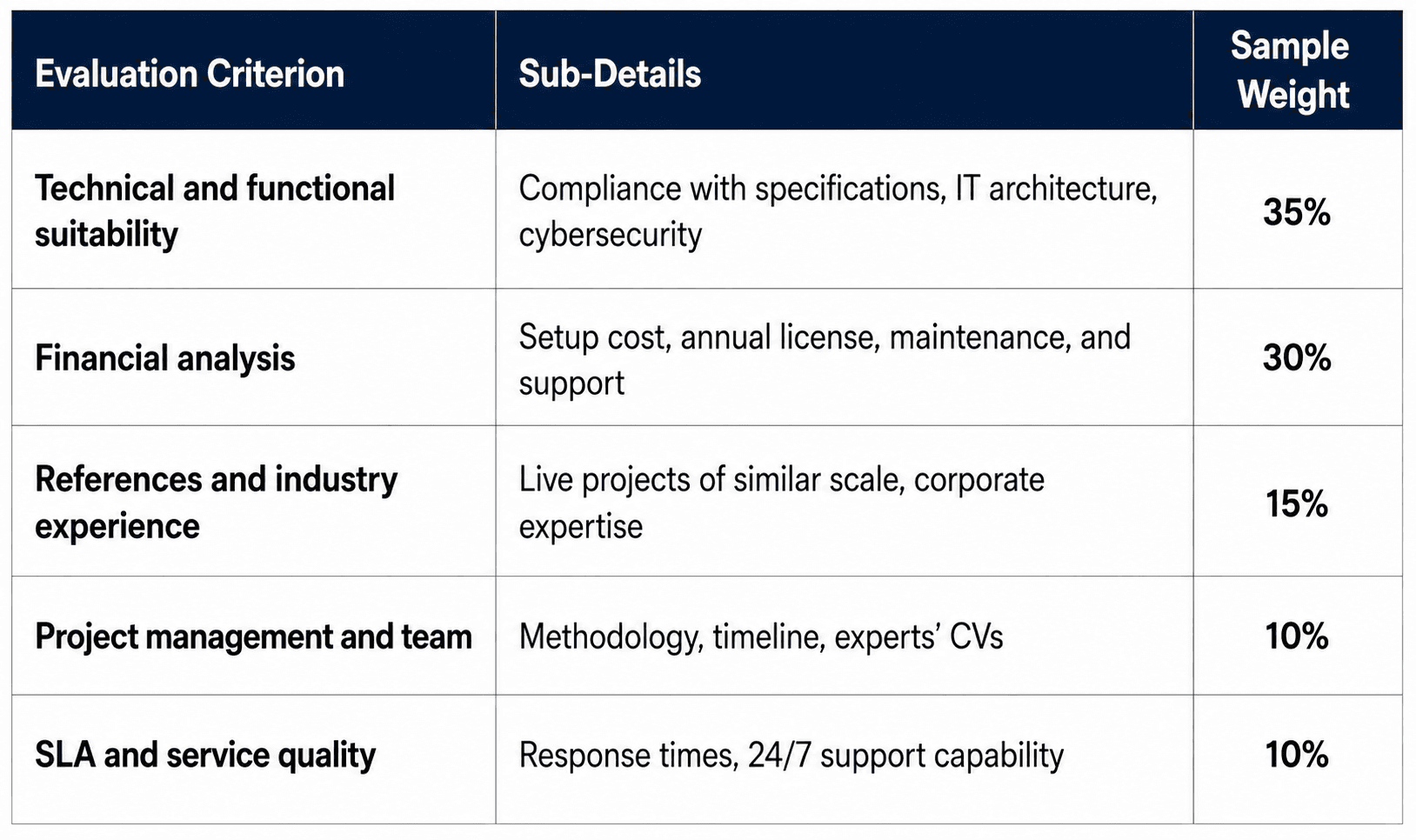
An RFP is not merely a document preparation process; it is also a multi-variable decision-making mechanism. To ensure proposals can be evaluated objectively, the criteria must be established in advance:
- Technical suitability (30–40%): This measures how well the supplier’s solution aligns with the company’s functional needs, IT architecture, cybersecurity protocols and quality standards.
- Price and TCO (25–35%): The comparison is based not only on the initial purchase price, but also on maintenance, support, licensing and hidden operational costs that may arise throughout the project lifecycle.
- Supplier experience and references (15–20%): The company’s track record in the industry, financial stability ratios and verified references from successfully completed projects of a similar scale are reviewed.
- Project plan, timeline and SLA (15–20%): The competence of the team managing the project, the realism of the timeline, the SLA and the customer success management approach are evaluated.
Sample RFP evaluation criteria and weighting matrix
What are the common mistakes made when preparing an RFP?
In real-world business processes, common mistakes made by procurement teams due to lack of experience or cumbersome workflows can lead to project failure:
- Issuing an RFP without clearly defining the need: When internal needs analysis is not conducted properly, suppliers fill in the gaps with their own assumptions. As a result, the procurement team receives proposals that cannot be compared effectively.
- Failing to establish evaluation criteria in advance: If the criteria are not clarified before proposals are received, the evaluation process becomes vulnerable to subjective interpretations and disagreements between internal departments. This, in turn, prolongs the decision-making process.
- Over-specifying the RFP: Excessive detail in the terms of reference can limit the innovative and creative solution proposals that industry experts could bring to the table.
- Failing to standardize the handling of supplier questions and keeping proposals disorganized: Sending the answer to a supplier’s question only to that specific firm undermines transparency. Managing the process through email attachments can also lead to version confusion and data loss.
How can RFP processes be managed more efficiently with Promena?
Selecting the right e-sourcing technology is one of the most critical factors influencing the quality and speed of bid collection processes. As an innovative digital platform offering procurement and supplier solutions, Promena provides professional solutions focused on the end-to-end digitization of e-procurement, supplier management, rapid bid collection, e-auctions and all RFx processes.
Promena’s advanced RFx, or Request for X, and e-auction modules provide organizations with the following strategic benefits in their bid management processes:
- Digitization of preparation and publishing processes: You can easily design your RFPs, technical specifications and commercial breakdowns on Promena, send them to target suppliers with instant notifications and monitor the entire timeline from a central dashboard.
- Standardized format collection: By requiring suppliers to submit bids in the same digital format, Promena eliminates the manual data entry burden on procurement teams. This enables technical and commercial evaluations to be conducted much faster and with fewer errors.
- Advanced comparison and easy evaluation: Experts across different departments can score bids based on their own criteria through Promena. The system automatically analyzes this input according to the relevant weightings and presents the most accurate supplier shortlist in seconds.
- Smooth transition to e-auction or RFQ processes: Thanks to Promena’s integrated structure, companies deemed technically qualified during the RFP phase can be moved to a competitive RFQ process or dynamic e-auction session with a single click.
- Transparency and audit trails: Which supplier was invited when, which bids were received and how bids were evaluated are all recorded through a secure audit trail.
Discover Promena’s consulting-focused solutions to eliminate gray areas in your procurement operations, base supplier decisions on concrete analytical data and manage all bidding processes with digital intelligence that meets global standards. Take the first step toward greater organizational agility and cost savings today.
Frequently asked questions about the RFP process
How much time should suppliers be given in the RFP process?
The timeframe given to suppliers should be determined based on the scope and technical complexity of the project. While 2 to 3 weeks may be sufficient for standard purchases, allowing 4 to 6 weeks for large-scale software or infrastructure projects can support a better outcome by giving suppliers enough time to develop a qualified solution architecture.
Should a demo or presentation be requested during the RFP process?
When procuring experience-based services, such as software, technology or consulting, requesting a demo or live presentation is essential. This makes it possible to assess how well a solution that looks promising on paper aligns with the company’s actual operational needs and user habits.
Should the lowest-priced supplier be selected after the RFP process?
No. The primary purpose of an RFP is to find the right balance between solution quality and commercial terms, rather than focusing solely on price. Decisions based only on price can cost the company much more in the long run due to project failure or hidden costs that emerge during implementation.