

What Is e-Procurement? A Guide to Corporate Procurement
What is e-Procurement? Discover how to digitize corporate procurement processes, reduce costs, and optimize procurement and supplier management.
As technology solutions become fully integrated into the workplace, business processes that were once bureaucratic, repetitive and time-consuming have become simpler, faster and more efficient. In this guide, we explore how e-procurement, one such solution, has streamlined procurement management.
E-procurement solutions streamline procurement management through digital procurement platforms that automate core processes and reduce the operational workload of procurement teams. These tools centralize the manual and bureaucratic aspects of day-to-day procurement, allowing teams to focus more on the company’s strategic objectives.
In this guide, Promena will begin by addressing the question “What is e-procurement?”, before examining in detail how e-procurement systems work, the digital transformation of enterprise procurement processes, and the benefits this transformation brings to companies.
What is e-procurement?
E-procurement is the general term for systems that enable companies to manage procurement processes through digital procurement platforms. The aim is to digitalize procurement activities while establishing a control mechanism that covers the entire procurement process, from generating demand and selecting suppliers to collecting quotes, placing orders and making payments.
Through an e-procurement system, companies can easily track which department submitted a request and for which product or service. They can also maintain records of how many suppliers were invited to tender and the criteria used to select them. This level of transparency significantly simplifies decision-making and risk assessment processes.
Why e-procurement systems matter
Cost is only one aspect of procurement processes; control, transparency and efficiency are equally important. A 2025 study by ProcureAbility and ProcureCon found that 43% of procurement organizations view process efficiency as the top focus area of digital transformation in procurement. This shows that digital procurement tools such as e-procurement are closely linked to the goal of accelerating procurement processes and managing them more effectively.
According to Gartner’s 2025 research , companies using digital procurement platforms benefit from stronger supplier performance tracking and faster decision-making. The digitalization of procurement operations offers a significant advantage, particularly for companies focused on growth and those managing complex operations.
Traditional procurement vs e-procurement
Traditional procurement is often fragmented, with processes heavily dependent on individuals. This increases the risk of data loss and makes consistency more difficult to maintain. E-procurement systems, by contrast, centralize and standardize the entire procurement process on a single digital platform.
The key differences between traditional procurement and e-procurement can be summarized as follows:
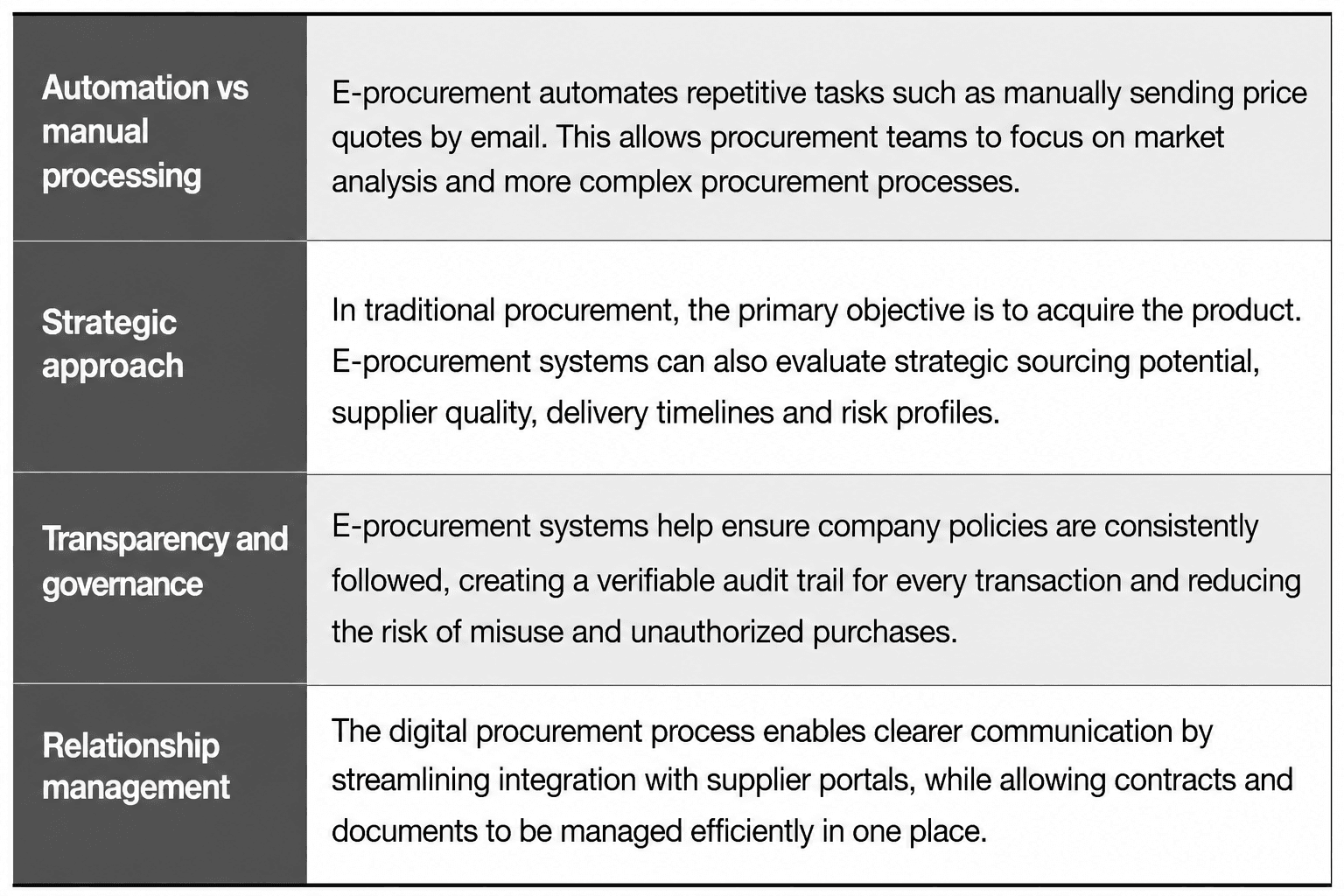
In short, while the traditional approach focuses on completing the purchase transaction, the digital procurement approach manages the entire process and creates a stronger foundation for future procurement activities.
How do corporate procurement processes work?
The procurement process follows a series of defined steps, although in practice there may be feedback loops and revisions along the way. The main stages of the corporate procurement process are as follows:
1.Creating a purchase request
The procurement process begins with a request. A department submits a request through the system for the product or service it requires. At this stage, the request must be clearly defined, as incomplete information can result in inaccurate quotes.
2.Supplier research and tender collection
Once requests have been approved, the supplier search and tender collection process begins.
Key considerations at this stage include:
-
Avoid focusing solely on price
-
Assess the supplier’s past performance
-
Take delivery times and quality into account
3.Tender evaluation and decision-making
When evaluating tenders, e-procurement systems accelerate the process by making data readily available in a format suitable for analysis.
4.Creating a purchase order
Once a decision has been made, a formal purchase order is created. Errors at this stage can affect the entire procurement process, so careful management is essential.
5.Delivery and payment process
At this stage, the ordered product or service is delivered and payment is made. Finance and procurement teams manage this process together. It is important to remember that delays at this stage can negatively affect supplier relationships.
How does e-procurement work?
An e-procurement system manages these processes within a digital environment, making the procurement process faster, more transparent and easier to control. Here are e-procurement process steps:
1. Creating digital purchase requests: Requests are created through the system and forwarded to the relevant parties.
2. Request for Quotation | RFQ process management: Requests for quotations are sent to suppliers and standardized.
3. Supplier quotation management: All quotations are collected, compared and evaluated within the system.
4. Purchase order management: Approved quotations are converted into purchase orders and tracked through the system.
5. Invoice and payment management: Invoice processes are managed digitally and integrated with the company’s existing ERP (Enterprise Resource Planning) and e-procurement systems.
What are the advantages of e-procurement systems?
The benefits of e-procurement systems extend beyond streamlining procurement processes. They have a direct impact on financial control, operational efficiency, supplier relationships and strategic decision-making.
1.Improved cost control
E-procurement systems digitally record and analyze expenditure across the procurement process. This allows companies to clearly track how much of the budget has been allocated to specific products or services. Historical procurement data can also be used to monitor cost trends and minimize unnecessary expenditure.
Deloitte’s 2025 Global CPO Survey shows that investments in digital procurement deliver more than cost savings alone, creating measurable value in terms of return on investment (ROI). According to the report, companies classified as “Digital Masters” achieve an average return of 3.2 times on investments in artificial intelligence and digital tools, while meeting procurement digitalization targets at high rates across their cost-saving and cost-avoidance plans.
2.Faster process management
With e-procurement, requests, approvals and purchase orders can be processed much more quickly through a digital procurement platform. Approval and verification stages that may take days in manual procurement processes can be completed within hours through automated workflows. This speed can provide a significant competitive advantage, particularly when responding to urgent requirements.
3.Greater transparency in supplier relationships
The system continuously monitors and records supplier performance. Data such as delivery times, quality scores and previous work history is consolidated on a single platform. This supports more informed supplier selection and helps reduce disputes.
4.Data analytics and reporting
E-procurement systems support strategic decision-making through procurement analytics and reporting tools that analyze historical data. Information such as which suppliers offer better value for specific products, or during which periods expenditure increases, can be reflected directly in management reports. This data-driven approach helps companies plan more effectively and optimize procurement management strategies.
Today, many e-procurement systems also use artificial intelligence (AI) technologies to optimize processes and accelerate decision-making. According to Gartner’s Future of Supply Chain 2026 research , approximately 72% of global supply chain organizations have integrated generative AI (GenAI) technologies into their operations, highlighting the growing scale of digital transformation in procurement and supply chains.
Key components of e-procurement systems
- Supplier management in e-procurement: The system continuously monitors supplier performance and generates reports. This enables supplier management decisions to be based not only on price, but also on criteria such as quality and reliability.
- Contract management: All contracts are stored digitally, making them easier to monitor and manage. Reminders for renewal dates, payment terms and special agreements are handled through the system.
- Purchase request management: Requests from departments are created through the system and routed to the relevant approval workflows. This improves both the accuracy and traceability of requests.
- Order management: Approved requests are converted into purchase orders and tracked through a central purchase order management system. This reduces the risk of errors and data loss throughout the procurement process.
- Reporting and analytics: The system supports strategic decision-making through procurement analytics and reporting capabilities. Insights such as which products are in higher demand and which suppliers deliver stronger performance are reflected in management reports.
The difference between ERP and e-procurement systems
While ERP systems provide a comprehensive framework covering all areas of a company’s operations, e-procurement systems focus specifically on procurement management and procurement processes. ERP and e-procurement integration enables a seamless flow of data and more reliable analytics. For example, this integration supports accurate, real-time stock management and financial reporting.
How can procurement processes be digitalized in companies?
- Analysis of existing processes: The company’s current procurement processes are first examined in detail. Shortcomings, risks and manual steps prone to human error are identified.
- Selection of the right e-procurement software: Procurement software suited to the company’s needs is selected by evaluating factors such as user numbers, integration capabilities and reporting features.
- System integration and infrastructure setup: The selected e-procurement system is integrated with existing ERP and other business systems. Data migration, user permissions and automated notifications are configured.
- Team training and adaptation: Employees adapt to the new system through training on processes, correct system usage and best practices. This stage is critical to the successful completion of digital transformation in procurement.
Points to consider when using e-procurement systems
- Data security: All sensitive information should be protected through secure servers and encryption methods. Regular audits should also be conducted to reduce the risk of system failures or cyber-attacks.
- Supplier adaptation: Suppliers must integrate with the new e-procurement system and adopt digital tendering processes. Supplier compliance is essential for procurement processes to operate effectively.
- System scalability: As the company grows, the system’s capacity and modules should be able to expand accordingly. Scalability increases the long-term value of the investment.
- User experience: The system should be user-friendly, with an intuitive interface and clear navigation. Platforms with poor user experience can disrupt procurement management processes.
The Importance of Digitalization in Corporate Procurement Processes
As this guide has shown, the digitalization of procurement processes is both an operational improvement and a strategic step for companies. Today, e-procurement systems have become a necessity rather than an option for many businesses.
Promena provides a practical and scalable solution for companies looking to manage digital transformation in procurement in a more controlled and sustainable way. Companies seeking to make procurement processes more efficient, transparent and data-driven can take their first step into digital procurement with Promena’s e-procurement solutions.
Frequently asked questions about e-procurement
What is e-procurement?
E-procurement systems manage every stage of the procurement process, from purchase request creation through to payment, on a single digital procurement platform.
What is an e-procurement system used for?
An e-procurement system automates procurement processes, saves time and reduces the risk of errors.
What are the benefits of an e-procurement system?
E-procurement system benefits include cost savings, procurement automation, greater transparency, procurement analytics and reporting, and improved supplier management.
How to digitalize procurement processes?
Companies can digitalize procurement processes through process analysis, selecting the right procurement automation software, ERP and e-procurement integration, and staff training.