

Data Privacy and Security Guide for Procurement Processes
Learn how to ensure compliance with Turkey's Personal Data Protection Law (KVKK) in procurement processes. Explore best practices for protecting procurement data, strengthening data security, and meeting legal compliance requirements.
In digital supply chains, data has become just as valuable as the products and services being procured. Failing to manage that data properly can lead not only to significant regulatory penalties, but also to long-term reputational damage. In this article, we explore how companies can strengthen data security in procurement processes, maintain compliance with legal regulations and turn secure procurement processes into a competitive advantage.
As digital transformation reshapes procurement into an increasingly data-driven function, data protection is no longer solely the responsibility of IT departments; it has become a shared priority across all strategic business functions. Companies managing supplier networks and global procurement operations routinely process a wide range of sensitive information, from personal identifiers and financial records to trade secrets and employee data. Under Türkiye’s Personal Data Protection Law No. 6698 (KVKK), managing this data has evolved beyond a legal obligation to become a matter of corporate trust and reputation. In this article, Promena explores how companies can maintain KVKK compliance in procurement processes, strengthen procurement data security and address the legal and operational challenges of digital procurement security.
Why is data security important in procurement processes?
Procurement departments are among the most externally connected functions within a company. Relationships with hundreds of suppliers, proposals exchanged through digital platforms and contracts shared across multiple parties make procurement operations a major target for cyber threats.
Weak data security in procurement processes can lead not only to regulatory penalties, but also to operational disruption, reputational damage and loss of competitive advantage. As cyber espionage and data theft continue to increase, procurement data such as pricing strategies, supplier portfolios and commercial terms have become highly sensitive corporate assets.
A company’s ability to maintain operational continuity, protect commercially sensitive information and preserve stakeholder trust depends directly on the strength of its procurement cybersecurity and data protection policies. In the event of a data breach, the impact often extends beyond the company’s own systems to affect suppliers, business partners and third-party networks. This can trigger long-term legal disputes, supplier disruption and significant reputational damage across the supply chain.
What is the KVKK law and how does it affect procurement processes?
KVKK, or the Personal Data Protection Law No. 6698, is designed to protect individuals’ fundamental rights and freedoms, particularly the right to privacy, during the processing of personal data. For procurement teams, this means that any information capable of identifying a natural person—from supplier contact details to CV information shared during consulting procurements—must be processed in accordance with strict legal requirements. While the law imposes significant obligations on companies acting as data controllers or data processors, it also grants individuals greater control over how their personal data is used. Compliance with personal data protection in procurement processes is based on several core principles:
- Data minimization: Companies should collect only the data strictly necessary for the procurement process and avoid retaining unnecessary personal information.
- Transparency and disclosure: All individuals whose data is processed must be clearly informed about why their data is being collected, how it will be used and how it will be protected.
- Limited purpose and retention period: Personal data should be stored only for the specific purpose for which it was collected and retained only for as long as necessary before being securely deleted or destroyed.
- Clear legal responsibility: Within procurement and supplier relationships, it must be clearly defined which party acts as the data controller, and which acts as the data processor to ensure proper data processing compliance and accountability.
The importance of KVKK compliance and data security in procurement processes
Compliance with the Personal Data Protection Law (‘KVKK’) does more than protect companies from administrative fines and regulatory sanctions. It is also a core component of corporate governance, procurement compliance and modern business management. A compliant procurement process enables companies to maintain a clear data inventory, eliminate unnecessary or high-risk data and improve operational efficiency through stronger data management practices. In addition, secure procurement processes and robust data protection standards are increasingly essential for companies operating in international markets.
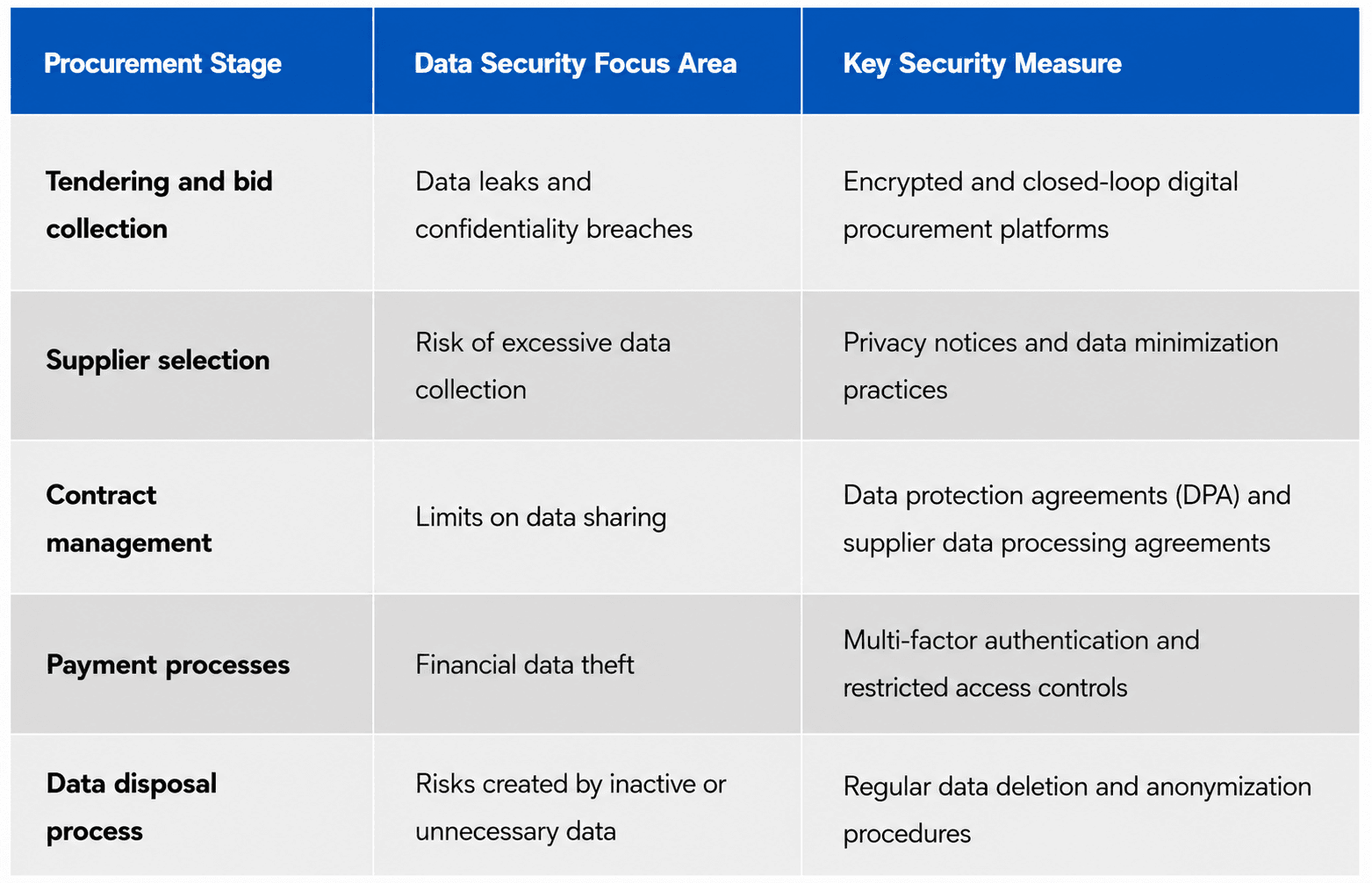
The table below outlines how procurement data security and personal data protection in procurement should be managed across different stages of the procurement process:
Key data security risks in procurement processes
While digital transformation has accelerated procurement operations, it has also increased the complexity of data security risks. Procurement departments, as one of the most data-intensive functions within an organization, have become a primary target for cyberattacks and unauthorized access attempts.
Data leaks and unauthorized access
Collecting proposals through unsecured email channels, storing sensitive information in unencrypted files or failing to revoke former employees’ access rights promptly are among the most common procurement cybersecurity vulnerabilities. These breaches can lead not only to regulatory penalties, but also to the exposure of commercially sensitive strategies and supplier information.
Supplier-related risks and third-party exposure
Internal systems alone cannot guarantee secure procurement processes. The level of supplier data security maintained by external vendors and business partners directly affects the organization’s own risk profile. If third-party data security controls are weak, a cyber incident affecting a supplier can quickly become a legal, operational and reputational issue for the company itself. For this reason, supplier audits and supplier data processing agreements are a critical part of procurement compliance and personal data protection strategies.
How can KVKK-compliant data management be ensured?
Maintaining compliance requires a combination of technical, administrative and legal measures. To establish secure and compliant procurement processes, companies should focus on the following steps:
Data processing policies and data inventory management
The first step is to create a detailed data inventory specific to procurement operations. Companies must clearly define what data is collected, why it is processed, who it is shared with and how long it will be retained. Once identified, data should be classified according to risk levels, forming the basis of a broader procurement data security and data processing compliance policy.
Protective clauses in supplier agreements
All procurement and supplier agreements should include provisions covering KVKK compliance, personal data protection and supplier data processing obligations. Companies should ensure that suppliers process shared data only for approved business purposes and implement the necessary technical and organizational safeguards to protect that data. Where necessary, supplier data processing agreements and separate data protection agreements (DPA) should also be incorporated into procurement contracts.
Access controls and role-based authorization
Employees should only have access to the data required to perform their specific responsibilities. Through role-based access management, access to financial records, supplier information and personnel data can be restricted to authorized individuals, reducing the risk of internal data leaks and unauthorized processing.
Security standards in digital procurement systems
Maintaining data security through manual methods such as paper archives or fragmented email chains is increasingly unsustainable. Modern digital procurement systems are built around secure procurement processes and advanced data protection standards. Many of these platforms align with internationally recognized frameworks such as ISO 27001 Information Security Management Systems and use strong encryption protocols to protect data both in storage and during transmission.
Additional security advantages provided by digital procurement platforms include the following:
1. Advanced audit trails: Every action performed within the system—including viewing, editing or deleting data—is logged together with detailed user activity records. This strengthens procurement compliance, accountability and traceability.
2. Automated data deletion processes: Data that exceeds its legal retention period can be automatically identified, archived or securely deleted in line with personal data protection and data minimization requirements.
3. Secure cloud infrastructure: Unlike physical archives, digital procurement security platforms store information on protected and redundant cloud servers designed to withstand cyberattacks, system failures and physical disruptions.
Data analytics in procurement processes and global trends
Investment in procurement cybersecurity and data protection delivers value far beyond reducing the impact of a potential breach. Strong data security frameworks also contribute directly to operational efficiency, resilience and long-term profitability. Companies that approach digital transformation not simply as a technology upgrade, but as part of a broader risk management culture, are generally better positioned to manage operational and financial disruption.
According to the 2025 Cost of a Data Breach report published by IBM and the Ponemon Institute, organizations that make extensive use of artificial intelligence and automation in their security operations reduce the average cost of a data breach by approximately $1.9 million compared to organizations that do not use these technologies.
The report also highlights a major concern for data-intensive functions such as procurement: 97% of organizations experiencing AI-related security incidents report weaknesses in access control mechanisms. This reinforces the importance of role-based access management, secure procurement processes and digital procurement security as core components of procurement compliance and personal data protection strategies.
Sustainable data governance and audit strategies
Turning KVKK and data privacy compliance into a sustainable operational framework—rather than a policy that exists only on paper—requires regular and effective audit mechanisms. These audits should assess not only the data processing practices and awareness levels of internal teams, but also the extent to which suppliers and external stakeholders comply with their own data protection obligations. Responsibility for personal data protection does not end once a contract is signed; it continues throughout the entire lifecycle of data processing activities.
As a result, supplier due diligence can no longer focus solely on financial capability or operational performance. In modern procurement compliance processes, a supplier’s cybersecurity maturity, data protection policies, historical breach records and overall security standards are now equally important evaluation criteria. In projects involving sensitive or high-risk personal data, requesting independent audit reports, ISO 27001 certifications or equivalent security credentials from suppliers should increasingly be treated as a standard procurement requirement.
This proactive approach strengthens not only the company’s own internal defenses, but also the broader security and resilience of the supplier ecosystem and third-party network.
The growing scale of cybersecurity threats and third-party risks in supply chains
The Verizon 2025 Data Breach Investigations Report (DBIR) , one of the most widely referenced studies in cybersecurity, highlights why third-party data security and data protection in supply chain have become critical business priorities. According to the report, 15% of data breaches over the past year involved third parties such as suppliers or business partners, representing a doubling compared to the previous year. This increase reflects a growing trend in which attackers target weaker suppliers or service providers to gain indirect access to larger organizations and disrupt entire operational ecosystems.
The same report also identified a 180% year-on-year increase in breaches caused by the exploitation of security vulnerabilities during initial system access. For procurement departments, this means that every software provider, supplier or digital procurement partner potentially becomes part of the company’s broader defense perimeter. Weak procurement cybersecurity practices within third-party networks can therefore create serious operational, legal and reputational risks.
Verizon’s findings also reinforce the importance of moving beyond contract-based trust alone. Organizations are increasingly encouraged to adopt zero-trust security principles, applying strict identity verification, access controls and continuous monitoring to supplier and third-party access within procurement systems and digital supply chains.
Frequently Asked Questions About the KVKK and data security
Is compliance with the Personal Data Protection Law (KVKK) mandatory in the procurement department?
Yes. All companies operating in Türkiye that process personal data are legally required to ensure that procurement processes comply with Personal Data Protection Law No. 6698 and broader data processing compliance requirements.
Is information relating to supplier representatives considered personal data?
Yes. Information such as names, business email addresses and phone numbers belonging to supplier representatives is classified as personal data. The collection, storage and processing of this information therefore falls under personal data protection regulations.
Why are manual procurement processes risky for data security?
Manual processes make it extremely difficult to monitor who accesses, copies or shares sensitive information transmitted through paper documents, spreadsheets or email chains. This significantly increases the risk of unauthorized access, data leaks and procurement cybersecurity incidents.
Are cloud-based procurement systems secure?
Well-designed cloud-based procurement systems typically provide stronger digital procurement security than fragmented physical infrastructure. Advanced encryption, continuous security updates and centralized monitoring capabilities help create more resilient protection against cyber threats and data breaches.