

What Is an RFI? When and Why Is It Used?
Learn what a Request for Information (RFI) is, when it is used in procurement and supplier evaluation processes, and how it differs from an RFP and an RFQ.
Modern procurement management is built on reducing uncertainty and making data-driven decisions. Procurement departments are no longer simply responsible for meeting operational needs; they have become strategic decision-making functions that directly affect a company’s profitability. One of the most critical building blocks of this transformation is the information-gathering process used in the early stages of the procurement cycle.
In traditional methods, tenders launched without prior market research lead to wasted time and operational risks. The most critical tool used to prevent this confusion, understand the market structure, and properly prepare for subsequent bidding processes is the RFI meaning “Request for Information” document. In this guide, Promena explores the concept of an RFI in procurement, when and why it should be used, and how to streamline this process using digital platforms.
What is an RFI?
RFI stands for “Request for Information.” An RFI is a corporate document used in procurement processes to gather preliminary information from potential suppliers about their products, services, capacity, experience, certifications, references and technical capabilities.
An RFI is typically used in the early stages of the procurement process to collect information on supplier capacity, product or service specifications, technical expertise, certifications and market conditions. It enables procurement teams to gather and analyze supplier data in a standardized format and create a market map based on tangible data.
When is an RFI used?
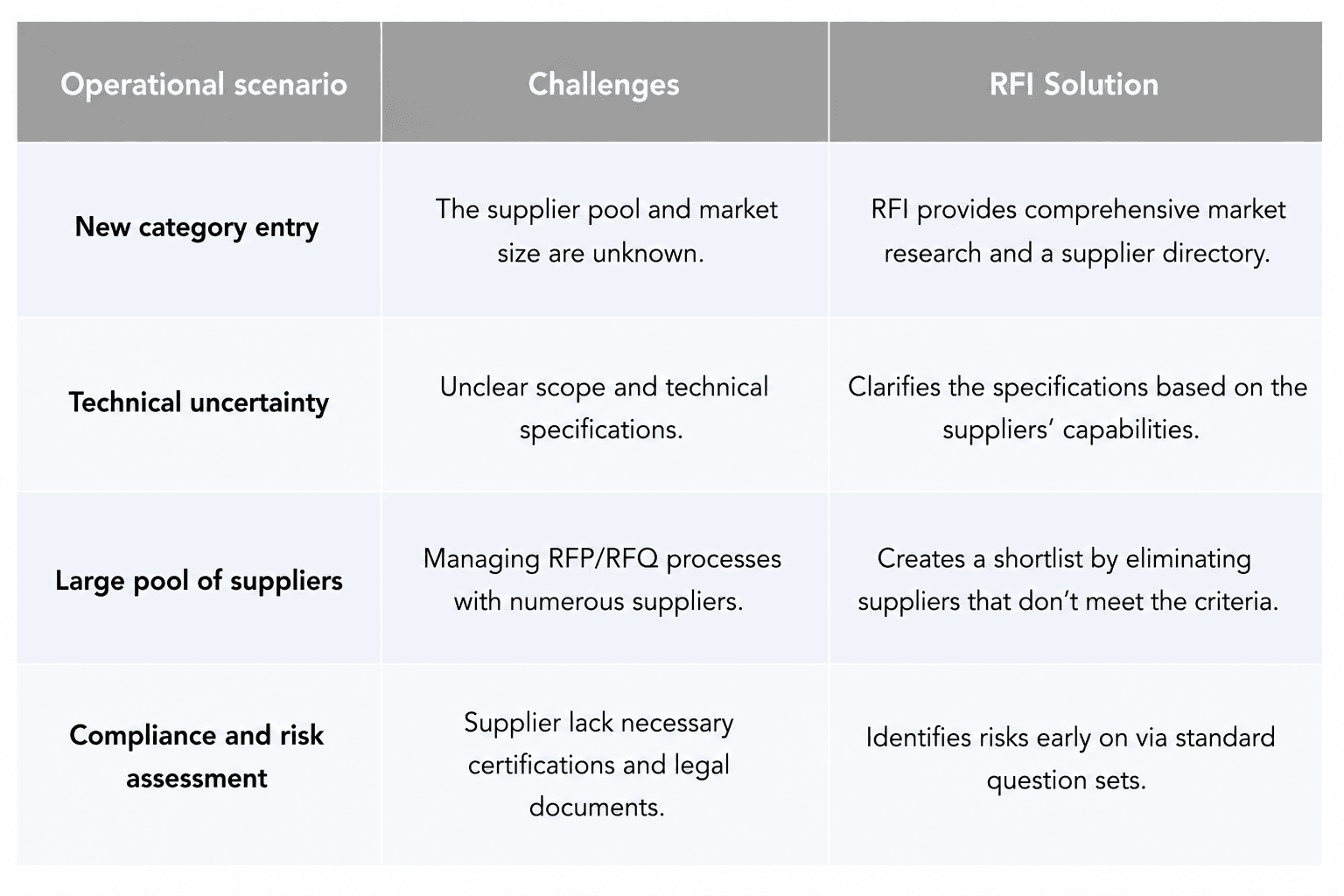
An RFI process does not need to be implemented in every procurement project. However, it is a critical method when certain operational uncertainties are present.
- When there is insufficient information about the market or supplier pool: When a company plans to procure a new product or service category, it may not yet be familiar with the relevant market dynamics. In this scenario, an RFI gives procurement teams clearer market visibility.
- If the need is not yet fully defined: If the business need is known in general terms, but the technical scope, service model or available technological alternatives are not yet clear, an RFI can be issued to understand suppliers’ innovative approaches and lay the groundwork for the technical specifications.
- If a preliminary evaluation is required: In markets with hundreds of suppliers, requesting detailed quotes from every company can create a cumbersome process. An RFI in procurement is used to filter suppliers and create a shortlist before moving on to more detailed Request for Proposal (RFP) or Request for Quotation (RFQ) processes.
Scenarios where an RFI can be successfully deployed
Why use an RFI?
When procurement teams dedicate time to the RFI process, it can provide the company with significant strategic and financial advantages in the long term.
- A more accurate procurement strategy: Responses from suppliers reveal the market’s actual capacity and trends. Based on this data, the procurement team can build its budget planning on much more realistic foundations.
- Expanding the supplier pool: An RFI provides an opportunity to discover not only familiar suppliers already registered in the company’s existing system, but also new, innovative and more competitive potential suppliers in the market.
- Identifying risks early on: Risks such as insufficient supplier production capacity, lack of legal compliance or missing quality certifications can be identified before the pricing phase begins.
- Efficiency in RFP and RFQ processes: Thanks to the refined information gathered through the RFI, the RFP or RFQ documents issued in the next phase can have a much clearer scope and an optimized bidder list consisting only of suppliers qualified to perform the work.
How does the RFI process work?
The procurement RFI process typically consists of the following steps: identifying the area of need or research, sending a standard set of questions to suppliers, collecting responses, comparing the information and shortlisting suitable suppliers.
- Defining the scope: The process begins with the procurement team identifying the specific area where information is needed. The scope of the RFI is limited to a particular product group or project.
- Preparing the questionnaire: The only way to ensure a fair and measurable evaluation is to ask all candidates the same questions. Yes/no or multiple-choice formats can be used to make responses easier to analyze.
- Comparing responses: Once the specified timeframe has elapsed, the forms submitted by suppliers are collected. All responses are then analyzed against predefined key performance indicators (KPIs).
- Shortlisting: A shortlist is created by identifying the suppliers that successfully meet the evaluation criteria. This list serves as the official list of candidates to be invited to the next phase, which may involve the technical solution (RFP) or pricing (RFQ) process.
RFI process steps and success criteria
What information should be included in an RFI document?
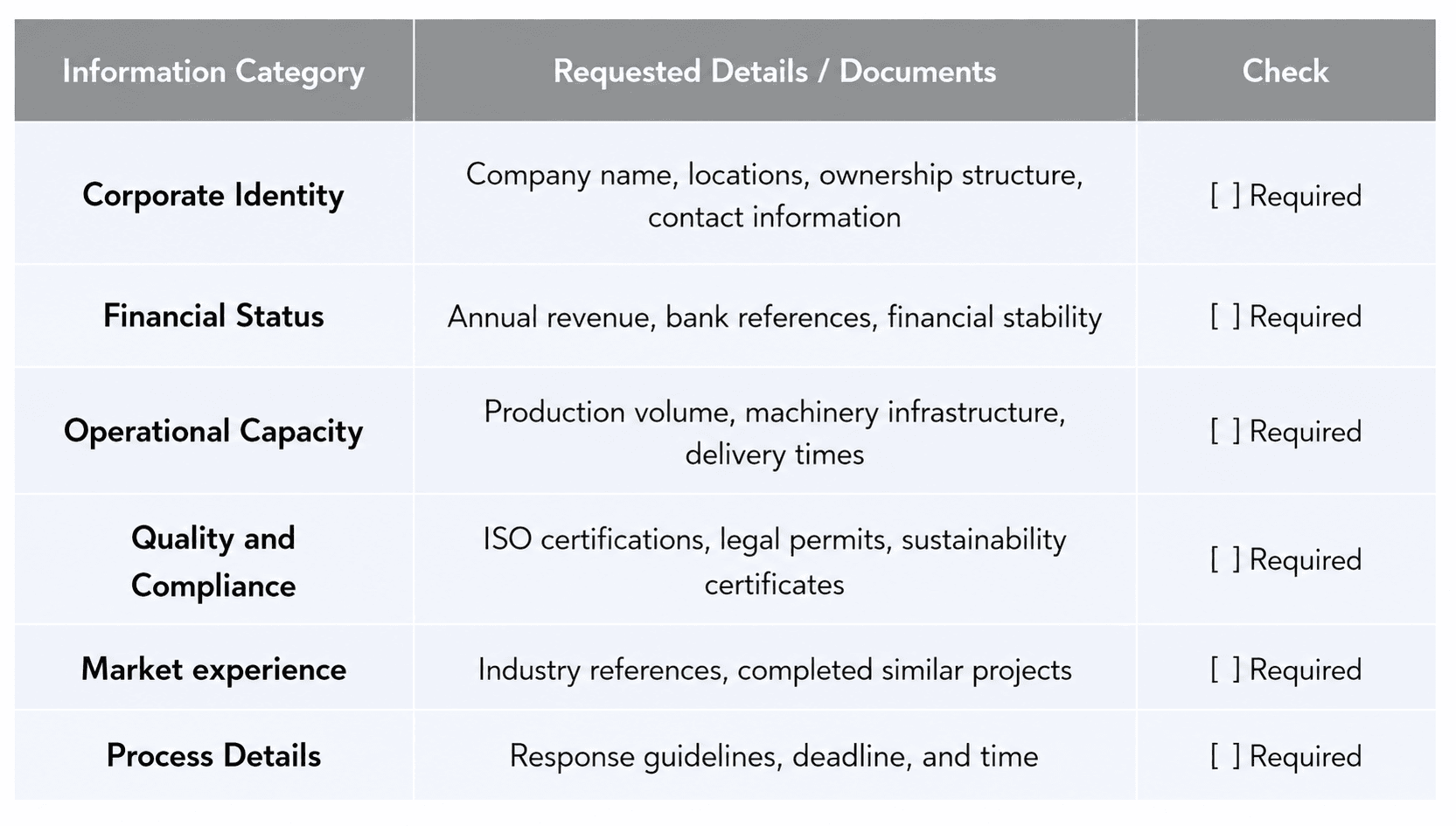
The quality of an RFI document directly determines the quality of the responses received from suppliers. The essential components that should be included in the document are as follows:
- Brief information about the company and the project: A short text outlining the overall vision and scope of the planned project should be included to ensure suppliers fully understand the context.
- Basic supplier information: This includes the supplier’s name, year of establishment, locations, revenue and contact details for the primary point of contact
- Technical and operational capability questions: These questions assess production or service capacity, technological infrastructure, delivery model and support capabilities.
- Compliance, certification and reference information: Legal compliance documents, ISO quality certificates, sustainability certifications and industry references should be requested.
- Response format and deadline: The digital channel suppliers should use to complete the form, together with the exact closing date and time, must be clearly specified.
Information and Checklist Required in the RFI Document
What are the key differences between an RFI, RFP, and RFQ?
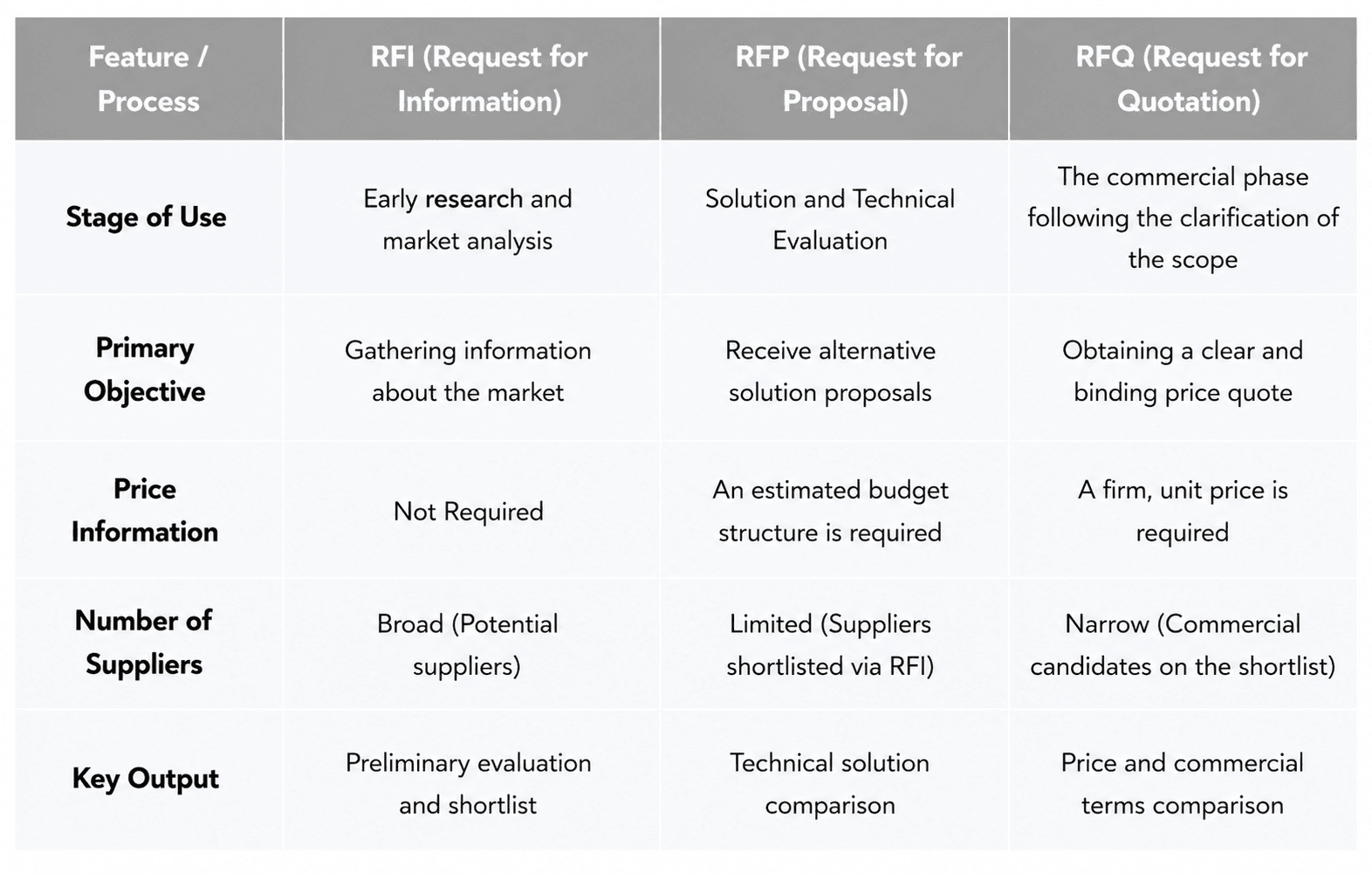
One of the most common mistakes in procurement is using the terms RFI, RFP and RFQ, which together form part of the RFx process, interchangeably. Each term relates to a different stage and purpose within the procurement cycle.
-
The difference between an RFI and an RFP: An RFI is used to gather general market information and pre-screen suppliers. It is not focused on pricing or detailed solutions. An RFP, or Request for Proposal, is used to request solution proposals and technical approaches from suppliers for a clearly defined problem.
-
The difference between an RFI and an RFQ: A procurement RFI is not a price-focused document, and a binding cost breakdown is not required at this stage. An RFQ, or Request for Quotation, is used to collect clear and binding price quotes for a product or service where the technical specifications, quantity and logistical details have been fully finalized.
Comparison Matrix of RFI, RFP, and RFQ Processes
What should be considered when preparing an RFI?
For an RFI process to deliver effective results, the objective must be clearly defined. RFIs prepared without a clear objective can lead to scattered and irrelevant responses from suppliers. The same standard questions should also be asked of all suppliers without exception, and responses should be collected in a comparable format. It is important to remember that an RFI is not an RFP or an RFQ; unnecessary details and price requests should therefore be avoided.
The most common mistake in this process is confusing an RFI with an RFQ. Requesting a detailed price quote during the RFI phase can lead suppliers to provide inaccurate prices, as the specifications have not yet been finalized. Another mistake is issuing an RFI without first establishing evaluation criteria. Without predefined screening criteria, responses cannot be compared objectively. Finally, conducting the process via email attachments can lead to data loss, so supplier responses should be stored centrally.
How is the RFI process managed on digital platforms?
Global procurement research shows that forward-looking procurement departments have set an ambitious course to increase operational agility and aim to digitalize 70% of their processes by 2027. As with almost every business process, RFI processes managed through traditional methods such as email and manual spreadsheets can eventually become a significant operational burden for procurement teams. Digital procurement and e-sourcing platforms eliminate this complexity by offering:
- Standardized question sets: Category-specific RFI question templates can be created on digital platforms and sent to suppliers in seconds.
- Centralized collection: All supplier responses and corporate documents are collected in a single, cloud-based central system, preventing version confusion.
- Systematic shortlisting: The system automatically scores incoming responses based on predefined criteria and lists the most suitable candidates.
- Traceability and transparency: A digital audit trail records which supplier responded and when.
- Integration: The information obtained from the RFI forms the basis for subsequent RFP, RFQ or e-auction processes, linking the processes together.
How does Promena make RFI processes more efficient?
Using the right e-sourcing technology is key to balancing the procedural requirements of procurement with the agility enabled by digitalization. As an innovative digital platform offering procurement and supplier solutions, Promena provides professional solutions focused on the end-to-end digitalization of e-procurement, supplier management, rapid quote collection, e-auctions and all RFx processes.
Promena’s advanced infrastructure provides organizations with the following strategic benefits in their RFI processes:
- Process digitalization: You can easily design your RFI documents digitally on Promena, send them to target supplier groups and ensure that all responses are collected in a secure cloud ecosystem.
- Comparable response management: By requiring suppliers to enter data in the same standard format, Promena eliminates the burden of manual sorting and creates an objective evaluation environment.
- Smooth process transition: Thanks to Promina’s modular structure, the supplier shortlist created at the end of the RFI process can be transferred with a single click and used as the basis for subsequent RFP, RFQ or e-auction processes.
- Process traceability: Promena provides a transparent tracking environment by integrating supplier performance history and RFI responses into your corporate memory.
Discover Promena’s expert solutions to eliminate uncertainty in your procurement operations and manage supplier relationships with digital intelligence; start benefiting from increased efficiency today.
Frequently Asked Questions about the RFI Process
Are RFI responses sufficient on their own for supplier selection?
No, RFI responses are not sufficient on their own. The primary purpose of an RFI is not to select a supplier directly or sign a contract, but to gather information about the market and create a shortlist of qualified companies capable of performing the work. Final supplier selection is made through subsequent RFP or RFQ processes.
Should price information be requested during the RFI process?
A firm and binding price quote should not be requested during the RFI phase. However, non-binding estimated budget ranges may be requested to help the procurement team with budget planning.
How many suppliers should an RFI be sent to?
There is no strict upper limit on the number of suppliers during the market research phase. To ensure that alternative solutions are not overlooked, it can be useful to send the RFI to as broad a pool of potential suppliers as possible. This is typically 10 to 20 companies that broadly meet the criteria, although the number may vary depending on the scope of the project.
How can supplier responses be scored during the RFI process?
To score responses objectively, a weighted scoring matrix should be created before the RFI is issued. For example, responses may be scored using a framework where technical capacity accounts for 40%, certifications for 30% and industry references for 30%.
What issues may arise if the RFI process is not conducted digitally?
When the process is managed manually via email, it becomes difficult to compare information because suppliers submit responses in different formats. Documents may be lost, version confusion can arise and institutional knowledge may not be retained.