

What Is Contract Management? A Guide to the Contract Lifecycle
What is contract management? Learn what you need to know about the contract lifecycle, risk management, and best practices for managing enterprise contract processes more efficiently.
Corporate contracts need to be actively managed, not simply signed and filed away. Research shows that poorly managed contract processes can lead to significant revenue losses for companies. In this article, we explore how businesses can turn contracts into tools for profitability, compliance and operational security through effective contract lifecycle management, contract risk management and digital contract management solutions.
Every new business partnership, raw material purchase or service agreement is built on a legal commitment. Yet for many companies, the real challenge begins after the contract is signed. Contracts are not static documents that can simply be stored away; they are living frameworks that directly affect cash flow, operational continuity and corporate reputation.
As regulatory requirements and commercial relationships become more complex, a “sign and forget” approach to contracts exposes companies to significant financial and operational risks. In this guide, Promena explores what contract management involves and explains how contract lifecycle management (CLM) processes can help businesses strengthen compliance, reduce risk and improve operational control.
What is Contract Management?
Contract management is the strategic oversight of every stage of a contract, from initial drafting through to execution, renewal and archiving. It covers all written agreements an organization establishes with suppliers, business partners, customers and employees. Contrary to common assumptions, contract management involves far more than preparing legal documents. It is a cross-functional management process that brings together departments such as operations, finance, procurement, supply chain and risk management.
From a corporate perspective, contract management ensures both the effective monitoring of a company’s contractual obligations and the enforcement of commitments made by the other party. A well-structured contract management system transforms complex legal language into clearly defined business objectives, helping organizations improve coordination, reduce risk and strengthen operational efficiency.
Contract Management is more than just record keeping
When contracts are signed and simply stored away, businesses often begin to experience hidden financial and operational losses. Poorly managed contract processes can lead to missed deadlines, compliance failures, operational disruptions and overlooked commercial opportunities. Effective contract management helps prevent these losses by transforming contracts from static records into active tools for value creation and risk control.
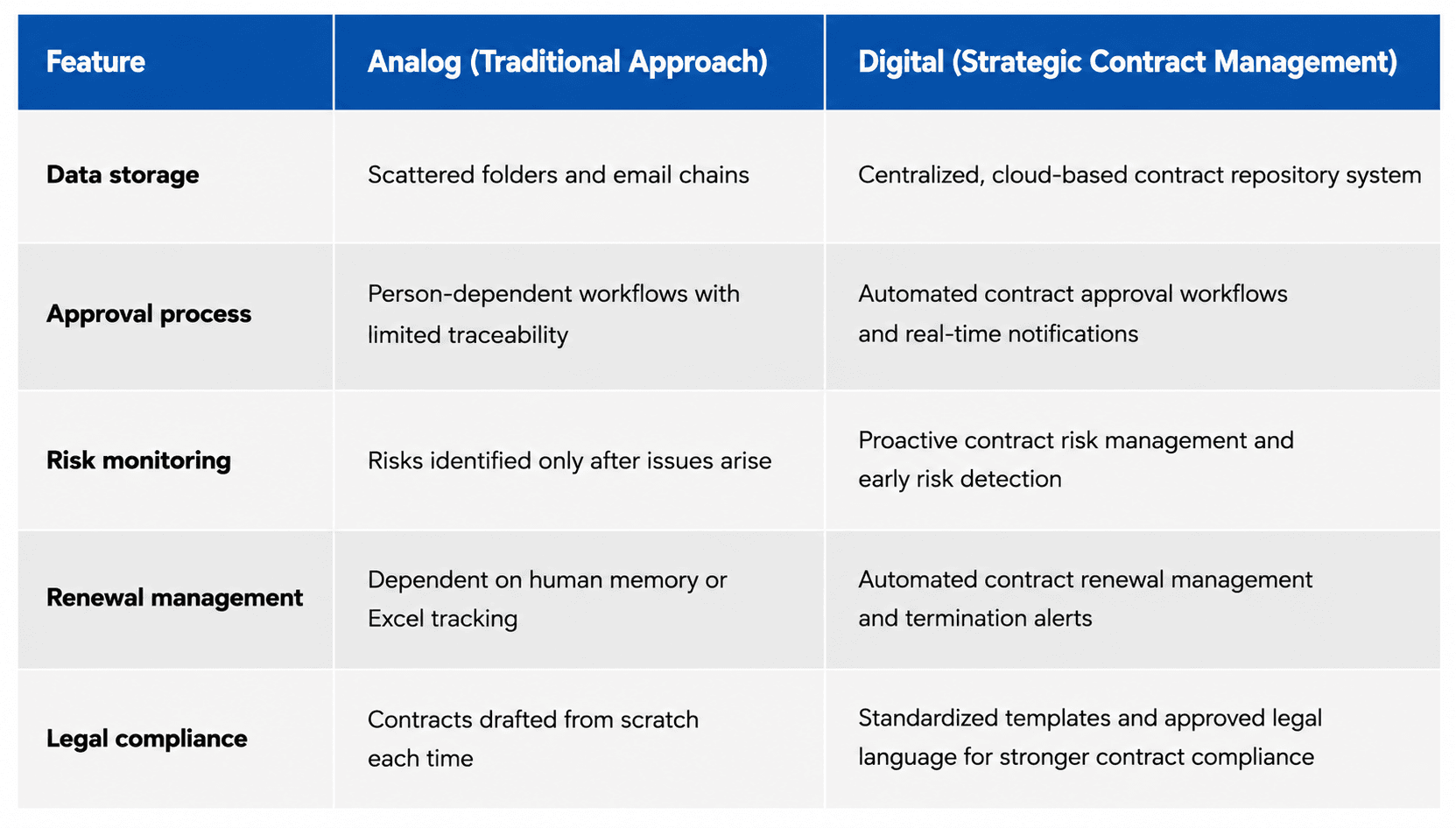
The table below highlights the differences between traditional contract management approaches and modern digital contract management systems:
Key components of Contract Management
In a structured contract management process, the following three core disciplines work together:
1. Legal compliance: The company’s legal framework is maintained through compliance with evolving legislation, industry regulations and internal policies.
2. Financial oversight: Contract terms such as pricing revisions, penalty clauses and payment conditions are monitored to protect cash flow and reduce financial leakage.
3. Operational continuity: Supplier and business partner performance is monitored to ensure compliance with contractual obligations and service standards, helping prevent disruptions to operations or service quality.
In this context, contract management is not simply a protective mechanism for companies, but also a strategic system that helps organizations manage commercial relationships more efficiently and securely.
Why is contract management important for corporates?
In large-scale projects where thousands of contracts may be active simultaneously, manual tracking quickly becomes unsustainable. Every unmanaged contract can create significant financial, operational or legal risks for the organization. The key reasons why professional contract management is essential include the following:
- Preventing hidden costs: Automatic renewal clauses can result in companies continuing to pay for unnecessary services or unused agreements. Effective contract renewal management helps eliminate these avoidable costs.
- Legal compliance and standardization: Contract language created independently across different departments can expose companies to legal inconsistencies and compliance risks. Centralized contract management systems reduce this risk through standardized templates and approved legal language.
- Strategic decision-making: Analyzing contract data helps companies identify which suppliers offer greater flexibility, which agreements generate stronger profitability and where operational risks may exist.
- Reputation management: Consistent compliance with contractual obligations strengthens credibility and trust in the market, supporting stronger long-term business partnerships.
What is the contract lifecycle management?
A contract is not a static document; it moves through a series of stages, each requiring a different level of oversight and control. This end-to-end process is known as the contract lifecycle management process.
1. Contract drafting process
Every contract begins with a business need. One of the most common mistakes at this stage is drafting agreements from scratch each time. Instead, organizations should work from standardized templates aligned with internal policies and risk frameworks. This approach not only accelerates contract workflow management but also helps standardize legal language across the organization.
2. Contract negotiation
This stage is where the parties negotiate commercial and legal terms while protecting their respective interests. In addition to pricing and commercial conditions, clauses covering confidentiality, force majeure, termination rights and dispute resolution are typically finalized here. Maintaining a clear record of all revisions and negotiation history is essential for future contract risk management and dispute prevention.
3. Contract approval process
The contract approval workflow is often one of the biggest sources of delay. Coordination between legal, finance, procurement and operational departments can significantly slow the process. Modern contract management systems streamline approvals through automated workflows, helping organizations reduce bottlenecks and shorten approval timelines.
4. Contract implementation and performance monitoring
Contract management does not end once an agreement is signed. This stage focuses on contract compliance, KPI monitoring, payment terms, delivery obligations and contract performance tracking. If suppliers or business partners fail to meet agreed standards, the issue must be identified and addressed quickly.
5. Contract renewal and termination
Before a contract expires, the system should automatically generate alerts for renewal reviews or termination deadlines. At this stage, companies assess whether the relationship should continue, whether commercial terms can be improved and whether the contract still aligns with operational needs. Effective contract renewal management helps prevent companies from becoming locked into outdated or unproductive agreements.
What is risk management in contract management?
Contract risk management should not be viewed solely as a defensive process designed to prevent potential losses. It also plays a critical role in helping organizations identify strategic opportunities, protect commercial advantages and respond more effectively to changing business conditions. A well-designed contract lifecycle management system strengthens both financial and operational resilience by evaluating potential risks across multiple dimensions.
Within this framework, contract risks are assessed from legal, operational and financial perspectives. This enables companies not only to protect their own interests, but also to maximize the strategic value, flexibility and commercial opportunities embedded within contract terms.
Risks encountered in contract management
• Legal risks: One of the most common contract management risks arises from poorly drafted clauses or improper authorization processes. An unclear termination clause or an unauthorized signature can undermine the validity of an agreement. In addition, non-compliance with data protection regulations and other legal requirements can expose companies to significant penalties and reputational risk.
• Operational risks: Operational risks emerge when contractual obligations are not fulfilled in practice. Supplier disruptions, raw material shortages or declining service quality can directly affect a company’s ability to meet its own commitments to customers. To reduce these risks, companies often implement aligned or “back-to-back” contract structures across the supply chain.
• Financial risks: Contracts that lack clear pricing adjustment mechanisms can create major financial exposure, particularly in inflationary or volatile market conditions. At the same time, poorly structured payment terms may create cash flow pressure and broader financial instability.
How to manage contracts effectively
If you are building a contract management system from the ground up, the following four steps are essential:
Centralized contract repository: Using OCR (Optical Character Recognition) technology, companies can eliminate fragmented physical archives and move contracts into a searchable digital contract repository system.
Access control and security: Not every employee should have access to every agreement. Contract access permissions should be managed carefully, with clear separation between departments such as HR, procurement, finance and legal.
Proactive notifications and alerts: Instead of relying on manual tracking or human memory, companies should implement automated reminders for expiration dates, renewal periods and other critical contractual deadlines.
Contract performance tracking and analysis: Contract data should be analyzed regularly to identify patterns, recurring legal issues and operational bottlenecks. Effective contract performance tracking helps organizations improve future contract management processes and reduce risk exposure.
The benefits of Digital Contract Management Systems
Managing contracts through traditional methods—tracking thousands of pages across physical files, email chains or fragmented folders—is both inefficient and a serious risk to operational and financial security. Modern contract lifecycle management (CLM) platforms transform this fragmented structure into a centralized and agile digital contract management system.
The key benefits of contract lifecycle management platforms include the following:
1. Operational speed and e-signature flexibility
Waiting days or weeks for physical signatures can significantly slow business operations. Through e-signature and contract management integrations, approval workflows can be completed within minutes regardless of location. This not only reduces paper and shipping costs, but also shortens contract cycle times and improves business agility.
2. End-to-end visibility and contract tracking
Digital contract management systems eliminate the need to manually track where contracts are located, or which agreements are approaching expiration. Managers can monitor contract approval workflows, contract renewal management and approval bottlenecks through centralized dashboards in real time.
3. AI-supported contract analysis
Modern contract management software increasingly uses AI in contract management to analyze large volumes of legal text within seconds. AI-powered tools can identify risky clauses, missing approvals or language that does not comply with internal standards before contracts are finalized. This strengthens both legal oversight and contract risk management processes.
4. Operational efficiency and cost savings
Digital contract management is not simply a technology upgrade; it directly contributes to operational efficiency and profitability. According to 2025 data published by World Commerce & Contracting (WorldCC), poorly managed contract processes result in average annual revenue leakage of 8.6% for companies, with losses exceeding 15% in more complex sectors. Contract automation and digital workflows help prevent these avoidable losses.
5. Corporate memory and data security
Every digitized contract becomes part of the organization’s searchable corporate knowledge base. Using OCR (Optical Character Recognition) technology, companies can locate specific clauses or historical agreements within seconds through a centralized contract repository system. At the same time, advanced encryption and access controls help protect sensitive information against unauthorized access and data breaches, strengthening overall contract compliance and security.
Frequently Asked Questions About Contract Management
Why has contract lifecycle management become so popular?
As global trade becomes more complex and regulatory requirements continue to increase, manual contract tracking is no longer sustainable. Companies now rely on contract lifecycle management (CLM) systems not only to reduce financial risk, but also to strengthen legal compliance, operational control and contract visibility.
How CLM systems improve procurement processes?
CLM systems help streamline procurement operations by automating contract approval workflows and reducing manual processing steps. Standardized contract templates also eliminate the need for legal and procurement teams to draft agreements from scratch each time. As a result, procurement and contract processes can be completed far more quickly and efficiently.
Is contract management necessary for small companies?
Absolutely. Regardless of company size, overlooking a critical supplier agreement, customer contract or renewal deadline can create significant operational and financial risks. Effective contract management helps businesses of all sizes improve control, reduce risk and support sustainable growth.