

What Is Supplier Relationship Management (SRM)? A Strategic Guide
What is Supplier Relationship Management (SRM)? Learn how to build sustainable supplier relationships, manage supplier performance, and implement strategic supplier management to create long-term business value.
In an increasingly interconnected business environment, a company’s strength is measured not only by its internal resources, but also by the vision of the stakeholders it works with and the depth of those relationships. Suppliers are no longer merely external entities that issue invoices; they are critical partners in innovation, resilience and sustainable growth.
As procurement processes evolve from a lowest-price approach into a more data-driven strategic function, Supplier Relationship Management (SRM) has shifted from being an operational option to a core business priority. In this article, Promena explores the foundations of successful supplier relationship management, from the fundamentals of SRM to strategic implementation steps, while examining the solutions that can create long-term value for businesses.
What is supplier relationship management (SRM)?
Supplier Relationship Management (SRM) is the process of systematically planning, evaluating and developing an organization’s interactions with the suppliers that provide its products and services. The primary goal of supplier relationship management is to minimize risks while maximizing the value and performance of the supplier network.
This process extends far beyond the point of purchase. It is a continuous cycle that covers supplier selection, supplier performance management, ongoing evaluation and the development of long-term strategic supplier partnerships. With a successful SRM strategy, companies position suppliers not simply as vendors, but as strategic partners working toward shared business objectives.
What is strategic supplier management?
Supply chains are no longer viewed simply as logistics networks; they have become one of the strongest pillars of corporate resilience. Securing the lowest cost alone is no longer enough to achieve sustainable success. Increasingly, competitive advantage depends on the strength of supplier relationships rather than the size of procurement budgets. This is where strategic supplier management comes into play: a discipline that moves beyond the traditional buyer-seller relationship to build long-term value and shared business goals.
Strategic supplier management goes far beyond one-off negotiations and short-term cost reduction to aligning procurement and supplier management processes with the company’s long-term growth strategy. In this model, the focus extends beyond pricing to include innovation potential, operational agility and the long-term value suppliers can contribute to the business. Companies that stop viewing suppliers solely as product providers are better positioned to build strategic supplier partnerships that support future growth.
Developing a strategic supplier management approach also means identifying which suppliers are most critical to business continuity and strengthening collaboration with those partners. In global markets increasingly shaped by uncertainty, supplier risk management and long-term supplier collaboration have become business necessities rather than operational preferences.
The 2025 Deloitte Global CPO Survey reinforces this shift. According to the survey, 61% of procurement leaders believe that improving supply chain resilience depends on deeper supplier collaboration and more transparent information sharing. The findings also show that companies building stronger strategic supplier partnerships generate significantly higher operational value than their competitors.
How does supplier relationship management work?
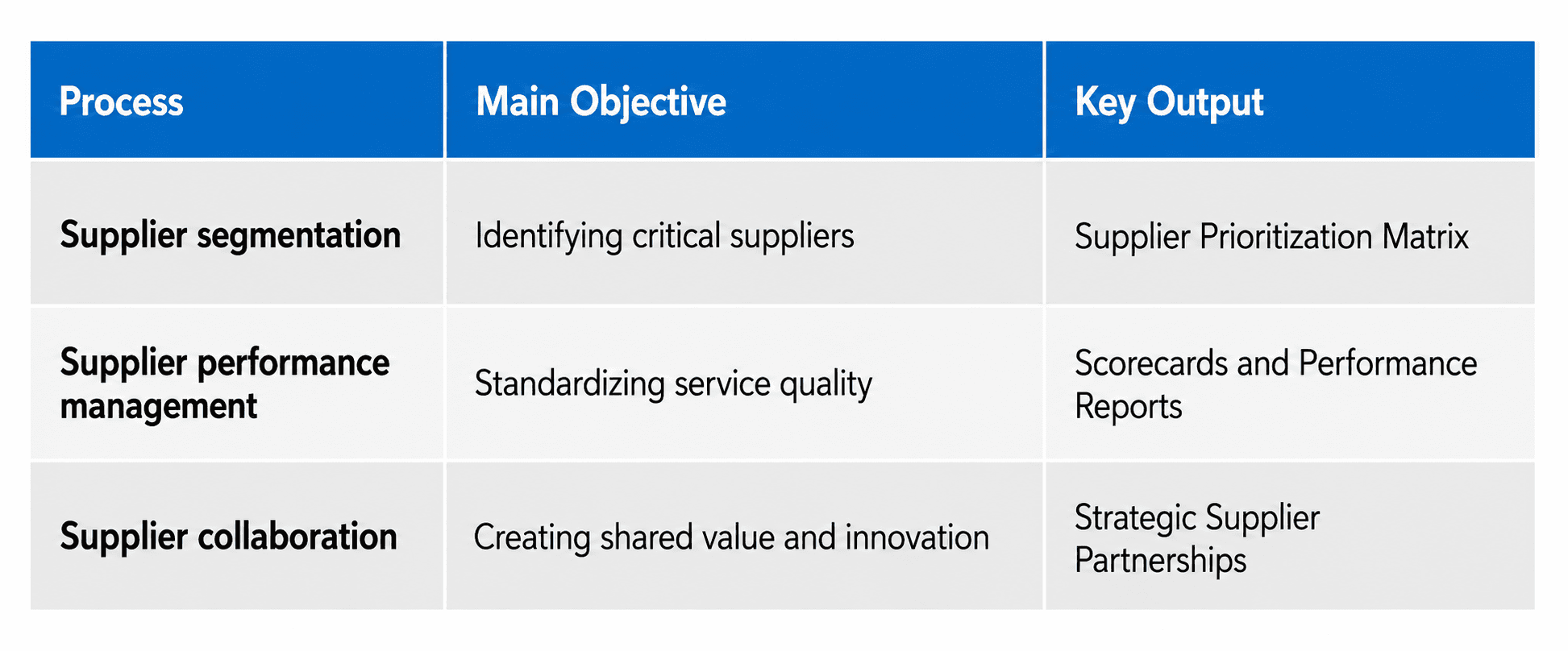
A successful supplier relationship management structure is built on a clear methodology rather than chance. The supplier relationship management process is generally based on three core pillars:
Supplier Segmentation
Not all suppliers carry the same level of strategic importance. Supplier segmentation in procurement involves classifying suppliers according to factors such as spend volume, operational importance and the criticality of the products or services they provide. For example, a supplier providing office stationery is managed very differently from a supplier delivering production-critical raw materials.
Supplier Performance Management
“You can’t manage what you can’t measure.” The supplier performance management process involves regularly monitoring suppliers against defined KPIs (Key Performance Indicators). Delivery performance, quality standards, financial stability and compliance are all evaluated at this stage.
Supplier Collaboration Processes
Supplier collaboration focuses on creating a mutually beneficial ecosystem in which both parties generate long-term value. Involving suppliers in R&D activities, joint cost optimization initiatives and knowledge-sharing processes forms the foundation of an effective supplier collaboration strategy.
The key benefits of a well-designed SRM
A well-designed supplier relationship management system extends beyond day-to-day procurement operations, providing a framework that directly strengthens a company’s competitive advantage. SRM system benefits include the following:
1.Sustainable Cost Optimization
When discussing SRM, negotiations are often the first aspect that comes to mind. However, long-term cost optimization extends well beyond unit pricing alone. Strong, trust-based supplier relationships help reduce order errors, accelerate logistics processes and improve inventory management efficiency. When suppliers are treated as strategic partners rather than transactional vendors, hidden operational costs decrease and companies achieve more sustainable improvements in total cost of ownership.
2.Proactive Supplier Risk Management
As global supply chains become more complex, supplier risk management in procurement has become increasingly important. An effective supplier relationship management process allows companies to continuously monitor supplier financial health, operational capacity, compliance standards and ethical performance. This enables procurement teams to identify potential risks early and take preventive action before disruptions affect operations.
3.Innovation and Joint Development Opportunities
Suppliers often share new technologies, production methods and raw material innovations first with their closest strategic partners. Companies that build strong supplier collaboration processes can involve suppliers directly in R&D and product development activities. This creates opportunities to access innovative solutions earlier and continuously improve product and service quality.
4.Supply Continuity and Priority Access
During raw material shortages, supply chain disruptions or global logistics bottlenecks, suppliers typically prioritize companies with stronger long-term relationships. Strategic supplier partnerships therefore play a critical role in maintaining operational continuity and protecting service reliability even during periods of market instability.
The relationship between SRM and Supply Chain Management (SCM)
Supply chain management (SCM) is a broad framework that covers the entire flow of goods, from raw material sourcing to delivery to the end customer. Supplier Relationship Management (SRM), by contrast, is one of the most critical components within this framework. The speed, resilience and efficiency of the supply chain depend heavily on the quality of supplier relationships. When SRM processes are weak, supply chain disruptions become far more difficult to prevent.
How is SRM implemented in companies?
Traditional procurement processes are increasingly struggling to keep pace with today’s dynamic market conditions. According to Gartner, companies that simplify overly complex business processes are significantly more successful in transformation projects than their competitors. This shift highlights how procurement and supplier management have evolved from operational support functions into strategic business capabilities.
Today’s leading organizations are focused not only on reducing costs, but also on using data analytics, artificial intelligence and digital procurement technologies to strengthen supplier performance management and identify risks before they escalate. In this model, built around strategic supplier partnerships, innovation, operational agility and transparent information sharing become essential drivers of sustainable growth.
However, establishing this vision alone is not enough. Successful supplier relationship management implementation requires a structured roadmap that embeds SRM processes into company culture and day-to-day operations.
To build an effective supplier relationship management process, companies should focus on the following steps:
-
Current situation analysis: Identify existing suppliers, procurement volumes and annual spending patterns.
-
Defining performance criteria: Clearly define what quality, performance and success mean for the organization.
-
Technology integration: Replace manual tracking processes with supplier management and procurement digitalization.
-
Establishing communication channels: Build regular supplier communication and feedback mechanisms while clearly defining expectations and responsibilities.
How is supplier performance measured?
In increasingly competitive markets, simply maintaining operational continuity is no longer a sufficient measure of success. Sustainable growth depends on processes supported by measurable and actionable data. Regular supplier performance evaluation helps companies identify potential weaknesses before they develop into larger operational issues. At the same time, this discipline strengthens supplier collaboration by moving relationships beyond transactional interactions toward more strategic supplier partnerships.
The business impact of this data-driven approach is also supported by industry research. According to the Log-hub 2024 Supply Chain Report , 53% of companies have improved operational efficiency using data analytics. Companies that apply the right supplier performance management processes and use supplier data strategically are therefore far better positioned to manage uncertainty and strengthen competitive advantage.
-
Quality Rate (Defect-Free Index): What percentage of incoming products meets your technical specifications and quality standards? High return rates create not only financial losses, but also production downtime and operational inefficiencies.
-
Delivery Performance (Time and Quantity): In global supply chains, timing is critical. Are products delivered on schedule and in the correct quantities? Even a single delayed shipment can disrupt the entire production plan.
-
Cost Alignment and Efficiency: How closely do agreed unit prices match final invoice amounts? Strong suppliers contribute more than products or services alone; they also support long-term efficiency by identifying process improvement opportunities and cost optimization measures.
-
Flexibility and Agility: Market conditions can change rapidly. How quickly can suppliers respond to unexpected increases in demand or operational disruptions? Agile suppliers help companies adapt more effectively to uncertainty and supply chain challenges.
Key considerations for successful SRM implementation
Implementing supplier relationship management software is only the first step. To ensure that an SRM system delivers measurable value rather than remaining a purely theoretical framework, companies need to focus on several critical success factors.
Strategic supplier management best practices such as the experience of global retailers like Auchan demonstrates the impact a well-structured supplier relationship management system can have. According to ScienceSoft’s case study, Auchan centralized supplier communication processes across more than 1,700 stores through its SRM platform, significantly improving operational agility and coordination.
-
Data Accuracy and Consistency: An SRM system is only as reliable as the data entered into it. Outdated or inaccurate supplier data weakens reporting and decision-making processes. Companies should therefore prioritize integrations and automation tools that reduce manual data entry wherever possible.
-
User-Friendly Interface (UX): If the system is overly complex, adoption rates among both internal teams and suppliers will decline. A simple, intuitive interface helps ensure that supplier relationship management processes are consistently used across the organization.
-
Scalability and Adaptability: Business needs evolve over time. Scalable, cloud-based SRM systems that can support increasing supplier volumes, data traffic and new operational modules provide greater long-term flexibility.
-
Transparency and Traceability: Transparency sits at the heart of effective supplier management. Ensuring that every stage of the procurement and supplier relationship management process is traceable and auditable helps reduce errors while strengthening trust and accountability between companies and suppliers.
Frequently Asked Questions about SRM systems
What is SRM in procurement?
An SRM system is supplier relationship management software that centralizes supplier information, performance data, contracts and communication history within a single digital platform.
Why is supplier segmentation important?
Supplier segmentation helps companies allocate time and resources more effectively. Rather than managing all suppliers in the same way, businesses can focus more strategically on suppliers that are most critical to operations and long-term growth.
Is SRM only for large companies?
No. Supplier relationship management can benefit businesses of all sizes. Any company working with suppliers can improve operational reliability, supplier collaboration and cost efficiency through a structured SRM approach.
How often should supplier performance management be conducted?
Critical suppliers are typically evaluated monthly or quarterly as part of the supplier performance management process, while annual evaluations may be sufficient for lower-risk or less strategic suppliers.