

Managing Unseen Risks in Procurement Through Strategic Sourcing
The procurement and supply function has evolved far beyond simply meeting product and service needs. In today’s business environment, a supplier’s risk profile, performance, environmental impact, and flexibility can directly impact the future of your company.
Strategic sourcing is defined as an approach to procuring products and services through data-driven decisions that align with a company’s business objectives and procurement strategy. This type of sourcing looks beyond cost reduction to drive cultural, organisational, and mindset transformation.
In this piece, Promena explores what this transformation requires, how strategic sourcing can be implemented, the challenges that may arise, and the role digitalisation plays in overcoming them.
Redefining supplier management: from cost-focused to value-focused
In the traditional approach to procurement, supplier negotiations often start as a race to the lowest price and continue through repeated price cutting. However, this method does not guarantee long-term or sustainable success in today’s business environment.
Strategic sourcing enables procurement teams to take a leading role in meeting a business’ needs and objectives while identifying opportunities to reduce costs and create additional value. The approach involves analysing company spending, market conditions and demand. Based on these insights, strategies are developed for each product or service category. The focus therefore shifts from price alone to the Total Cost of Ownership (TCO).
This type of strategic sourcing brings new perspectives to procurement processes:
- Suppliers’ risk management capacity, technological capabilities and innovation potential are considered.
- Long-term cooperation is prioritised, with emphasis on the supplier’s contribution, added value and sustainability performance.
- Procurement evolves from a transactional process into a strategic function aligned with the company’s overall vision.
This transformation reshapes how suppliers are perceived, positioning them as strategic partners rather than external service providers.
What are the challenges to this mindset transformation?
Shifting from a cost-focused to a value-driven procurement mindset is not easy. Employees, managers and the wider organisational culture may initially resist such a change. The most common challenges encountered in this process include:
- Deep-rooted habits: It takes time for a procurement culture shaped over many years around “finding the lowest price” to evolve into a strategic management perspective. Some decision-makers in particular may find it difficult to move beyond familiar methods.
- A narrow definition of success: When success within an organisation is measured only by cost savings or budget performance, employees tend to prioritise short-term gains rather than long-term strategic goals.
- Interdepartmental disconnect: Limited information flow between procurement, operations and finance teams prevents the establishment of shared objectives and hinders the adoption of a strategic sourcing approach.
- Lack of data and transparency: When supplier performance, risk and ESG compliance data are incomplete, decisions rely on intuition rather than insight, reducing the impact of a strategic perspective.
- Lack of leadership and vision: Without the support of senior management, employees may doubt that the transformation is genuine or lasting. A mindset shift cannot take root unless it is driven and reinforced from the top.
- Capacity shortfalls: When expertise in strategic sourcing, analytical thinking and risk management is not yet widespread within the organisation, transformation goals remain theoretical and fail to translate into practice.
These challenges can be overcome with determination, careful planning and a strong cultural communication strategy.
What does strategic sourcing contribute to a business?
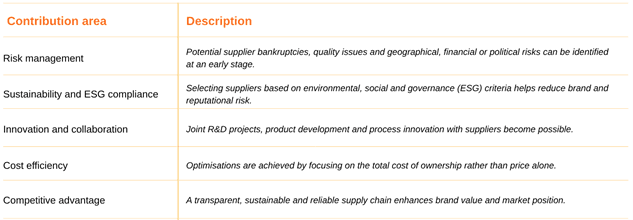
Adopting a strategic sourcing approach delivers measurable benefits for companies over the short, medium and long term. The key contributions of strategic sourcing can be summarised as follows:
Why are digitalisation and technology important for a strategic sourcing approach?
The strategic sourcing process depends on a technological infrastructure that accelerates data-driven decision making and automates supplier management, creating a more transparent and flexible structure. The key technological elements that define strategic sourcing as part of a broader digital transformation include:
- Supplier sustainability platforms: Tools for monitoring ESG scores, tracking performance, issuing alerts and making comparisons.
- Data analytics and artificial intelligence: Systems that analyse supplier performance history, identify risk indicators and predict future behaviour.
- Blockchain and traceability systems: Technologies that track the flow of materials from source to finished product, helping to reduce the risk of counterfeiting.
- Process automation and integration: Solutions that enhance efficiency by automating supplier evaluation, approval processes, monitoring and reporting.
Supplier management is a core component of a strategic sourcing strategy. This process focuses on identifying, evaluating and selecting suppliers to optimise costs, reduce risks and improve agility across the supply chain.
According to this 2024 MIT Report, companies that fail to invest in technological monitoring and data automation for supply chain sustainability will struggle to close the gap between sustainability goals and real-world implementation.
Key steps to consider when implementing
Transitioning to strategic sourcing through a comprehensive roadmap, with phased and careful steps, enables the anticipation of potential risks and increases the likelihood of a successful transformation. The roadmap to follow when adopting this new approach to supplier management should include the following key steps:
- Situation assessment and performance evaluation: Obtain a clear picture of how your current procurement processes operate, identify the strengths and weaknesses of your current performance.
- Critical supplier segmentation: Categorise your suppliers as strategic and supportive, and identify those with high ESG risk.
- Create a scoring model using criteria: Establish an evaluation system that includes financial, environmental, social, quality, and other criteria.
- Pilot implementation and phased transition: Manage pilot processes with critical suppliers first, then transition to a broader supplier pool as successful results are achieved.
- Training and internal communication: Design training and communication projects to align the mindset of procurement, relevant departments, senior management, and external stakeholders.
- Continuous feedback and improvement: Focus on continuously improving processes, enhancing quality through performance data, tables, analyses, audits, and supplier feedback.
Thanks to these steps, the journey to strategic procurement can move beyond theory into practice. Everyone involved in the process can easily track which action will be implemented when and for what purpose.
Strategic sourcing is not simply a cost reduction tool; it represents a mindset transformation that influences company culture, vision and competitive strength. Managing the unseen in procurement makes risks visible and controllable. It elevates sustainability to an institutional reflex.
Digital tools such as Promena play a key role in this transformation, helping companies establish an automated and data-driven approach to supply chain management.
Promena supports organisations in turning their strategic sourcing vision into concrete practice. To evaluate and monitor your suppliers based on performance, minimise risks and embed this mindset across your organisation in line with your corporate culture, contact our sales team or fill out the request a demo form.