

How to Measure Supplier Performance? Key Evaluation Criteria
How do you measure supplier performance? Learn effective supplier management through supplier evaluation criteria, key performance indicators (KPIs), and supplier performance analysis methods.
A company’s operational continuity, product quality and brand reputation are closely linked to the performance of its suppliers. In this piece, we look at what supplier performance means, how to measure supplier performance, and which supplier evaluation criteria, supplier KPIs and performance metrics should be used in an effective supplier performance management process.
Today, supply chain management has evolved far beyond a narrow focus on securing products at the lowest possible cost. A company’s operational continuity, product quality and brand reputation are directly linked to the performance of the suppliers it works with. Even a minor supply delay or a small deviation from quality standards can disrupt production, creating significant cost pressures and reputational risk.
This is where supplier performance management plays a critical role. By establishing clear supplier performance evaluation criteria, monitoring supplier KPIs and using structured supplier performance metrics, companies can identify bottlenecks earlier, manage risks more effectively and build stronger supplier relationships. In this article, Promena examines how supplier performance measurement is structured in corporate procurement processes and which criteria matter most in the digital age.
What is supplier performance?
Supplier performance refers to the extent to which a supplier meets its contractually defined obligations, quality standards and agreed timelines. In simple terms, it measures how effectively, efficiently and consistently a supplier delivers the product or service it has committed to provide.
However, one common mistake should be avoided: supplier performance measurement should not be reduced to subjective feedback or informal opinions. It requires a data-driven, objective and continuous supplier assessment process. This process should consider a wide range of factors, from financial stability and operational reliability to delivery performance, quality standards and ethical business practices.
Why should supplier performance be measured?
Supplier performance measurement is less about issuing a report card and more about protecting a company’s agility, profitability and resilience in changing market conditions. A supplier performance management framework built on concrete data acts as a navigation system, helping companies make better decisions in increasingly complex markets.
Many companies do not feel the need to assess their suppliers in depth as long as operations appear to be running smoothly and shipments continue to arrive at the warehouse. However, in today’s complex market environment, supplier performance tracking is not merely a way to report on the past. It is a strategic radar that helps companies anticipate future bottlenecks before they turn into operational problems.
In other words, supplier performance measurement allows companies to identify potential risk areas early, rather than responding only after a crisis has already occurred.
The key reasons why supplier performance measurement has become indispensable in modern procurement strategies include the following:
1. Data-driven savings in operational costs
Digital transformation and advanced analytics tools are no longer optional in cost management. They have become essential components of effective supplier performance management. Global procurement studies published by Deloitte show that companies focusing on artificial intelligence and digital transformation in procurement achieve a 96% success rate in meeting their cost-saving targets. Organizations that track performance data through digital tools generate an average return of 2.8 times on their AI investments, while achieving 15% to 20% operational cost savings compared with competitors that rely on manual tracking.
2. Supply chain resilience and risk management
Geopolitical uncertainty and sudden changes in logistics routes have pushed secure supply to the top of the corporate agenda. Recent strategic research shared by The Hackett Group indicates that supply chain resilience remains the number one priority for procurement leaders. Supplier performance tracking plays a critical role in this process. Even a slight fluctuation in a supplier’s delivery times can trigger an early warning signal in the system, allowing companies to activate alternative plans without disrupting core workflows. This strengthens operational resilience and reduces exposure to supply chain risk.
3. The total value approach beyond cost
In modern procurement, success is no longer measured solely by securing the lowest unit price. Gartner’s analysis of supply chain technology trends shows that companies are increasingly assessing supplier performance based on total value. With the integration of technologies such as agentic AI, supplier evaluation can now include real-time analysis of sustainability alignment, digital integration capabilities and innovation capacity. When supplier performance is measured at this level of depth, the supplier is no longer seen merely as a vendor, but as a strategic partner that supports the company’s long-term goals.
4. Transparency and stronger organizational memory
Regular supplier performance measurement strengthens organizational memory and places decision-making on a more objective foundation. Through this system, answers to questions such as why a particular supplier was selected or how previous quality issues were resolved are no longer based on personal opinions. They are recorded through concrete data within the system. This supports a more transparent, accountable and professional approach, both in internal audit processes and in relationships with external stakeholders.
How is supplier performance measured?
A single metric is not enough to measure supplier performance effectively. A robust supplier evaluation process should be structured as a multidimensional framework that brings together data from departments such as procurement, quality, logistics and finance. This cross-functional flow of data shows not only what the supplier has committed to on paper, but also how well it performs in day-to-day operations.
The following areas are among the most important components of an effective supplier performance measurement system:
1. Delivery performance and time management
A supplier’s ability to meet agreed deadlines is critical to operational continuity. At this stage, the on-time and in-full delivery KPI, often referred to as OTIF supplier performance, is one of the most important key supplier performance indicators. It is not enough for an order to reach the warehouse. It must arrive at the agreed time and in the exact quantity requested. Every delayed or incomplete delivery can disrupt production schedules and directly increase operational costs.
2. Quality performance and compliance with standards
Supplier quality performance metrics assess whether delivered products comply with technical specifications and predefined quality standards. Acceptance rates, defects identified on the production line and complaints from end clients are evaluated under this heading. Quality performance is not limited to the physical product. It also covers the accuracy of accompanying documentation and compliance with packaging standards. Working with suppliers that consistently maintain a low error rate helps businesses avoid additional inspection, correction and rework costs.
3. Cost and price competitiveness analysis
Comparing a supplier’s quoted price with the market average is now managed in a much more detailed way. A narrow focus on unit price can be misleading, which is why the total cost of ownership approach is increasingly used in supplier assessment. This analysis takes into account logistics costs, customs clearance, storage and potential risk-related costs. Payment terms and price stability in long-term collaborations are also key factors that influence the supplier’s cost score.
4. Supply continuity and flexibility
A supplier’s resilience during raw material shortages, labour issues or global disruptions is critical to operational security. The speed with which a supplier responds to sudden increases in demand or urgent order changes shows its level of flexibility. Suppliers with strong continuity capabilities help companies maintain an uninterrupted flow of materials despite market fluctuations, strengthening their strategic supplier score.
5. Communication quality, transparency and collaboration
Alongside technical and numerical data, supplier evaluation should also consider how quickly suppliers resolve problems and how transparently they share information. When an issue arises, proactive behaviour and a solution-oriented approach can significantly ease operational pressure. Collaboration based on open data sharing, technological integration and trust reduces the managerial burden on businesses and enables more efficient use of resources.
The data collected under these five main headings is then processed through a supplier scorecard using a weighted scoring system. This turns each supplier’s alignment with the company’s priorities, operational needs and long-term objectives into a concrete and comparable dataset.
What are the supplier evaluation criteria?
To establish an effective supplier performance management system, the evaluation criteria must be clear from the outset. The following example illustrates the core criteria and weightings that can be included in a professional supplier performance scorecard:
Example: Supplier Performance Scorecard Table
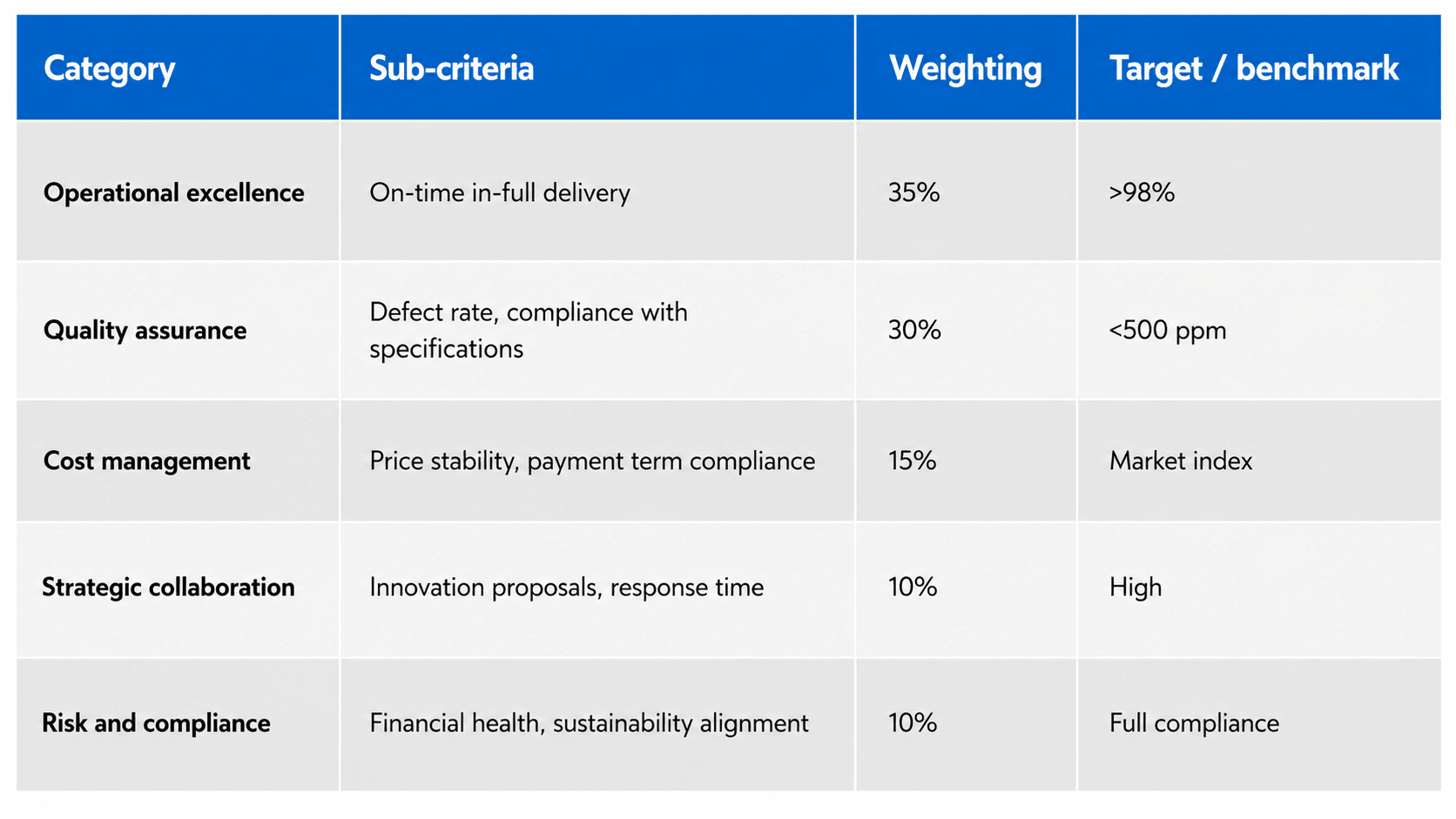
KPIs used to measure supplier performance
The following supplier performance measurement KPIs and formulas can be used for data-driven supplier performance measurement:
1. OTIF, on-time in-full delivery
OTIF measures whether an order is delivered at the agreed time and in the correct quantity. It is not enough for the product simply to arrive. It must arrive on time, complete and without errors.
OTIF = On-time and complete deliveries / Total deliveries × 100
Example: If 18 out of 20 orders are delivered on time and in full, the OTIF rate is 90%.
2. Yield rate
Yield rate shows the percentage of materials entering the production line that can be processed without defects.
Yield rate = Number of successful units / Total input × 100
Example: If 98 out of 100 raw materials received from a supplier pass through the production line without defects, the yield rate is 98%.
How is supplier performance management implemented in companies?
Establishing a systematic supplier performance management process means creating a dynamic cycle, rather than carrying out a one-off supplier evaluation. When building this framework, companies should proceed step by step and prioritise reliable data at every stage. This directly affects the success of the overall supplier assessment process.
The key steps for implementing this cycle within an organisational structure are as follows:
1. Supplier segmentation: the Kraljic Matrix
Companies do not allocate the same level of time, attention and resources to every supplier. This is where strategic supplier segmentation becomes important. Suppliers are typically divided into four main groups: strategic, bottleneck, leverage and routine suppliers. This approach, known as the Kraljic Matrix, helps companies focus on the business partners that have the greatest impact on profitability and risk. By directing more resources towards strategic suppliers that are difficult to replace, companies can manage both time and resources more efficiently.
2. Identifying data sources and infrastructure
Accurate supplier performance measurement depends on centralised and reliable data. Information from ERP systems, warehouse management software and digital procurement platforms should be consolidated into a single data pool. To reduce the margin of error caused by manual data entry, data should flow automatically into the system at the point of delivery wherever possible. This ensures that supplier performance analysis is based on concrete figures rather than personal estimates.
3. Developing a weighted scoring system
Because every company has different priorities, supplier scorecard models should be tailored to the company’s strategic objectives. For example, quality may carry a 50% weighting for a high-precision production line, while delivery speed may be weighted more heavily in an organization where logistics costs are a top priority. This customized scoring model makes it easier to identify the suppliers most closely aligned with the company’s strategy in a transparent and comparable way.
4. Corrective and preventive actions process
Supplier performance measurement should not be used only to assign low scores. It should also support continuous improvement. Improvement plans should be shared with suppliers that fall short of expectations, with progress generally tracked over three- to six-month intervals. Rather than removing a supplier from the pool immediately, guiding them how to improve supplier performance in specific areas can help build a more resilient and reliable supply chain over the long term.
5. Digitalisation and autonomous monitoring
Cumbersome Excel spreadsheets are increasingly being replaced by dashboard systems that provide real-time supplier performance tracking. Through digitalisation, a decline in supplier performance can be detected before it turns into a crisis. This autonomous monitoring mechanism reduces the operational tracking burden on procurement teams and gives them more time to focus on strategic decision-making.
Frequently asked questions about the supplier performance evaluation process
How to evaluate supplier performance?
Supplier performance is evaluated by regularly tracking predefined supplier performance metrics, such as quality, delivery speed and cost, and converting them into a structured supplier scorecard. This allows companies to compare suppliers objectively and monitor performance over time.
How does the digitalization of performance data affect supplier relationships?
Keeping performance data in a transparent digital environment removes subjective interpretation from supplier relationships and grounds discussions in concrete facts. When suppliers can view their performance scores in real time, they can clearly see which areas require improvement. This transparency builds mutual trust and helps transform the relationship from a simple buyer-seller arrangement into a more strategic partnership.
How is the process managed with a low-performing supplier?
Low performance should be treated as an opportunity for improvement, rather than an immediate reason to end the partnership. For suppliers whose performance scores fall below target, corrective and preventive actions should be planned. The supplier should be shown clear data on the areas requiring improvement, and their progress should be monitored closely over a defined period. If no improvement is achieved, alternative supplier scenarios can then be implemented.